South Texas Medical Center, San Antonio
Updated · 6,359 residents
The South Texas Medical Center serves as a premier clinical and research hub in northwest San Antonio, defined by its high density of healthcare institutions and commercial activity. While the area offers moderate walkability for residents, it is characterized by significant road traffic noise and a landscape dominated by apartment complexes and office facilities.
Key Highlights
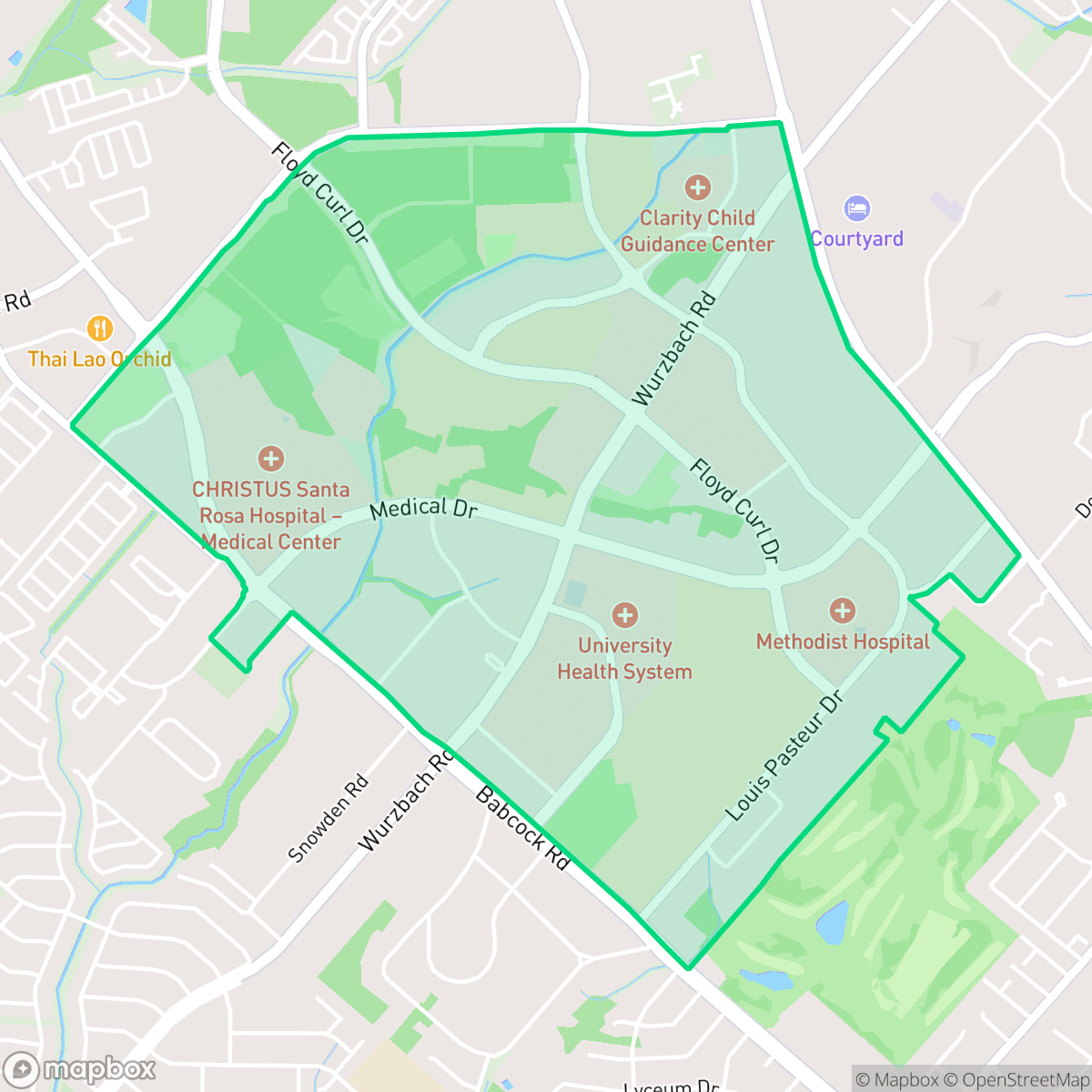
About South Texas Medical Center
Once a vast expanse of dairy farmland—primarily the Joe J. Nix Dairy Farm—the South Texas Medical Center (STMC) in northwest San Antonio was transformed through the efforts of the San Antonio Medical Foundation, chartered in 1947. Seeking to establish a medical school in the nation's largest city without one, the foundation secured donated acreage to construct a massive healthcare hub. Development accelerated in 1963 when Methodist Hospital opened as the district's first facility. This was followed in 1968 by the dedication of the University of Texas Medical School (now UT Health San Antonio) and the Bexar County Teaching Hospital (now University Hospital). Today, STMC spans over 900 acres and serves as a premier bioscience and clinical research district, anchored by major institutions like the Audie L. Murphy Memorial VA Hospital.
This district functions as a bustling center for professional and academic life, anchored by major facilities like the Audie L. Murphy Memorial VA Hospital and UT Health San Antonio. The environment is heavily influenced by its medical mission, creating a landscape of mid-rise apartments, office buildings, and diverse dining options that cater to a transient workforce and student population.
Residents in this area should expect a fast-paced environment where convenience is balanced against specific livability challenges. The neighborhood is notably loud due to constant road traffic and faces lower air quality scores compared to the city average. While the presence of sidewalks supports some pedestrian movement, the overall layout remains car-dependent. It is well-suited for healthcare professionals and students who prioritize proximity to their workplace or the highly-rated Health Careers High School over quiet, secluded living.
Neighborhood Scores Across 15 Qualities
Building spacing varies between high-density apartment blocks and single-family homes, resulting in slightly less privacy than the San Antonio average. Residents may find limited buffers between neighbors in more densely zoned areas of the district.
Established sidewalks on main roads and residential loops provide safe pedestrian routes throughout the area. This level of walkability is slightly higher than the San Antonio average, according to iHuus data.
Larger apartment complexes and office buildings dominate the landscape, providing more amenities than the typical San Antonio neighborhood. Streetscapes primarily consist of multi-family housing and professional structures with spacious parking areas.
Nearby wooded areas and green spaces adjacent to residential zones provide ample walking space, though most public greenery is limited to enclosed apartment complexes. This area offers slightly better access to walking paths than the San Antonio average according to iHuus data.
A mix of dense apartment complexes, commercial office parks, and paved lots defines this area. According to iHuus data, the landscape is slightly more developed than the San Antonio average, featuring more concentrated infrastructure and fewer open fields.
Constant movement and a noticeable concentration of social hubs make this area significantly more active than the San Antonio average. While many diverse dining options and businesses are present, the car-dependent layout limits ease of walking between locations.
Ongoing traffic sounds from nearby busy streets create a consistent ambient hum. This level of acoustic activity is roughly in line with the city average.
Frequent unhealthy air quality levels pose a significant risk to sensitive groups. According to iHuus data, conditions in this area are worse than the San Antonio average.
Industrial activity and heavy warehouses are absent from this area, which consists entirely of residential, retail, and medical facilities. This lack of industrial proximity is notably higher than the San Antonio average, according to iHuus data.
Health insurance accessibility in this area is consistent with the average levels found across San Antonio. According to iHuus data, coverage rates among residents are neither notably high nor low compared to the rest of the city.
Voting patterns and census indicators show a significantly more liberal leaning than the San Antonio average, according to iHuus data.
Residents live alongside a balanced mix of young professionals, families, and seniors. This demographic spread is roughly in line with the broader San Antonio area according to iHuus data.
Flood risk in this area is difficult to assess because official FEMA studies for the district remain incomplete. According to iHuus data, the level of risk is roughly in line with the San Antonio average.
Address-Level Insights for South Texas Medical Center


iHuus Neighborhood Intelligence Insights
Get address-level neighborhood insights for South Texas Medical Center
- Street-level scores — see how individual blocks compare, not just neighborhood averages
- Micro-zone boundaries — identify quiet pockets, flood boundaries, and walkable clusters before you visit
- 15 dimensions in full — walkability, noise, air quality, school quality, insurance coverage, population age profile, urban/rural index, and more
- Boundary risk alerts — know if your address sits near a block boundary where scores drop, the kind of detail no listing will ever mention
- School insights — individual school ratings and insights, not just district-level data
- Compare before you commit — side-by-side data across neighborhoods, down to block precision
No credit card required
Compare with Any Neighborhood
| Dimension | South Texas Medical Center | 145 Association |
|---|---|---|
| 🚶 Walkabilityavg 6.44 | ||
| 🔊 Acoustic Comfortavg 4.07 | ||
| 🤫 Privacy Indexavg 5.75 | ||
| 🎨 Visual Appealavg 6.11 | ||
| 🐕 Dog Friendlinessavg 5.91 | ||
| 🗺️ Urban-Rural Indexavg 6.87 | ||
| ✨ Neighborhood Vibeavg 4.35 | ||
| 🏥 Health Insurance Coverageavg 5.94 | ||
| 🌿 Air Qualityavg 2.27 | ||
| 🏭 Industrial Proximityavg 8.31 | ||
| 🌊 Flood Safetyavg 4.2 | ||
| 🗳️ Ideological Leanavg 7.37 | ||
| 👥 Population Age Profileavg 4.68 | ||
| 🔥 Fire Safety | ||
| 🏫 School Quality |
South Texas Medical Center Rankings
School Districts Serving South Texas Medical Center
School Insights for South Texas Medical Center
Below average outcomes; significant attendance and academic challenges.
School Insights
See what's really behind every school rating near South Texas Medical Center
- Individual school ratings — each school's own score with outcome context, not just a district average
- Enrollment & class size data — student-to-teacher ratio and how it compares to the state average
- Full demographics breakdown — ethnicity and gender composition for every school in the enrollment zone
- Every school in the district — all schools within the enrollment boundary ranked by rating, not just the closest one
- Grade levels & benchmarks — elementary through high school, with below/above state-average flags
No credit card required