Shady Oaks, San Antonio
Updated · 4,415 residents
Shady Oaks is a quiet, visually appealing neighborhood known for its mid-century architecture and mature, oak-lined streets. While it offers a serene, park-like environment, residents are primarily car-dependent and should expect notable noise levels from the nearby highway.
Key Highlights
About Shady Oaks
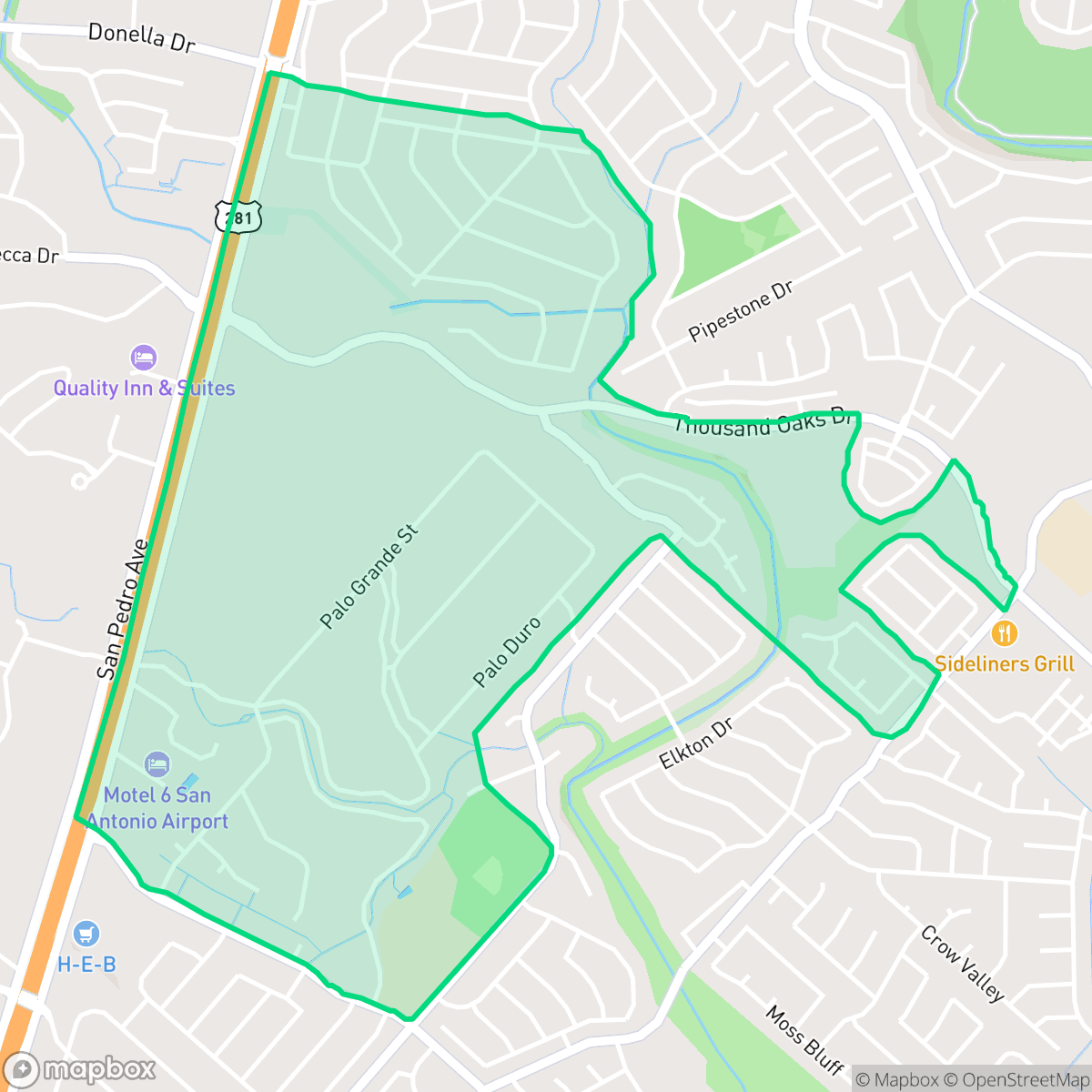
Nestled on the east side of U.S. Highway 281 in San Antonio, Shady Oaks began development in the late 1950s as a rural enclave far outside the city limits. Characterized by its country-like atmosphere, the neighborhood features large, acre-sized lots with legacy live oak trees, winding greenbelts, and no sidewalks. The architectural landscape of Shady Oaks is highly distinct, showcasing mid-century ranch-style homes alongside custom residences designed by prominent San Antonio architects, including O’Neil Ford and William Jones. Jones constructed a notable Frank Lloyd Wright-inspired home here in 1960. Originally lacking municipal sewer and gas services, the neighborhood was later annexed by San Antonio but has preserved its quiet, wooded character and abundant wildlife, including a large local deer population.
The neighborhood provides a distinct residential experience defined by its aesthetic appeal and well-kept landscaping. Residents benefit from a high degree of industrial separation, ensuring a strictly residential atmosphere punctuated by local dining options and green spaces. The area is highly regarded for its visual character, which features private pools and spacious lots that foster a sense of seclusion despite its suburban setting. According to data, the community maintains a high level of visual appeal compared to the city average.
Prospective residents should note that the area is car-dependent, with limited daily essentials within walking distance. While the tree canopy and greenbelts are excellent for dog walking, the proximity to major thoroughfares results in elevated traffic noise and lower air quality scores. Families are served by the North East Independent School District, including the well-rated Bradley Middle School, though the district is currently navigating ongoing fiscal transitions.
Neighborhood Scores Across 15 Qualities
Housing density remains moderate with a mix of detached homes and multi-family units. According to iHuus data, the neighborhood offers slightly more buffer between neighbors than the San Antonio average.
Low traffic volumes and a comprehensive sidewalk network facilitate safe walking through residential cul-de-sacs and main arteries. According to iHuus data, the walkability level here is consistent with the San Antonio average.
Large homes, private pools, and well-maintained landscaping characterize this area; according to iHuus data, the visual environment is notably more polished than the San Antonio average.
Wide roadside verges and a central wooded greenbelt provide ample space for pets to roam. According to iHuus data, these connected green spaces and tree canopies offer a more pet-friendly environment than the San Antonio average.
Open land and woodland are common throughout this area, providing a slightly more rural atmosphere than the typical San Antonio landscape. According to iHuus data, the environment features a mix of scattered homes and dense suburban pockets with high vegetation coverage.
A variety of dining options and social hubs provide more energy than the typical San Antonio neighborhood. While certain blocks offer pockets of activity near highway corridors, much of the area remains low-density and requires a car for most errands.
Frequent noise from nearby freeways and rail lines characterizes this area. According to iHuus data, acoustic comfort levels are lower than the San Antonio average.
Frequent unhealthy air quality levels pose significant risks to sensitive groups. This condition is slightly worse than the San Antonio average, according to iHuus data.
Industrial activity and large warehouses are absent from this area, offering a much cleaner profile than the San Antonio average. According to iHuus data, the neighborhood consists exclusively of residential and light commercial zones with no detectable hazardous sites.
Health insurance accessibility is notably higher than the San Antonio average, according to iHuus data. Residents in this area benefit from significantly better access to coverage than most of the city.
Political viewpoints in this area are distributed relatively evenly between conservative and liberal leanings. This represents a more balanced ideological split compared to the more strongly leaning average found across San Antonio.
Residents live alongside a diverse range of age groups, including young professionals, families, and seniors. This demographic spread is more balanced than the average found across San Antonio, according to iHuus data.
Flood risk in this area is slightly higher than the San Antonio average, though FEMA has not yet completed a detailed study to definitively classify the danger level. According to iHuus data, residents should remain cautious as the precise level of inundation potential is currently unverified.
Address-Level Insights for Shady Oaks


iHuus Neighborhood Intelligence Insights
Get address-level neighborhood insights for Shady Oaks
- Street-level scores — see how individual blocks compare, not just neighborhood averages
- Micro-zone boundaries — identify quiet pockets, flood boundaries, and walkable clusters before you visit
- 15 dimensions in full — walkability, noise, air quality, school quality, insurance coverage, population age profile, urban/rural index, and more
- Boundary risk alerts — know if your address sits near a block boundary where scores drop, the kind of detail no listing will ever mention
- School insights — individual school ratings and insights, not just district-level data
- Compare before you commit — side-by-side data across neighborhoods, down to block precision
No credit card required
Compare with Any Neighborhood
| Dimension | Shady Oaks | 145 Association |
|---|---|---|
| 🚶 Walkabilityavg 6.44 | ||
| 🔊 Acoustic Comfortavg 4.07 | ||
| 🤫 Privacy Indexavg 5.75 | ||
| 🎨 Visual Appealavg 6.11 | ||
| 🐕 Dog Friendlinessavg 5.91 | ||
| 🗺️ Urban-Rural Indexavg 6.87 | ||
| ✨ Neighborhood Vibeavg 4.35 | ||
| 🏥 Health Insurance Coverageavg 5.94 | ||
| 🌿 Air Qualityavg 2.27 | ||
| 🏭 Industrial Proximityavg 8.31 | ||
| 🌊 Flood Safetyavg 4.2 | ||
| 🗳️ Ideological Leanavg 7.37 | ||
| 👥 Population Age Profileavg 4.68 | ||
| 🔥 Fire Safety | ||
| 🏫 School Quality |
Shady Oaks Rankings
School Districts Serving Shady Oaks
School Insights for Shady Oaks
Below average outcomes; significant attendance and academic challenges.
School Insights
See what's really behind every school rating near Shady Oaks
- Individual school ratings — each school's own score with outcome context, not just a district average
- Enrollment & class size data — student-to-teacher ratio and how it compares to the state average
- Full demographics breakdown — ethnicity and gender composition for every school in the enrollment zone
- Every school in the district — all schools within the enrollment boundary ranked by rating, not just the closest one
- Grade levels & benchmarks — elementary through high school, with below/above state-average flags
No credit card required