Rolling Ridge Club, San Antonio
Updated · 1,254 residents
Rolling Ridge Club is a residential subdivision on San Antonio's northwest side, defined by its mid-century ranch-style homes and a strong focus on shared community amenities. While the neighborhood provides residents with a social atmosphere and convenient access to local dining, it is notably impacted by road traffic noise from nearby major thoroughfares.
Key Highlights
About Rolling Ridge Club
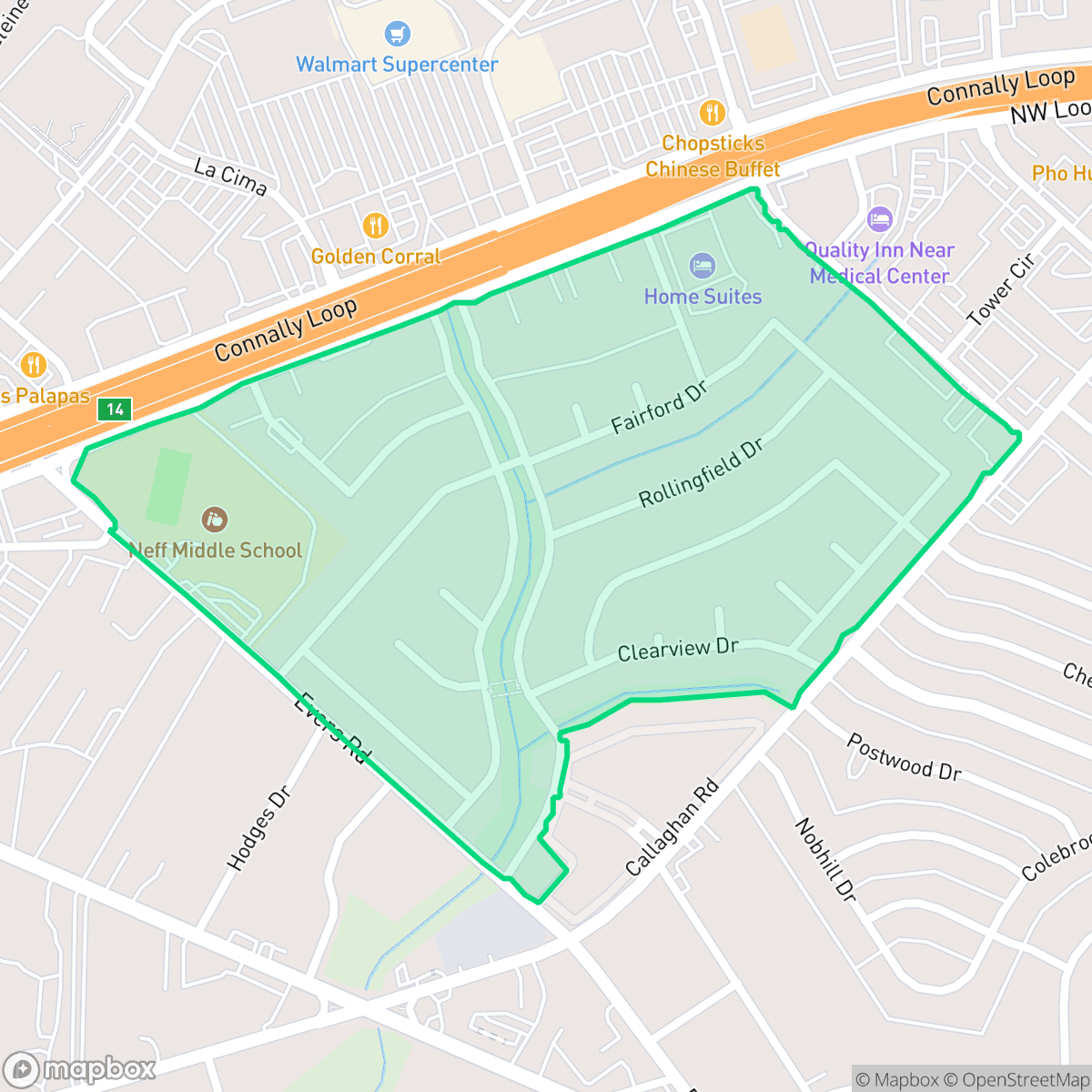
The Rolling Ridge Club neighborhood, nestled within the broader Alamo Farmsteads community on San Antonio's northwest side, was established as a residential subdivision in the late 1960s. The Rolling Ridge Club Association was officially incorporated on January 25, 1967, to govern the subdivision's 321 property owners. Developed primarily during this mid-to-late 20th-century era, the neighborhood's building stock consists largely of classic single-story ranch homes and townhomes featuring brick exteriors. The community is organized around shared infrastructure, notably its local clubhouse, community pool, and tennis courts, which serve as central gathering spaces for neighborhood association meetings, seasonal events, and local recreational activities.
The neighborhood serves as a residential enclave within the northwest side of San Antonio, defined by its established mid-century architecture and communal focus. Residents benefit from shared infrastructure, including a clubhouse, swimming pool, and tennis courts, which foster a consistent social environment. The area is positioned near major arteries, providing convenient access to diverse dining options such as Albi's Vite Italian Kitchen and local landmarks like Hope Lutheran Church.
According to iHuus data, the area presents a distinct set of trade-offs for prospective residents. While the neighborhood offers a higher level of social engagement than many surrounding parts of the city, the proximity to major roadways results in significant road traffic noise. Families may consider the Northside Independent School District, which provides access to high-performing magnet programs, though local schools like Neff Middle present varying academic performance levels. The area is best suited for those who prioritize community-oriented living and access to regional infrastructure over absolute acoustic privacy.
Neighborhood Scores Across 15 Qualities
Residential spacing is mixed with some buffer between neighbors, sitting slightly above the San Antonio average according to iHuus data.
Low traffic volumes make for a calm environment for pedestrians, though the lack of sidewalks makes walking less integrated than in many other parts of San Antonio. According to iHuus data, the area remains a functional choice for those who prefer quiet, low-speed streets.
Standard tract housing characterizes the area, featuring tidy but small yards and simple rooflines. This visual profile is slightly below the San Antonio average according to iHuus data.
Access to public parks and wide green verges for walking is below the San Antonio average. Residents may find fewer dedicated outdoor spaces for pets compared to other parts of the city.
Open land and scattered homes among woodland areas define this area, which is slightly less developed than the San Antonio average according to iHuus data.
Diverse dining options and social hubs provide a more active atmosphere than the city average, though many amenities remain car-dependent. While some blocks offer a quiet suburban feel, others feature a mix of light industrial units and accessible restaurants.
Frequent loud disturbances from nearby airport runway activity and heavy rail infrastructure create significant acoustic challenges. This level of noise is considerably higher than the average for San Antonio, according to iHuus data.
Frequent unhealthy air quality levels pose a significant risk to sensitive groups. According to iHuus data, the air quality in this area is slightly worse than the San Antonio average.
Residential life here is largely uninterrupted by heavy industry, though some light commercial activity exists near mixed-use zones. According to iHuus data, the area contains slightly more industrial presence than the San Antonio average.
Health insurance access in this area is below the San Antonio average. Residents may find fewer options for employer-sponsored coverage compared to the city as a whole, according to iHuus data.
Political leanings in this area trend more liberal than the San Antonio average, according to iHuus data.
Residents live alongside a balanced distribution of young adults, families, and seniors. This age profile is largely consistent with the broader San Antonio area, according to iHuus data.
Flood risk in this area is significantly higher than the San Antonio average due to its location in a coastal high-hazard zone. Residents should expect much higher insurance costs and potential exposure to wave action according to iHuus data.
Address-Level Insights for Rolling Ridge Club


iHuus Neighborhood Intelligence Insights
Get address-level neighborhood insights for Rolling Ridge Club
- Street-level scores — see how individual blocks compare, not just neighborhood averages
- Micro-zone boundaries — identify quiet pockets, flood boundaries, and walkable clusters before you visit
- 15 dimensions in full — walkability, noise, air quality, school quality, insurance coverage, population age profile, urban/rural index, and more
- Boundary risk alerts — know if your address sits near a block boundary where scores drop, the kind of detail no listing will ever mention
- School insights — individual school ratings and insights, not just district-level data
- Compare before you commit — side-by-side data across neighborhoods, down to block precision
No credit card required
Compare with Any Neighborhood
| Dimension | Rolling Ridge Club | 145 Association |
|---|---|---|
| 🚶 Walkabilityavg 6.44 | ||
| 🔊 Acoustic Comfortavg 4.07 | ||
| 🤫 Privacy Indexavg 5.75 | ||
| 🎨 Visual Appealavg 6.11 | ||
| 🐕 Dog Friendlinessavg 5.91 | ||
| 🗺️ Urban-Rural Indexavg 6.87 | ||
| ✨ Neighborhood Vibeavg 4.35 | ||
| 🏥 Health Insurance Coverageavg 5.94 | ||
| 🌿 Air Qualityavg 2.27 | ||
| 🏭 Industrial Proximityavg 8.31 | ||
| 🌊 Flood Safetyavg 4.2 | ||
| 🗳️ Ideological Leanavg 7.37 | ||
| 👥 Population Age Profileavg 4.68 | ||
| 🔥 Fire Safety | ||
| 🏫 School Quality |
Rolling Ridge Club Rankings
School Districts Serving Rolling Ridge Club
School Insights for Rolling Ridge Club
Below average outcomes; significant attendance and academic challenges.
School Insights
See what's really behind every school rating near Rolling Ridge Club
- Individual school ratings — each school's own score with outcome context, not just a district average
- Enrollment & class size data — student-to-teacher ratio and how it compares to the state average
- Full demographics breakdown — ethnicity and gender composition for every school in the enrollment zone
- Every school in the district — all schools within the enrollment boundary ranked by rating, not just the closest one
- Grade levels & benchmarks — elementary through high school, with below/above state-average flags
No credit card required