Rolling Oaks, San Antonio
Updated · 1,001 residents
Rolling Oaks is a quiet, semi-rural residential community in northeastern San Antonio characterized by spacious lots and a secluded atmosphere. While it offers a polished and upscale visual character, residents should expect moderate traffic noise and limited walkability due to the absence of sidewalks.
Key Highlights
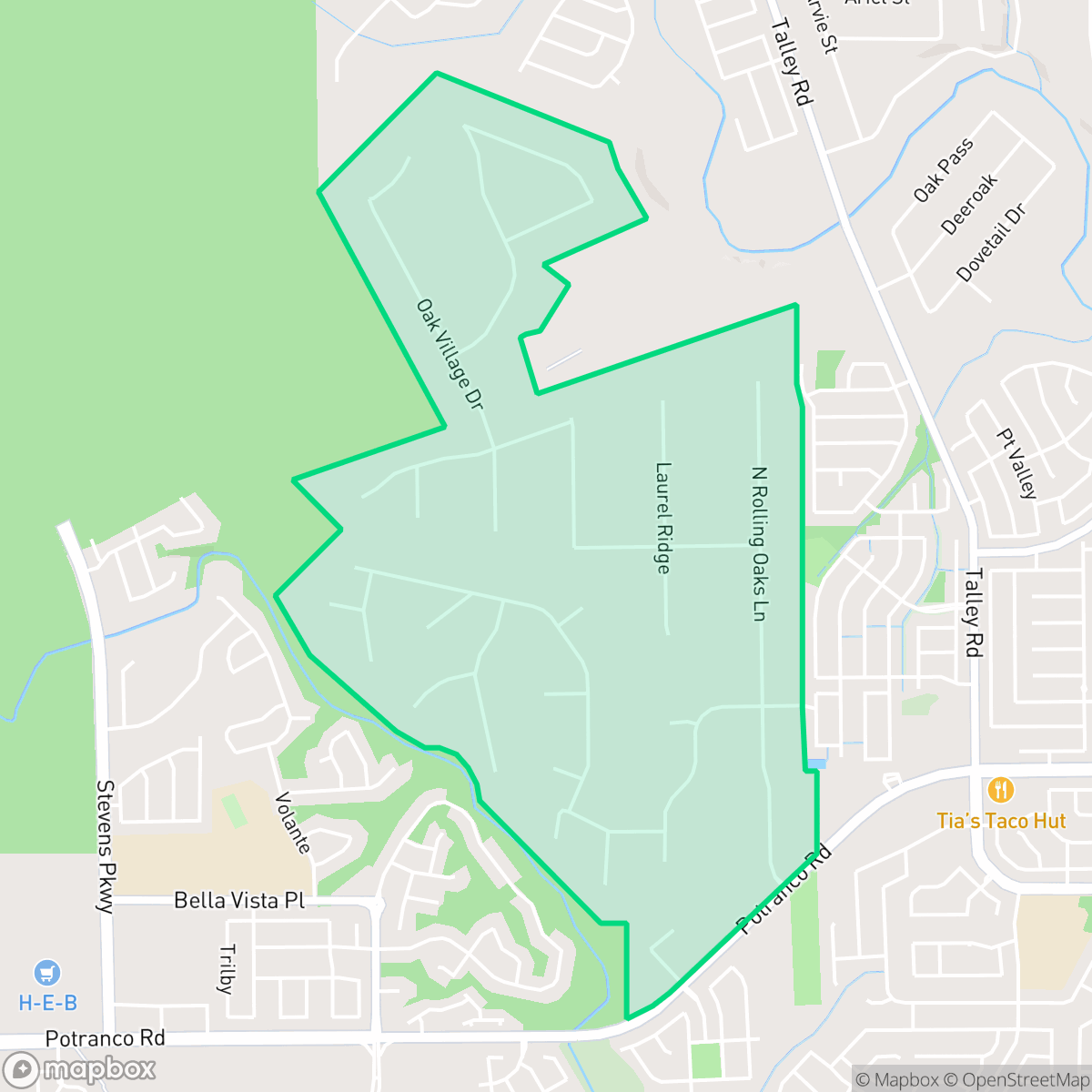
About Rolling Oaks
The Rolling Oaks area in northeastern San Antonio is defined by a history stretching from Native American use of the elevated 'Comanche Hill' to 19th-century land grants, including tracts once owned by Republic of Texas President Mirabeau B. Lamar. In the early 20th century, the area became a settlement for African Americans, including Buffalo Soldier Amos Jackson, who farmed the land between Cibolo Creek and Thousand Oaks Drive. Modern development began in the 1970s with city annexations, followed by the 1988 opening of Rolling Oaks Mall at Loop 1604 and Nacogdoches Road. Originally a remote retail project surrounded by farmland, the mall became a regional landmark that catalyzed suburban growth. Today, the area is characterized by a mix of established residential subdivisions and a evolving commercial center that serves as a hub for the surrounding community.
The area provides a distinct, semi-rural feel with large residential lots that offer significant privacy for homeowners. According to iHuus data, the neighborhood maintains a clean, purely residential environment, entirely free from industrial sites or commercial warehouses. Its visual character is marked by well-maintained properties and spacious driveways, creating a polished aesthetic that stands out from more densely packed urban sectors of San Antonio.
Prospective residents should consider that the neighborhood is primarily car-dependent, as the lack of sidewalks and sparse local amenities make walking difficult. While the community provides a peaceful, quiet atmosphere, it is situated near busy roadways that contribute to moderate traffic noise. The area is well-suited for those who prioritize privacy and a spacious, wooded environment over immediate proximity to walkable retail or urban nightlife. Residents also benefit from high levels of health insurance coverage and a balanced, moderate political landscape.
Neighborhood Scores Across 15 Qualities
Large residential lots provide significant separation between homes, offering a higher level of privacy than the San Antonio average.
Low traffic volumes make for calm walking conditions, although the absence of sidewalks means pedestrians must share the road with vehicles. This level of walkability is slightly below the San Antonio average, according to iHuus data.
Large residential lots and frequent upscale amenities contribute to a landscape that is notably more polished than the San Antonio average. According to iHuus data, the area features spacious driveways and well-maintained properties.
Access to public parks and large green verges is somewhat limited in this area. According to iHuus data, dog friendliness is slightly below the San Antonio average.
Frequent open land and scattered homes among woodlands provide a more rural feel than most of San Antonio. This area offers more space and natural scenery compared to the city average, according to iHuus data.
Local amenities and businesses are sparse, creating a subdued atmosphere that is notably calmer than the San Antonio average. Most streets are primarily residential and offer a secluded feel with limited nearby services.
Steady sounds from nearby busy streets are present. According to iHuus data, this level of acoustic activity is slightly higher than the San Antonio average.
Frequent unhealthy air quality levels pose significant risks to sensitive groups; this condition is slightly worse than the San Antonio average according to iHuus data.
No warehouses, industrial facilities, or hazard sites are present within the neighborhood. This area is exclusively residential and offers a cleaner environment than the San Antonio average according to iHuus data.
Health insurance accessibility is significantly higher than the San Antonio average, according to iHuus data. Most residents in this area maintain active health coverage.
Political viewpoints in this area are split nearly evenly between conservative and liberal leanings. This reflects a more moderate ideological landscape than the more strongly partisan average found across San Antonio.
A balanced mix of young adults, families, and older residents defines the community. According to iHuus data, the age distribution is slightly more concentrated in certain age brackets compared to the San Antonio average.
Flood risk in this area is difficult to precisely assess because a detailed study has not yet been completed by FEMA. According to iHuus data, the potential for flooding is slightly higher than the San Antonio average.
Address-Level Insights for Rolling Oaks


iHuus Neighborhood Intelligence Insights
Get address-level neighborhood insights for Rolling Oaks
- Street-level scores — see how individual blocks compare, not just neighborhood averages
- Micro-zone boundaries — identify quiet pockets, flood boundaries, and walkable clusters before you visit
- 15 dimensions in full — walkability, noise, air quality, school quality, insurance coverage, population age profile, urban/rural index, and more
- Boundary risk alerts — know if your address sits near a block boundary where scores drop, the kind of detail no listing will ever mention
- School insights — individual school ratings and insights, not just district-level data
- Compare before you commit — side-by-side data across neighborhoods, down to block precision
No credit card required
Compare with Any Neighborhood
| Dimension | Rolling Oaks | 145 Association |
|---|---|---|
| 🚶 Walkabilityavg 6.44 | ||
| 🔊 Acoustic Comfortavg 4.07 | ||
| 🤫 Privacy Indexavg 5.75 | ||
| 🎨 Visual Appealavg 6.11 | ||
| 🐕 Dog Friendlinessavg 5.91 | ||
| 🗺️ Urban-Rural Indexavg 6.87 | ||
| ✨ Neighborhood Vibeavg 4.35 | ||
| 🏥 Health Insurance Coverageavg 5.94 | ||
| 🌿 Air Qualityavg 2.27 | ||
| 🏭 Industrial Proximityavg 8.31 | ||
| 🌊 Flood Safetyavg 4.2 | ||
| 🗳️ Ideological Leanavg 7.37 | ||
| 👥 Population Age Profileavg 4.68 | ||
| 🔥 Fire Safety | ||
| 🏫 School Quality |
Rolling Oaks Rankings
School Districts Serving Rolling Oaks
School Insights for Rolling Oaks
Below average outcomes; significant attendance and academic challenges.
School Insights
See what's really behind every school rating near Rolling Oaks
- Individual school ratings — each school's own score with outcome context, not just a district average
- Enrollment & class size data — student-to-teacher ratio and how it compares to the state average
- Full demographics breakdown — ethnicity and gender composition for every school in the enrollment zone
- Every school in the district — all schools within the enrollment boundary ranked by rating, not just the closest one
- Grade levels & benchmarks — elementary through high school, with below/above state-average flags
No credit card required