Quintana Community, San Antonio
Updated · 10,507 residents
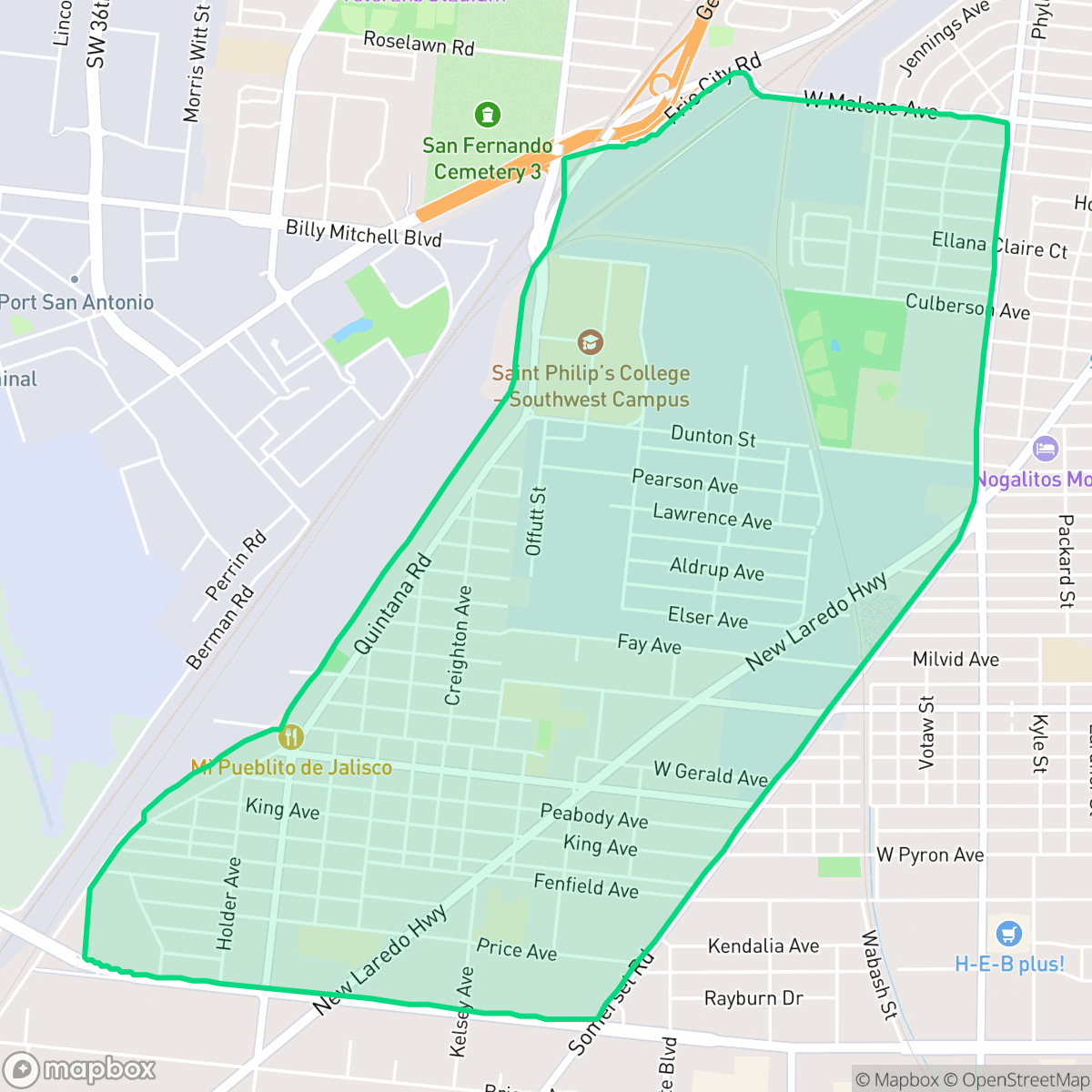
Quintana Community is a dense, industrial-fringe neighborhood on San Antonio’s South Side characterized by a mix of single-story residential blocks and heavy logistics infrastructure. While the area offers a variety of local dining and social hubs, residents face significant noise from nearby rail yards and highways, alongside challenges regarding air quality and flood safety.
Key Highlights
About Quintana Community
In the early 1900s, the Quintana Community on San Antonio’s South Side was part of South San Antonio, a distinct, incorporated suburban town centered along West Southcross Boulevard (formerly Main Avenue). This historic corridor stretched to Quintana Road and featured its own city hall, bank, post office, and movie theater. The area experienced rapid growth during World War II due to its proximity to the adjacent Kelly Field and local rail lines. Following its annexation by the city of San Antonio in 1944, the neighborhood's small-town commercial core gradually declined. Today, local efforts like the South San Main Street Project aim to revitalize the historic, pedestrian-friendly West Southcross corridor, preserving landmarks such as the local American Legion Hall.
The area functions as a low-density urban fringe where residential streets intersect with active rail lines and large-scale warehouse complexes. The landscape is defined by tight suburban lots and a grid layout that supports a quiet, car-dependent daily life. Local social activity is centered around neighborhood ministries and diverse, independent eateries that provide a sense of community despite the heavy industrial surroundings.
Prospective residents should consider the trade-offs of living in an active logistics zone, where high levels of road and rail noise are common. The neighborhood presents significant challenges including poor air quality and high flood risk, which may impact long-term livability. While the local school districts face systemic instability, families may find options through specific high-performing charter schools within the broader region. The area is best suited for those who prioritize proximity to industrial employment hubs and value a modest, established residential setting.
Neighborhood Scores Across 15 Qualities
Residential lots feature mixed spacing with some buffer between neighbors, though density increases in certain northern blocks. This level of privacy is roughly in line with the San Antonio average.
Inconsistent sidewalk networks and proximity to high-speed rail corridors make pedestrian transit difficult. While low-traffic streets offer some quiet routes, the lack of continuous pavement makes walking less accessible than in many other parts of San Antonio.
Simple rooflines and high building density characterize the area. The visual landscape appears more utilitarian than the San Antonio average due to small yards and unpaved lots.
Limited access to public parks and narrow sidewalk verges make outdoor walking difficult for pet owners. According to iHuus data, greenery is primarily confined to private, fenced backyards, which is below the San Antonio average.
Residential grids and single-family homes transition into industrial zones and large warehouse complexes. This layout is slightly more developed than the city average, featuring a blend of low-density housing and heavy industrial infrastructure.
Active pockets of dining and social hubs exist alongside industrial corridors and warehouses. This area offers more variety in local amenities and restaurants than the San Antonio average, though most destinations require a vehicle to reach.
Frequent disturbances from nearby rail lines and major thoroughfares contribute to a less quiet environment than the San Antonio average. According to iHuus data, residents may experience significant acoustic disruption from heavy traffic and transit infrastructure.
Frequent unhealthy air quality levels pose a significant risk to sensitive groups; according to iHuus data, conditions in this area are worse than the San Antonio average.
Active rail yards and warehouse logistics contribute to higher levels of noise and truck traffic than seen elsewhere in San Antonio. While the area contains residential pockets, the presence of scrap yards and commercial strips creates a more industrial character than the city average.
Health insurance coverage among residents is notably lower than the San Antonio average. This lack of coverage may present challenges for accessing preventative medical care within the community.
Voting patterns and census indicators show a distinctly liberal leaning, which is notably more pronounced than the San Antonio average.
Residents live alongside a diverse range of age groups, including young adults, families, and older community members. This demographic distribution is largely consistent with the broader San Antonio area, according to iHuus data.
Flood vulnerability is significantly higher than the San Antonio average, with a notable risk of coastal-style hazards and wave action. Residents should expect elevated or potentially prohibitive flood insurance costs according to iHuus data.
Address-Level Insights for Quintana Community


iHuus Neighborhood Intelligence Insights
Get address-level neighborhood insights for Quintana Community
- Street-level scores — see how individual blocks compare, not just neighborhood averages
- Micro-zone boundaries — identify quiet pockets, flood boundaries, and walkable clusters before you visit
- 15 dimensions in full — walkability, noise, air quality, school quality, insurance coverage, population age profile, urban/rural index, and more
- Boundary risk alerts — know if your address sits near a block boundary where scores drop, the kind of detail no listing will ever mention
- School insights — individual school ratings and insights, not just district-level data
- Compare before you commit — side-by-side data across neighborhoods, down to block precision
No credit card required
Compare with Any Neighborhood
| Dimension | Quintana Community | 145 Association |
|---|---|---|
| 🚶 Walkabilityavg 6.44 | ||
| 🔊 Acoustic Comfortavg 4.07 | ||
| 🤫 Privacy Indexavg 5.75 | ||
| 🎨 Visual Appealavg 6.11 | ||
| 🐕 Dog Friendlinessavg 5.91 | ||
| 🗺️ Urban-Rural Indexavg 6.87 | ||
| ✨ Neighborhood Vibeavg 4.35 | ||
| 🏥 Health Insurance Coverageavg 5.94 | ||
| 🌿 Air Qualityavg 2.27 | ||
| 🏭 Industrial Proximityavg 8.31 | ||
| 🌊 Flood Safetyavg 4.2 | ||
| 🗳️ Ideological Leanavg 7.37 | ||
| 👥 Population Age Profileavg 4.68 | ||
| 🔥 Fire Safety | ||
| 🏫 School Quality |
Quintana Community Rankings
School Districts Serving Quintana Community
School Insights for Quintana Community
Below average outcomes; significant attendance and academic challenges.
School Insights
See what's really behind every school rating near Quintana Community
- Individual school ratings — each school's own score with outcome context, not just a district average
- Enrollment & class size data — student-to-teacher ratio and how it compares to the state average
- Full demographics breakdown — ethnicity and gender composition for every school in the enrollment zone
- Every school in the district — all schools within the enrollment boundary ranked by rating, not just the closest one
- Grade levels & benchmarks — elementary through high school, with below/above state-average flags
No credit card required