Prospect Hill, San Antonio
Updated · 33,060 residents
Prospect Hill is a historic Westside San Antonio neighborhood defined by its deep-rooted Mexican-American culture and a dense, grid-based residential layout. The area offers a quiet, suburban atmosphere with access to local dining and green drainage corridors, though it remains largely car-dependent with significant flood safety concerns.
Key Highlights
About Prospect Hill
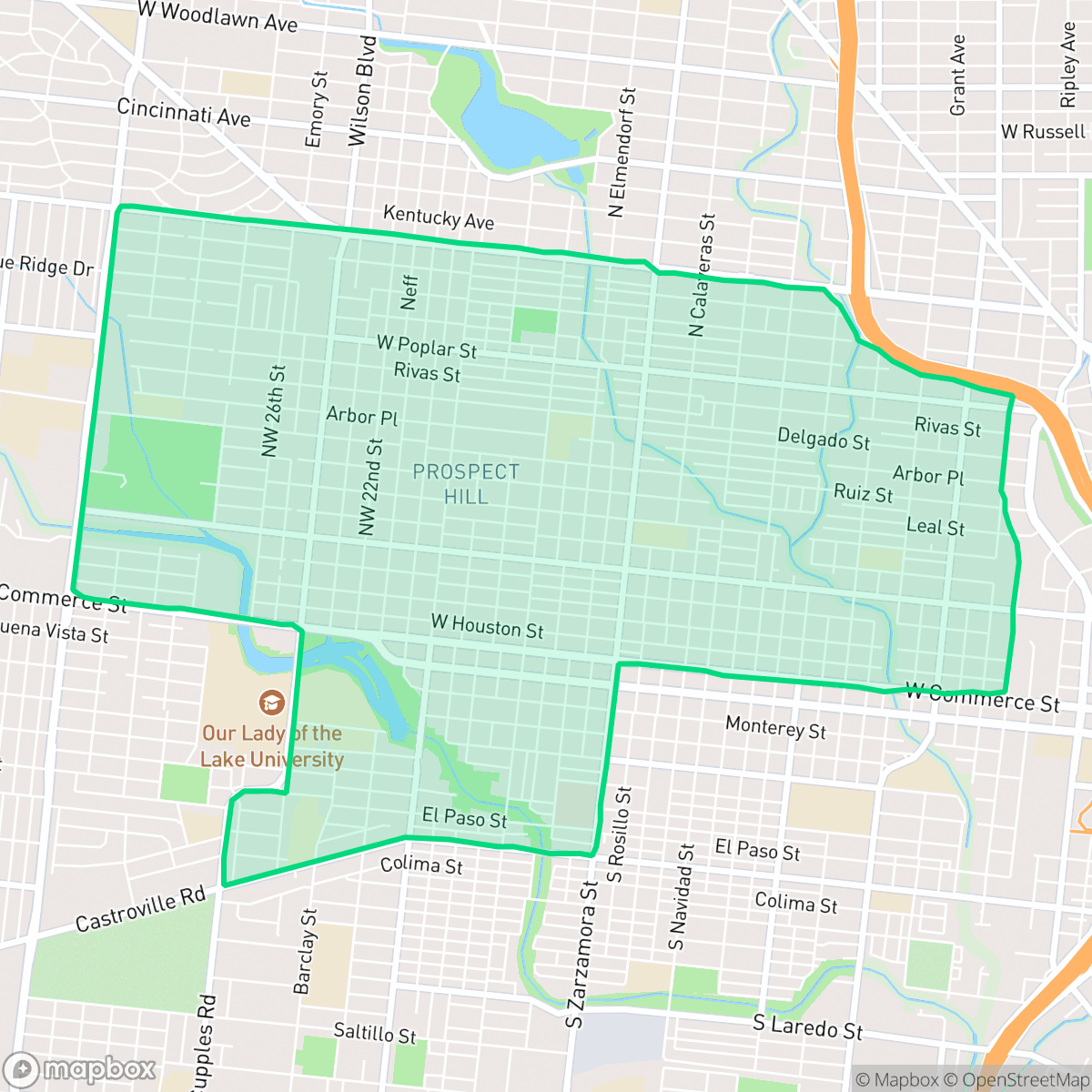
Initially settled by German and East European immigrants, San Antonio’s Prospect Hill neighborhood on the Westside evolved between 1920 and 1950 into one of the first major middle-class Latino communities in the United States. The neighborhood, bounded historically by Alazan Creek and Hamilton, became a vibrant cultural and commercial hub. It was home to prominent Latino merchants, artists, and leaders, including former Mayor Henry Cisneros, artist Jesse Treviño, and landscape painter Porfirio Salinas. Architecturally, the area features historic landmarks like the 1911 Beaux-Arts style Prospect Hill Missionary Baptist Church, alongside diverse residential styles ranging from Victorian homes to Craftsman bungalows. Cultural institutions like the Prospect Hill Yellow Jackets Athletic Club, founded in 1932, and long-standing local businesses like Janie's Record Shop have long anchored the community's rich Mexican-American identity.
Prospect Hill functions as a dense, low-rise urban grid characterized by modest, single-family homes and a strong sense of community identity. The neighborhood features a mix of quiet residential streets and light commercial pockets, where residents frequent local staples like Ray's Drive Inn and various neighborhood taquerias. Access to green space is primarily provided by drainage canal corridors, which offer public walking paths despite the limited number of traditional public parks in the immediate vicinity. The area maintains a consistent architectural character, with homes closely spaced on narrow lots, reflecting its development as a middle-class hub during the mid-twentieth century.
Prospective residents should note that the neighborhood presents specific infrastructure challenges, including a high risk of flooding and inconsistent sidewalk connectivity that impacts overall walkability. While the area boasts a strong cultural legacy and high community ideological alignment, it faces systemic issues related to low health insurance coverage and aging school district infrastructure. It is best suited for those seeking an established, affordable community with a deep local identity, provided they are prepared for the realities of living in a car-dependent environment with notable environmental and infrastructure trade-offs.
Neighborhood Scores Across 15 Qualities
Residential structures feature varying levels of spacing with some narrow lots offering limited buffer between neighbors. According to iHuus data, the level of separation between homes is roughly comparable to the San Antonio average.
A consistent grid of low-traffic streets and campus pathways allows for easy pedestrian movement, though sidewalk continuity varies throughout the area. This level of connectivity is typical for the city, as some residential blocks feature narrow or intermittent paths due to tree cover and aging infrastructure.
Simple rooflines and small, tightly packed lots characterize this area. According to iHuus data, the visual landscape is less varied and lacks the lush greenery or luxury amenities found throughout much of San Antonio.
Green drainage corridors and nearby riverfront trails provide useful walking paths for pets, though many residential streets feature narrow verges and limited public park access. This level of accessibility is slightly below the San Antonio average according to iHuus data.
A balanced blend of street grids and green space defines this area, providing a more suburban feel than the more urbanized city average. Residential lots are interspersed with significant tree canopy and institutional campus spaces.
A balanced mix of residential streets and local dining provides a slightly more active atmosphere than the San Antonio average. While many areas offer accessible social hubs and green spaces, certain blocks remain primarily car-dependent due to a sparse distribution of businesses.
Steady noise from nearby busy streets is present, though levels are slightly more tranquil than the city average according to iHuus data.
Frequent unhealthy air quality levels pose a significant risk to sensitive groups. According to iHuus data, these levels are slightly worse than the San Antonio average.
Industrial presence is minimal throughout most of the neighborhood, with only occasional light commercial activity and some warehouse clusters near the eastern edges. This area remains slightly better than the San Antonio average for avoiding heavy industrial hazards.
Health insurance coverage among residents is lower than the San Antonio average, which may impact local access to certain preventative care services. According to iHuus data, a minority of the population is currently covered by a health plan.
Voting patterns and census indicators in Prospect Hill reflect a significantly more liberal leaning than the San Antonio average, according to iHuus data.
A balanced variety of young adults, families, and older residents characterizes this area, reflecting a demographic spread that is consistent with the San Antonio average.
Elevated flood hazards and potential wave action make this area significantly more vulnerable to flooding than the San Antonio average. Residents should expect higher or potentially prohibitive flood insurance costs according to iHuus data.
Address-Level Insights for Prospect Hill


iHuus Neighborhood Intelligence Insights
Get address-level neighborhood insights for Prospect Hill
- Street-level scores — see how individual blocks compare, not just neighborhood averages
- Micro-zone boundaries — identify quiet pockets, flood boundaries, and walkable clusters before you visit
- 15 dimensions in full — walkability, noise, air quality, school quality, insurance coverage, population age profile, urban/rural index, and more
- Boundary risk alerts — know if your address sits near a block boundary where scores drop, the kind of detail no listing will ever mention
- School insights — individual school ratings and insights, not just district-level data
- Compare before you commit — side-by-side data across neighborhoods, down to block precision
No credit card required
Compare with Any Neighborhood
| Dimension | Prospect Hill | 145 Association |
|---|---|---|
| 🚶 Walkabilityavg 6.44 | ||
| 🔊 Acoustic Comfortavg 4.07 | ||
| 🤫 Privacy Indexavg 5.75 | ||
| 🎨 Visual Appealavg 6.11 | ||
| 🐕 Dog Friendlinessavg 5.91 | ||
| 🗺️ Urban-Rural Indexavg 6.87 | ||
| ✨ Neighborhood Vibeavg 4.35 | ||
| 🏥 Health Insurance Coverageavg 5.94 | ||
| 🌿 Air Qualityavg 2.27 | ||
| 🏭 Industrial Proximityavg 8.31 | ||
| 🌊 Flood Safetyavg 4.2 | ||
| 🗳️ Ideological Leanavg 7.37 | ||
| 👥 Population Age Profileavg 4.68 | ||
| 🔥 Fire Safety | ||
| 🏫 School Quality |
Prospect Hill Rankings
School Districts Serving Prospect Hill
School Insights for Prospect Hill
Below average outcomes; significant attendance and academic challenges.
School Insights
See what's really behind every school rating near Prospect Hill
- Individual school ratings — each school's own score with outcome context, not just a district average
- Enrollment & class size data — student-to-teacher ratio and how it compares to the state average
- Full demographics breakdown — ethnicity and gender composition for every school in the enrollment zone
- Every school in the district — all schools within the enrollment boundary ranked by rating, not just the closest one
- Grade levels & benchmarks — elementary through high school, with below/above state-average flags
No credit card required