Perrin Park, San Antonio
Updated · 250 residents
Perrin Park is a quiet, rural enclave on San Antonio’s Northeast Side defined by its expansive open spaces and connection to the Salado Creek Greenway. Residents enjoy an exceptionally dog-friendly environment, though the area maintains a low-key atmosphere with limited commercial activity and significant noise levels from nearby traffic.
Key Highlights
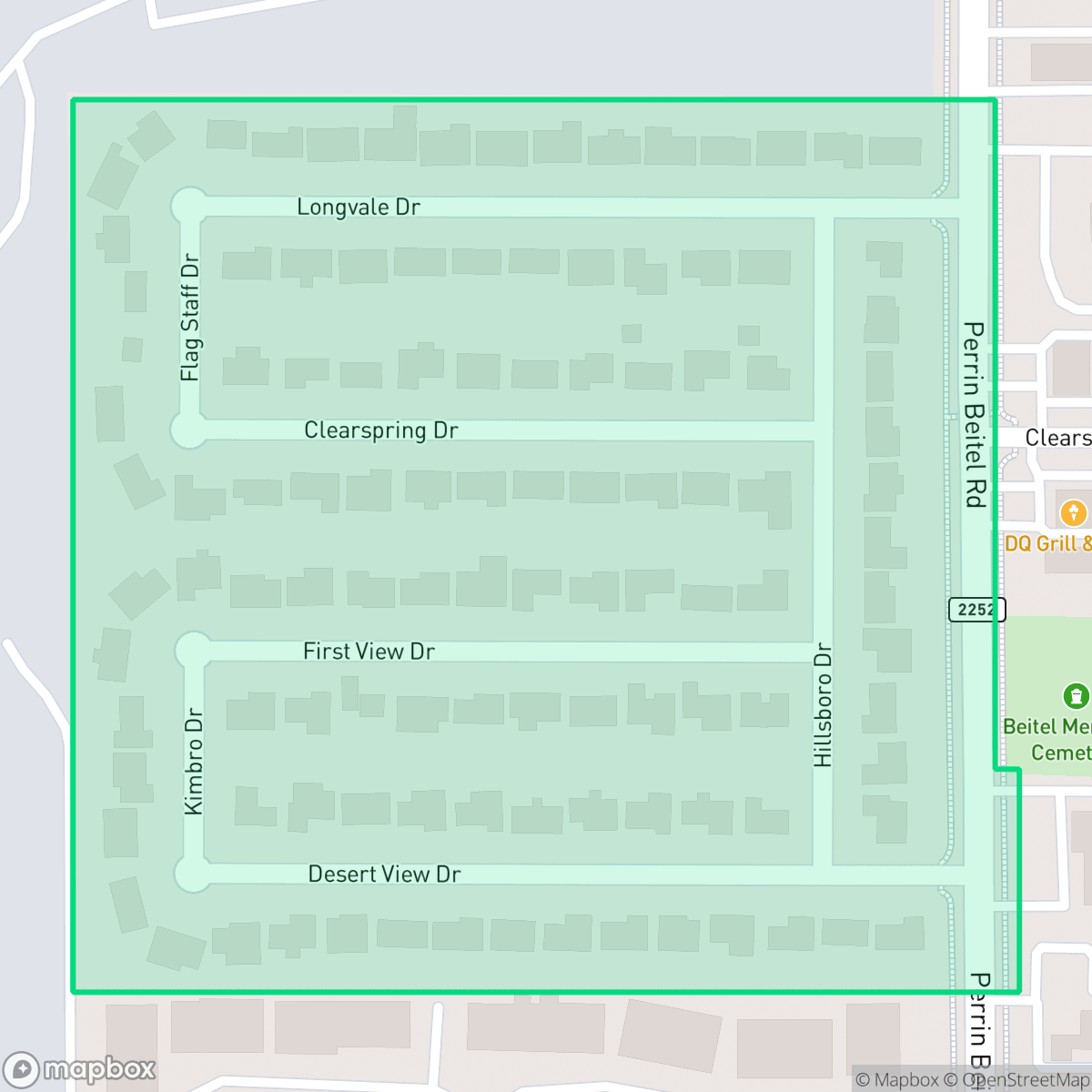
About Perrin Park
Located on San Antonio’s Northeast Side, the Perrin Park neighborhood is rooted in the late 19th-century agricultural history of the Perrin family. In 1875, Alphonse W. Perrin and his wife, Nina, purchased 540 acres near Salado Creek to establish Hope Farm. The neighborhood’s historic centerpiece is the 1875 Perrin Homestead on Swan's Landing Road, a limestone farmhouse designated as both a Recorded Texas Historic Landmark and a City of San Antonio Landmark. Recently, the City of San Antonio rehabilitated the homestead for adaptive reuse by the Parks and Recreation Department. This preservation project also introduced a new nature trail connecting the historic homestead to Lady Bird Johnson Park and the broader Salado Creek Greenway, maintaining a link to the area's rural heritage.
This neighborhood serves as a tranquil retreat from the dense urban core of San Antonio, offering a distinct rural character that is rare within the city limits. The landscape is dominated by open terrain and natural beauty, providing direct access to trails that link to larger regional greenways. While the area lacks a bustling commercial center, it offers a peaceful setting for those who prioritize outdoor access and a slower pace of life.
Prospective residents should note that the neighborhood functions as a mixed-use environment where residential life intersects with active daytime commercial traffic. According to iHuus data, acoustic comfort is a primary consideration for those sensitive to noise, as the area experiences higher sound levels than the city average. It is best suited for individuals who value proximity to nature, especially dog owners, while being prepared for the trade-offs of a less walkable, industrial-adjacent location.
Neighborhood Scores Across 15 Qualities
Residential spacing offers a typical suburban layout with some buffer between neighbors, though levels of privacy are slightly below the San Antonio average according to iHuus data.
Low traffic volumes make residential streets safe for pedestrians, though the lack of consistent sidewalks makes the area slightly less walkable than the San Antonio average. According to iHuus data, the absence of formal pedestrian infrastructure remains a notable feature for those navigating the neighborhood on foot.
Residential scenery consists of uniform tract housing and apartment complexes with modest yards and closely spaced homes. This level of visual variety is roughly in line with the San Antonio city average, according to iHuus data.
Primarily composed of private backyards, this area lacks wide sidewalk verges for casual walking. According to iHuus data, the availability of shared public greenery is roughly comparable to the San Antonio average.
Open land and scattered homes predominate the landscape, providing a more semi-rural feel than the San Antonio average. According to iHuus data, the area features a mix of woodland, fields, and larger residential plots.
A largely suburban and industrial landscape provides a calm setting, though the area is less active than the San Antonio average. According to iHuus data, the environment is characterized by light industrial units, freight corridors, and a low density of commercial activity.
Constant noise from the nearby airport runway and heavy rail proximity makes this area significantly louder than most parts of San Antonio. Residents should expect frequent high-decibel disruptions throughout the day.
Air quality levels fluctuate between acceptable and unhealthy, presenting occasional concerns for sensitive groups. According to iHuus data, the air quality in this area is notably better than the San Antonio average.
Light industrial zones and small warehouses sit alongside residential streets, which results in lower industrial density than the San Antonio average. Residents may experience increased daytime traffic and noise from nearby commercial activities, according to iHuus data.
Health insurance enrollment among residents is notably higher than the San Antonio average, according to iHuus data.
Political leanings in this area trend liberal, though there is a modest presence of opposing views. This political landscape is slightly less liberal than the San Antonio city average, according to iHuus data.
Residents live alongside a diverse mix of young adults, families, and seniors. This age distribution is largely in line with the typical profile seen across San Antonio.
Flood risk levels in this area are higher than the San Antonio average, though local authorities have not yet finalized a detailed study to determine exact vulnerability. Residents should remain cautious as official FEMA classifications for this specific zone are currently undetermined.
Address-Level Insights for Perrin Park


iHuus Neighborhood Intelligence Insights
Get address-level neighborhood insights for Perrin Park
- Street-level scores — see how individual blocks compare, not just neighborhood averages
- Micro-zone boundaries — identify quiet pockets, flood boundaries, and walkable clusters before you visit
- 15 dimensions in full — walkability, noise, air quality, school quality, insurance coverage, population age profile, urban/rural index, and more
- Boundary risk alerts — know if your address sits near a block boundary where scores drop, the kind of detail no listing will ever mention
- School insights — individual school ratings and insights, not just district-level data
- Compare before you commit — side-by-side data across neighborhoods, down to block precision
No credit card required
Compare with Any Neighborhood
| Dimension | Perrin Park | 145 Association |
|---|---|---|
| 🚶 Walkabilityavg 6.44 | ||
| 🔊 Acoustic Comfortavg 4.07 | ||
| 🤫 Privacy Indexavg 5.75 | ||
| 🎨 Visual Appealavg 6.11 | ||
| 🐕 Dog Friendlinessavg 5.91 | ||
| 🗺️ Urban-Rural Indexavg 6.87 | ||
| ✨ Neighborhood Vibeavg 4.35 | ||
| 🏥 Health Insurance Coverageavg 5.94 | ||
| 🌿 Air Qualityavg 2.27 | ||
| 🏭 Industrial Proximityavg 8.31 | ||
| 🌊 Flood Safetyavg 4.2 | ||
| 🗳️ Ideological Leanavg 7.37 | ||
| 👥 Population Age Profileavg 4.68 | ||
| 🔥 Fire Safety | ||
| 🏫 School Quality |
Perrin Park Rankings
School Districts Serving Perrin Park
School Insights for Perrin Park
Below average outcomes; significant attendance and academic challenges.
School Insights
See what's really behind every school rating near Perrin Park
- Individual school ratings — each school's own score with outcome context, not just a district average
- Enrollment & class size data — student-to-teacher ratio and how it compares to the state average
- Full demographics breakdown — ethnicity and gender composition for every school in the enrollment zone
- Every school in the district — all schools within the enrollment boundary ranked by rating, not just the closest one
- Grade levels & benchmarks — elementary through high school, with below/above state-average flags
No credit card required