People Active in Community Effort, San Antonio
Updated · 24,550 residents
People Active in Community Effort is a quiet, dense suburban neighborhood in southwest San Antonio defined by its proximity to Lackland Air Force Base and Miller’s Pond Park. Residents benefit from a consistent sidewalk network and a peaceful atmosphere, though the area is largely car-dependent with limited local commercial amenities.
Key Highlights
About People Active in Community Effort
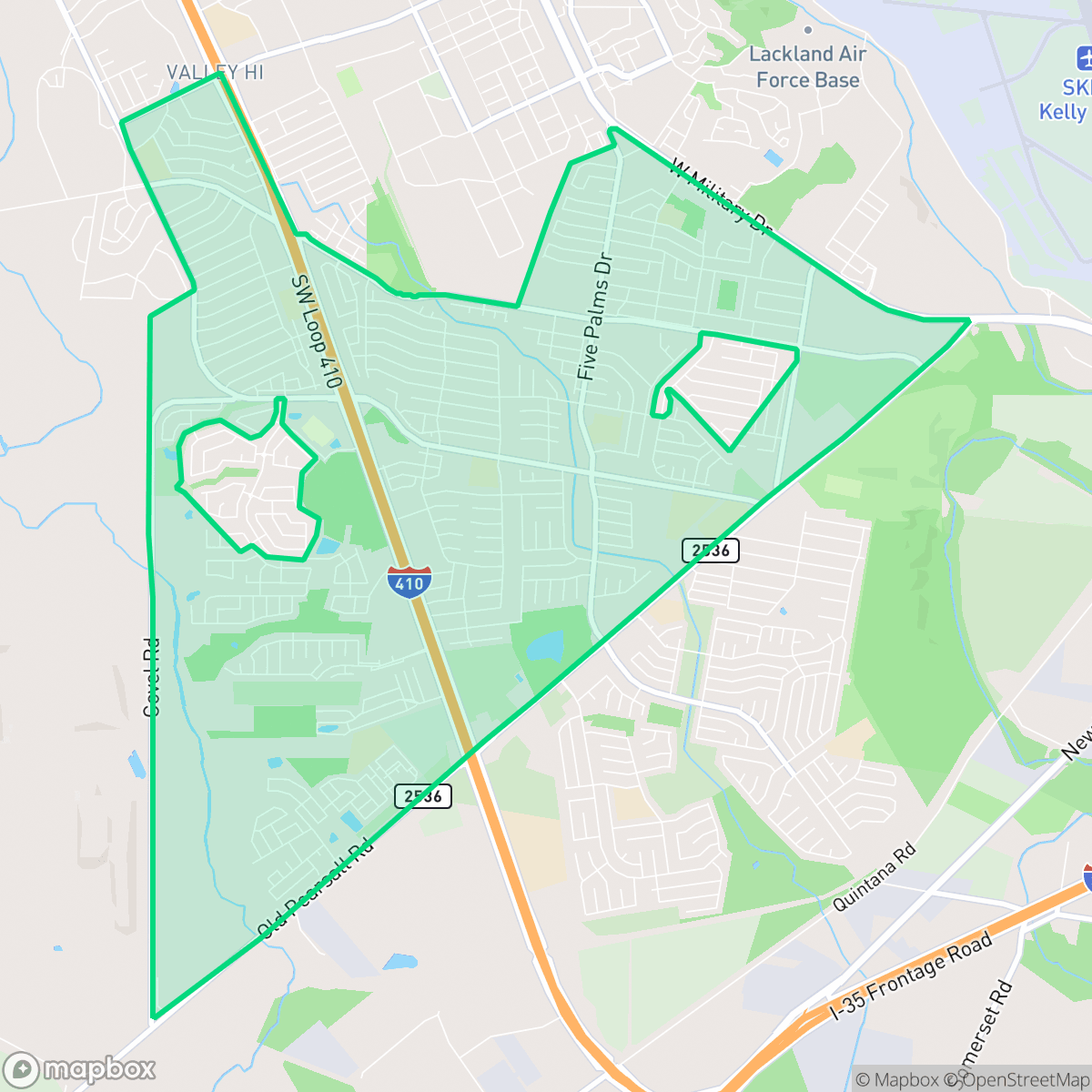
The People Active in Community Effort (P.A.C.E.) neighborhood in southwest San Antonio is historically tied to the mid-20th-century expansion of the local military presence. Following the 1942 separation of Lackland Air Force Base from Kelly Air Force Base, the area was developed to provide affordable supplemental housing for military personnel. Developer Ray Ellison served as the primary homebuilder here throughout the 1970s and 1980s. The neighborhood's modern identity was solidified in 1982 when concerned Valley Hi area residents organized P.A.C.E. to protest a nearby sanitary landfill and advocate for local education, officially chartering as a neighborhood association in 1983. Bounded by Interstate 410, Medina Base Road, and Lackland Air Force Base, the neighborhood features local community hubs like Miller’s Pond Park.
The area is characterized by its uniform, mid-century suburban layout, featuring closely spaced single-family homes and a quiet residential environment. It serves as a practical hub for those connected to the nearby military installations, offering a straightforward, low-density lifestyle centered around community staples like Miller’s Pond Park. While the neighborhood provides a calm atmosphere, it lacks a dense commercial core, meaning most daily errands require a vehicle. The proximity to major highways facilitates travel, though it also contributes to moderate levels of road traffic noise.
This neighborhood is well-suited for military families and long-term residents who prioritize a predictable, quiet suburban setting over urban walkability. While the area offers a safe, consistent residential grid, prospective residents should note the limited local business density and the necessity of commuting for major retail or dining options.
Neighborhood Scores Across 15 Qualities
Residential spacing provides a moderate level of seclusion, with most homes situated at a distance similar to the city average. According to iHuus data, properties feature varied density ranging from closely packed structures to detached houses with clear side yards.
Low traffic volumes and accessible cul-de-sacs provide safe walking conditions, though sidewalk continuity varies by street. This level of walkability is slightly higher than the San Antonio average according to iHuus data.
Standard tract housing and apartment complexes characterize the area, featuring consistent rooflines and modest yards. This visual profile is largely in line with the city average for San Antonio.
Large green belts and open sports fields provide ample walking space, though some residential streets lack wide grass verges. This level of dog friendliness is roughly in line with the San Antonio average, according to iHuus data.
Residential pockets blend with open green spaces and undeveloped plots, matching the typical urban-rural balance found across San Antonio. This mix of dense suburban housing and occasional agricultural or industrial fringe areas provides a transitional landscape.
Low business density and a reliance on vehicles characterize this area, which feels less active than the San Antonio average. While some suburban pockets offer walkable access to local eateries, much of the landscape consists of quiet, low-density residential and industrial spaces.
Steady hums from nearby busy streets characterize the area, though levels are comparable to the city average.
Frequent unhealthy air quality levels pose a significant risk to sensitive groups; according to iHuus data, conditions here are slightly worse than the San Antonio average.
Industrial hazards and heavy manufacturing are virtually non-existent here, offering a cleaner environment than much of San Antonio. While some areas border light commercial warehouses or utility structures, the neighborhood remains primarily residential and free from heavy industrial pollutants.
Health insurance coverage among residents is below the San Antonio average. Access to medical benefits may be less widespread in this area according to iHuus data.
Political leanings in this area skew toward liberal ideologies, representing a more progressive tilt than the San Antonio average according to iHuus data.
Residents live alongside a balanced mix of young adults, families, and older individuals. This demographic distribution is slightly more varied than the average seen across San Antonio.
Flood risk levels are currently difficult to determine because official FEMA studies for this area are incomplete; however, the risk remains slightly higher than the San Antonio average according to iHuus data.
Address-Level Insights for People Active in Community Effort


iHuus Neighborhood Intelligence Insights
Get address-level neighborhood insights for People Active in Community Effort
- Street-level scores — see how individual blocks compare, not just neighborhood averages
- Micro-zone boundaries — identify quiet pockets, flood boundaries, and walkable clusters before you visit
- 15 dimensions in full — walkability, noise, air quality, school quality, insurance coverage, population age profile, urban/rural index, and more
- Boundary risk alerts — know if your address sits near a block boundary where scores drop, the kind of detail no listing will ever mention
- School insights — individual school ratings and insights, not just district-level data
- Compare before you commit — side-by-side data across neighborhoods, down to block precision
No credit card required
Compare with Any Neighborhood
| Dimension | People Active in Community Effort | 145 Association |
|---|---|---|
| 🚶 Walkabilityavg 6.44 | ||
| 🔊 Acoustic Comfortavg 4.07 | ||
| 🤫 Privacy Indexavg 5.75 | ||
| 🎨 Visual Appealavg 6.11 | ||
| 🐕 Dog Friendlinessavg 5.91 | ||
| 🗺️ Urban-Rural Indexavg 6.87 | ||
| ✨ Neighborhood Vibeavg 4.35 | ||
| 🏥 Health Insurance Coverageavg 5.94 | ||
| 🌿 Air Qualityavg 2.27 | ||
| 🏭 Industrial Proximityavg 8.31 | ||
| 🌊 Flood Safetyavg 4.2 | ||
| 🗳️ Ideological Leanavg 7.37 | ||
| 👥 Population Age Profileavg 4.68 | ||
| 🔥 Fire Safety | ||
| 🏫 School Quality |
People Active in Community Effort Rankings
School Districts Serving People Active in Community Effort
School Insights for People Active in Community Effort
Below average outcomes; significant attendance and academic challenges.
School Insights
See what's really behind every school rating near People Active in Community Effort
- Individual school ratings — each school's own score with outcome context, not just a district average
- Enrollment & class size data — student-to-teacher ratio and how it compares to the state average
- Full demographics breakdown — ethnicity and gender composition for every school in the enrollment zone
- Every school in the district — all schools within the enrollment boundary ranked by rating, not just the closest one
- Grade levels & benchmarks — elementary through high school, with below/above state-average flags
No credit card required