Oakland Estates, San Antonio
Updated · 2,213 residents
Oakland Estates is a semi-rural enclave in San Antonio that prioritizes privacy and a quiet atmosphere over urban amenities. The area features low-density housing and mature trees, though it lacks traditional suburban infrastructure like sidewalks, resulting in low walkability and significant road traffic noise.
Key Highlights
About Oakland Estates
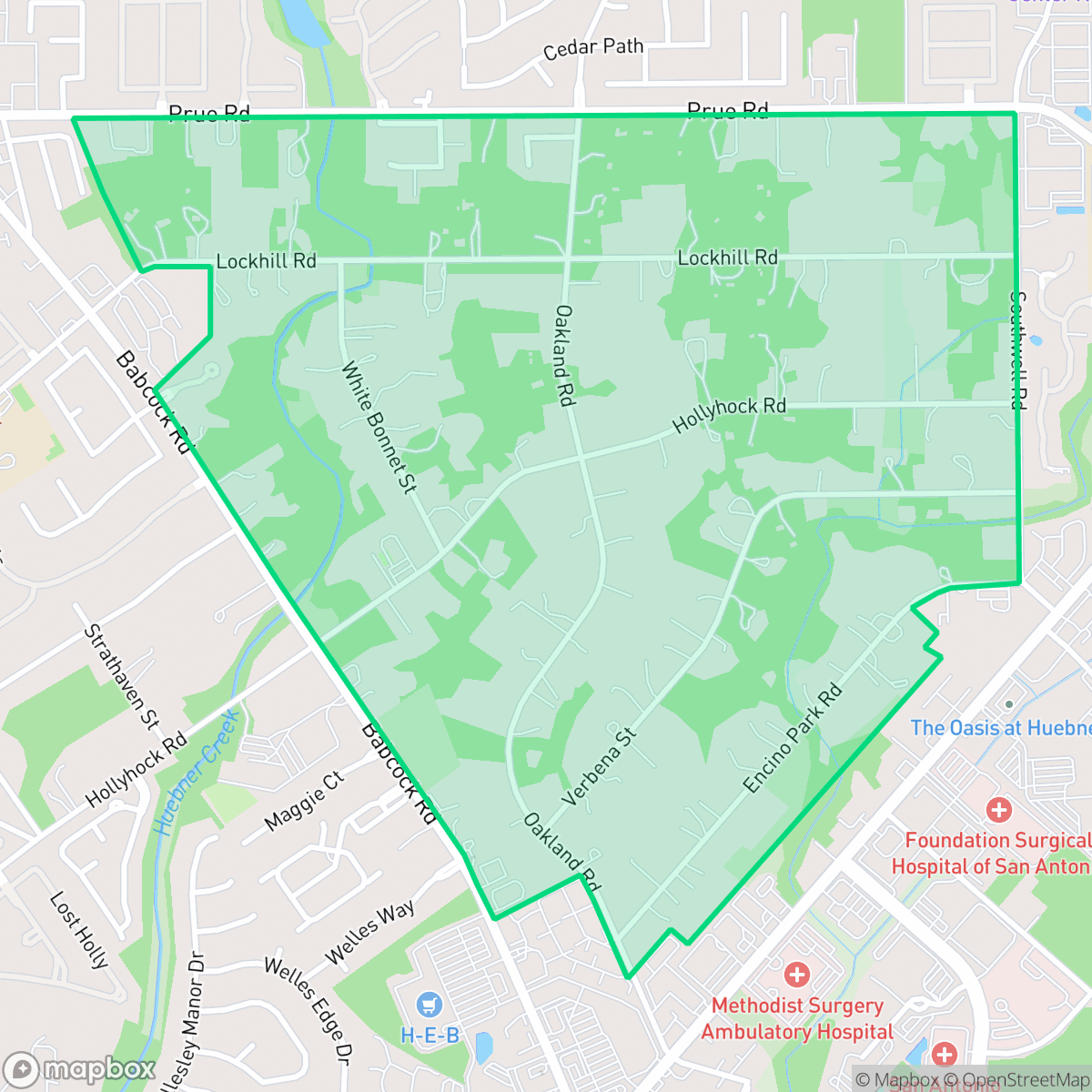
The history of San Antonio's Oakland Estates began with an 1842 Republic of Texas land grant awarded to Jose Alameda, a soldier who fought in the 1835 Siege of Bexar under Juan Seguín. In 1877, Amos Babcock purchased the land, which is defined today by Babcock, Huebner, and Prue Roads. The 900-acre tract was sold to developers in 1923 and platted as a Bexar County subdivision in 1926 with large, multi-acre lots. Annexed by San Antonio in 1972, Oakland Estates has intentionally preserved its distinct, semi-rural character. Residents have actively resisted urban modernization—shunning sidewalks, curbs, and streetlights—to maintain a "country with convenience" atmosphere characterized by gravel-shoulder streets, mature oak trees, and local livestock.
This neighborhood offers a distinct semi-rural environment within the broader San Antonio landscape, characterized by its low-density residential blocks and significant visual appeal. Residents benefit from a sense of seclusion and high levels of personal privacy, supported by a strong local community presence that includes the Sikh Center of San Antonio and diverse dining options like Biryani Express and Garcia Barbecue. The area maintains an intentional distance from modern urban design, which contributes to its unique aesthetic but necessitates a reliance on personal vehicles for daily errands. According to iHuus data, the area presents specific trade-offs for prospective residents. While it boasts higher-than-average health insurance coverage and a stable population age profile, the neighborhood faces challenges regarding acoustic comfort due to road traffic and lower air quality metrics. Families are served by the Northside Independent School District, which is recognized for its academic programs despite current budgetary and capacity considerations. The environment is best suited for those who value space and a quiet, non-traditional suburban experience over proximity to walkable retail or quiet streetscapes.
Neighborhood Scores Across 15 Qualities
Varying distances between homes create mixed levels of seclusion; certain areas feature closely spaced housing and narrow yards that offer less physical buffering than the San Antonio average.
Low traffic volumes and continuous sidewalk networks in residential sections provide safe pedestrian access. While walkability is slightly below the San Antonio average, the area remains suitable for casual strolls.
Large homes and frequent upscale amenities provide a more polished aesthetic than the San Antonio average. According to iHuus data, the area features spacious driveways and well-maintained property features.
Sidewalks throughout the area lack wide green verges, and most vegetation is confined to private yards. According to iHuus data, this provides fewer opportunities for outdoor walking compared to the city average.
Open land and scattered homes amidst woodland or fields characterize this area, providing a more semi-rural feel than the typical San Antonio landscape. According to iHuus data, the neighborhood features a mix of dense suburban elements like commercial plazas alongside more spacious, natural settings.
Low-density residential blocks and light industrial units create a peaceful environment that is slightly calmer than the San Antonio average. While various local dining and religious centers are accessible, the area remains largely car-dependent due to the spread-out nature of the landscape.
A continuous hum from a nearby busy street defines the acoustic environment. This level of ambient noise is roughly consistent with the city average.
Frequent unhealthy air quality levels pose a significant risk to sensitive groups. This area experiences worse air quality than the San Antonio average, according to iHuus data.
Largely residential streets and open green spaces define the area, though some noise and traffic concerns exist near warehouse structures on the east side. This level of industrial presence is slightly higher than the San Antonio average, according to iHuus data.
Health insurance coverage is notably higher than the San Antonio average, indicating a well-insured resident population according to iHuus data.
Political leanings in this area are largely liberal, aligning closely with the broader San Antonio average.
A balanced mix of young adults, families, and older residents defines the area. This demographic spread is slightly more varied than the San Antonio average, according to iHuus data.
Flood risk in this area is higher than the San Antonio average, though a lack of detailed FEMA studies means the specific level of danger remains undetermined. Residents should remain cautious as the current data indicates more vulnerability than most parts of the city.
Address-Level Insights for Oakland Estates


iHuus Neighborhood Intelligence Insights
Get address-level neighborhood insights for Oakland Estates
- Street-level scores — see how individual blocks compare, not just neighborhood averages
- Micro-zone boundaries — identify quiet pockets, flood boundaries, and walkable clusters before you visit
- 15 dimensions in full — walkability, noise, air quality, school quality, insurance coverage, population age profile, urban/rural index, and more
- Boundary risk alerts — know if your address sits near a block boundary where scores drop, the kind of detail no listing will ever mention
- School insights — individual school ratings and insights, not just district-level data
- Compare before you commit — side-by-side data across neighborhoods, down to block precision
No credit card required
Compare with Any Neighborhood
| Dimension | Oakland Estates | 145 Association |
|---|---|---|
| 🚶 Walkabilityavg 6.44 | ||
| 🔊 Acoustic Comfortavg 4.07 | ||
| 🤫 Privacy Indexavg 5.75 | ||
| 🎨 Visual Appealavg 6.11 | ||
| 🐕 Dog Friendlinessavg 5.91 | ||
| 🗺️ Urban-Rural Indexavg 6.87 | ||
| ✨ Neighborhood Vibeavg 4.35 | ||
| 🏥 Health Insurance Coverageavg 5.94 | ||
| 🌿 Air Qualityavg 2.27 | ||
| 🏭 Industrial Proximityavg 8.31 | ||
| 🌊 Flood Safetyavg 4.2 | ||
| 🗳️ Ideological Leanavg 7.37 | ||
| 👥 Population Age Profileavg 4.68 | ||
| 🔥 Fire Safety | ||
| 🏫 School Quality |
Oakland Estates Rankings
School Districts Serving Oakland Estates
School Insights for Oakland Estates
Below average outcomes; significant attendance and academic challenges.
School Insights
See what's really behind every school rating near Oakland Estates
- Individual school ratings — each school's own score with outcome context, not just a district average
- Enrollment & class size data — student-to-teacher ratio and how it compares to the state average
- Full demographics breakdown — ethnicity and gender composition for every school in the enrollment zone
- Every school in the district — all schools within the enrollment boundary ranked by rating, not just the closest one
- Grade levels & benchmarks — elementary through high school, with below/above state-average flags
No credit card required