Oak Meadow, San Antonio
Updated · 1,528 residents
Oak Meadow is a quiet, visually appealing residential community in North Central San Antonio defined by its mature trees and established suburban character. Residents benefit from high health insurance coverage and proximity to local dining, though the area experiences moderate noise levels from nearby road traffic.
Key Highlights
About Oak Meadow
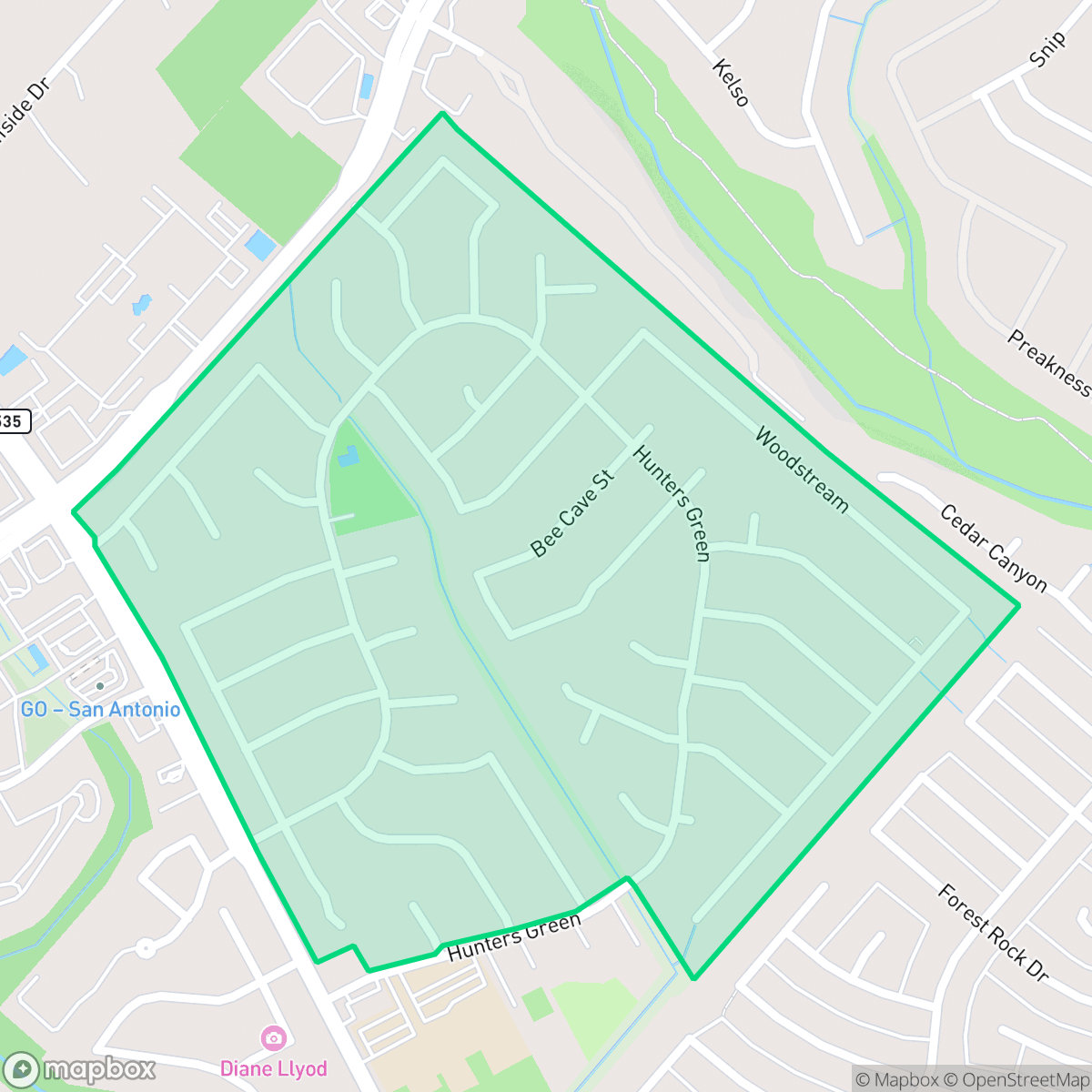
Established in 1973 in North Central San Antonio, the Oak Meadow subdivision was developed on 223 acres of wooded land originally owned by Louis Voelcker. Developer Lloyd Denton, alongside prominent local builders Frank Sitterle and Robert Gragg, built the residential community in seven phases throughout the 1970s. In its early years, the neighborhood retained a rustic character, with wandering cattle from the adjacent Max Voelcker dairy farm—now Phil Hardberger Park—frequently straying into yards. Due to slow emergency response times from distant volunteer departments, early residents successfully petitioned for annexation into the city of San Antonio to secure municipal services. Today, Oak Meadow is a stable, multi-generational neighborhood characterized by its active homeowners association, community swim club, and strong neighborhood identity.
The neighborhood offers a stable, suburban environment characterized by high visual appeal and a strong sense of community. Situated in a region with significant green space and access to local amenities like Frederick's Bistro and Black Rock Coffee Bar, the area maintains a consistent residential feel. According to iHuus data, the community ranks highly for health insurance coverage, reflecting a stable demographic profile that values long-term residency and established infrastructure.
Prospective residents should note that the area presents a balance of trade-offs, including moderate walkability and acoustic levels primarily influenced by road traffic. While the neighborhood is largely removed from industrial zones, local air quality metrics suggest a need for awareness regarding environmental factors. It is well-suited for families and individuals seeking a quiet, established environment within the highly regarded North East Independent School District, provided they are comfortable with a suburban pace of life.
Neighborhood Scores Across 15 Qualities
Residential spacing and mature backyard trees provide a level of seclusion that is slightly higher than the San Antonio average. Neighboring houses are set at a moderate distance with natural vegetation acting as a buffer between properties.
Low traffic streets and cul-de-sacs provide safe environments for walking, offering a slightly higher level of walkability than the San Antonio average. According to iHuus data, sidewalks are present on one side of many residential roads along with safe crossings.
Large homes with complex rooflines and private backyard pools create an aesthetic that is notably more polished than the San Antonio average. According to iHuus data, the presence of frequent upscale amenities and expansive driveways contributes to a highly manicured streetscape.
Wide residential verges and large forested buffer zones provide ample green space for pets. According to iHuus data, these connected natural areas offer more walking opportunities than the San Antonio average.
Frequent open land and scattered homes amid woodland characterize this area, which feels slightly less urbanized than the San Antonio average. Dense suburban development with high tree canopy coverage is common throughout the neighborhood according to iHuus data.
Residential life here is primarily quiet and suburban with a limited selection of nearby businesses. According to iHuus data, the level of activity and commercial density is below the San Antonio average.
Steady noise from nearby busy streets is common here, which is roughly consistent with the city average. According to iHuus data, residents may experience a persistent hum from local vehicle traffic.
Frequent unhealthy air quality levels pose significant risks to sensitive groups. According to iHuus data, these conditions are slightly worse than the San Antonio average.
Industrial activity is non-existent here, providing a landscape free of warehouses and factories. This area maintains a much higher level of separation from industrial zones than the San Antonio average, according to iHuus data.
Health insurance access is significantly higher than the San Antonio average, according to iHuus data. This level of coverage suggests a more stable baseline for resident healthcare access.
Political leanings in this area are balanced between conservative and liberal perspectives. This represents a more moderate ideological landscape than the more heavily liberal lean found across the rest of San Antonio.
Residents experience a balanced demographic mix of young adults, families, and seniors. This age distribution is more varied than the average seen across San Antonio, according to iHuus data.
Residual flood risk exists within this area because parts of the neighborhood sit within a 500-year floodplain. According to iHuus data, the safety level here is notably higher than the San Antonio city average.
Address-Level Insights for Oak Meadow


iHuus Neighborhood Intelligence Insights
Get address-level neighborhood insights for Oak Meadow
- Street-level scores — see how individual blocks compare, not just neighborhood averages
- Micro-zone boundaries — identify quiet pockets, flood boundaries, and walkable clusters before you visit
- 15 dimensions in full — walkability, noise, air quality, school quality, insurance coverage, population age profile, urban/rural index, and more
- Boundary risk alerts — know if your address sits near a block boundary where scores drop, the kind of detail no listing will ever mention
- School insights — individual school ratings and insights, not just district-level data
- Compare before you commit — side-by-side data across neighborhoods, down to block precision
No credit card required
Compare with Any Neighborhood
| Dimension | Oak Meadow | 145 Association |
|---|---|---|
| 🚶 Walkabilityavg 6.44 | ||
| 🔊 Acoustic Comfortavg 4.07 | ||
| 🤫 Privacy Indexavg 5.75 | ||
| 🎨 Visual Appealavg 6.11 | ||
| 🐕 Dog Friendlinessavg 5.91 | ||
| 🗺️ Urban-Rural Indexavg 6.87 | ||
| ✨ Neighborhood Vibeavg 4.35 | ||
| 🏥 Health Insurance Coverageavg 5.94 | ||
| 🌿 Air Qualityavg 2.27 | ||
| 🏭 Industrial Proximityavg 8.31 | ||
| 🌊 Flood Safetyavg 4.2 | ||
| 🗳️ Ideological Leanavg 7.37 | ||
| 👥 Population Age Profileavg 4.68 | ||
| 🔥 Fire Safety | ||
| 🏫 School Quality |
Oak Meadow Rankings
School Districts Serving Oak Meadow
School Insights for Oak Meadow
Below average outcomes; significant attendance and academic challenges.
School Insights
See what's really behind every school rating near Oak Meadow
- Individual school ratings — each school's own score with outcome context, not just a district average
- Enrollment & class size data — student-to-teacher ratio and how it compares to the state average
- Full demographics breakdown — ethnicity and gender composition for every school in the enrollment zone
- Every school in the district — all schools within the enrollment boundary ranked by rating, not just the closest one
- Grade levels & benchmarks — elementary through high school, with below/above state-average flags
No credit card required