Oak Hills, San Antonio
Updated · 3,582 residents
Oak Hills is a well-established community in Northwest San Antonio defined by its mature tree canopy and mid-century architectural charm. While the area offers a vibrant social scene with numerous dining and coffee options, residents should anticipate a car-dependent lifestyle and elevated noise levels from nearby transit corridors.
Key Highlights
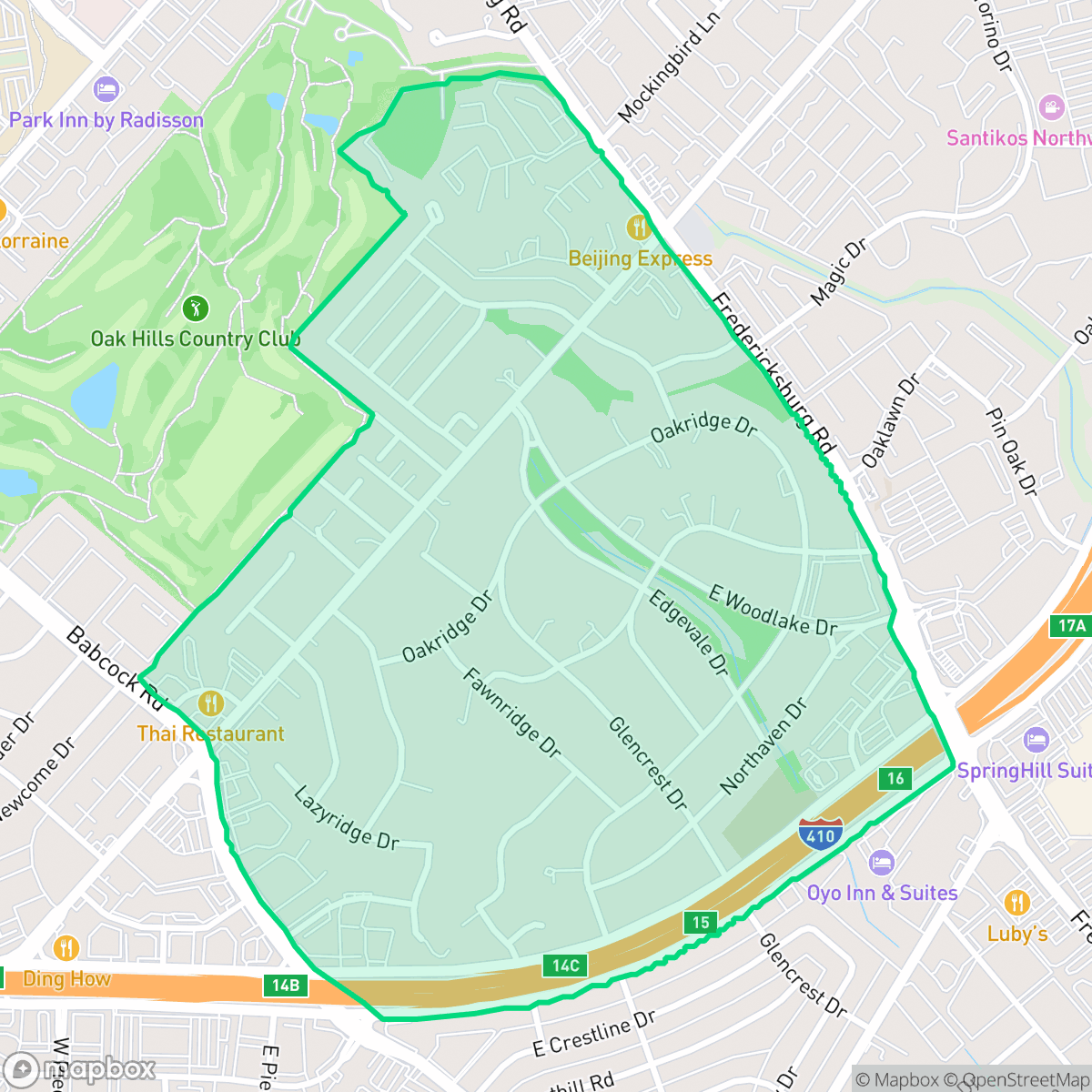
About Oak Hills
Oak Hills, located in Northwest San Antonio, is primarily defined by its mid-20th-century development, which accelerated in the 1960s alongside the expansion of the nearby South Texas Medical Center. The neighborhood is anchored by the Oak Hills Country Club, originally founded in 1922 as the Alamo Country Club, which serves as a central social and recreational landmark. Architecturally, the area is characterized by spacious mid-century modern and ranch-style homes, reflecting the suburban growth patterns of the post-war era. Its proximity to the medical district has long influenced its character, attracting many healthcare professionals and establishing a stable, professional demographic. The neighborhood remains a distinct enclave known for its mature tree canopy and established residential landscape, maintaining a cohesive identity rooted in its mid-century suburban origins.
The neighborhood provides a distinct aesthetic characterized by spacious homes and a semi-rural atmosphere, featuring frequent open land and woodlands that contrast with typical suburban density. Residents benefit from a lively local culture with high concentrations of social hubs, making it a popular choice for those who value community engagement and diverse dining experiences. According to iHuus data, the area maintains a notably liberal political lean and a balanced demographic mix of young adults, families, and older residents who appreciate the established residential landscape. The lack of industrial activity ensures a clean environment, though the visual appeal is balanced by the practical reality of living in a developed, yet older, suburban pocket.
Living in this part of the city involves specific trade-offs regarding infrastructure and environmental factors. Prospective residents should note that air quality often falls below the city average, and frequent noise from nearby major freeways can impact acoustic comfort. While the area is moderately walkable, most errands require a vehicle. Families often look toward the Northside Independent School District for education, which remains a primary regional option despite ongoing budget and enrollment management challenges. The neighborhood also presents a moderate risk for flooding, and while private fenced yards are common and pet-friendly, public green space remains somewhat limited near the busier arterial roads.
Neighborhood Scores Across 15 Qualities
Residential spacing offers a moderate level of separation between neighbors, which is slightly higher than the San Antonio average. Houses are generally positioned with consistent buffers from adjacent properties.
Sidewalks are available along many streets but can be fragmented in certain areas. Pedestrian movement is slightly more convenient here than the city average due to safe crossings and a mix of residential and arterial roads.
Large homes and frequent upscale amenities contribute to a more aesthetically pleasing environment than the San Antonio average. Some areas contain standard middle-class tract housing and apartment blocks with smaller yards.
Private fenced yards are common throughout the area, though public green spaces are somewhat limited near busy roads. According to iHuus data, the availability of pet-friendly space is above the San Antonio average.
Frequent open land and scattered homes amid woodlands provide a more rural atmosphere than the San Antonio average. According to iHuus data, the area also contains pockets of dense suburban development with integrated commercial complexes.
Frequent visits to diverse local dining and coffee shops are common here, as the area possesses a much higher concentration of social hubs than the San Antonio average. While these lively pockets offer variety, most residents will find the neighborhood remains largely car-dependent.
Frequent noise from nearby major freeways and transit corridors makes this area significantly louder than the San Antonio average. According to iHuus data, residents may experience regular auditory disturbances from heavy traffic and proximity to transit infrastructure.
Frequent unhealthy air quality levels pose a significant risk to sensitive groups. According to iHuus data, the air quality in this area is worse than the San Antonio average.
Industrial activity is virtually non-existent here, as the area consists of residential streets and light commercial retail. According to iHuus data, this lack of heavy industry and hazard sites makes the neighborhood significantly cleaner of industrial presence than the San Antonio average.
Health insurance access among residents is slightly below the San Antonio average, according to iHuus data.
Political leanings in Oak Hills are notably more liberal than the San Antonio average. According to iHuus data, the area maintains a liberal majority with a modest opposing presence.
A balanced mix of young adults, families, and older residents characterizes the area. According to iHuus data, this age distribution is slightly more varied than the typical San Antonio profile.
Flood risk in this area is higher than the San Antonio average; however, a detailed FEMA study for this specific location has not yet been completed.
Address-Level Insights for Oak Hills


iHuus Neighborhood Intelligence Insights
Get address-level neighborhood insights for Oak Hills
- Street-level scores — see how individual blocks compare, not just neighborhood averages
- Micro-zone boundaries — identify quiet pockets, flood boundaries, and walkable clusters before you visit
- 15 dimensions in full — walkability, noise, air quality, school quality, insurance coverage, population age profile, urban/rural index, and more
- Boundary risk alerts — know if your address sits near a block boundary where scores drop, the kind of detail no listing will ever mention
- School insights — individual school ratings and insights, not just district-level data
- Compare before you commit — side-by-side data across neighborhoods, down to block precision
No credit card required
Compare with Any Neighborhood
| Dimension | Oak Hills | 145 Association |
|---|---|---|
| 🚶 Walkabilityavg 6.44 | ||
| 🔊 Acoustic Comfortavg 4.07 | ||
| 🤫 Privacy Indexavg 5.75 | ||
| 🎨 Visual Appealavg 6.11 | ||
| 🐕 Dog Friendlinessavg 5.91 | ||
| 🗺️ Urban-Rural Indexavg 6.87 | ||
| ✨ Neighborhood Vibeavg 4.35 | ||
| 🏥 Health Insurance Coverageavg 5.94 | ||
| 🌿 Air Qualityavg 2.27 | ||
| 🏭 Industrial Proximityavg 8.31 | ||
| 🌊 Flood Safetyavg 4.2 | ||
| 🗳️ Ideological Leanavg 7.37 | ||
| 👥 Population Age Profileavg 4.68 | ||
| 🔥 Fire Safety | ||
| 🏫 School Quality |
Oak Hills Rankings
School Districts Serving Oak Hills
School Insights for Oak Hills
Below average outcomes; significant attendance and academic challenges.
School Insights
See what's really behind every school rating near Oak Hills
- Individual school ratings — each school's own score with outcome context, not just a district average
- Enrollment & class size data — student-to-teacher ratio and how it compares to the state average
- Full demographics breakdown — ethnicity and gender composition for every school in the enrollment zone
- Every school in the district — all schools within the enrollment boundary ranked by rating, not just the closest one
- Grade levels & benchmarks — elementary through high school, with below/above state-average flags
No credit card required