Oak Haven Heights, San Antonio
Updated · 1,477 residents
Oak Haven Heights is a secluded Northeast San Antonio community known for its high visual appeal, mature oak canopy, and free-roaming wildlife. While the area offers a distinct rural atmosphere, residents should be aware of significant noise from nearby road traffic and a reliance on personal vehicles for transportation.
Key Highlights
About Oak Haven Heights
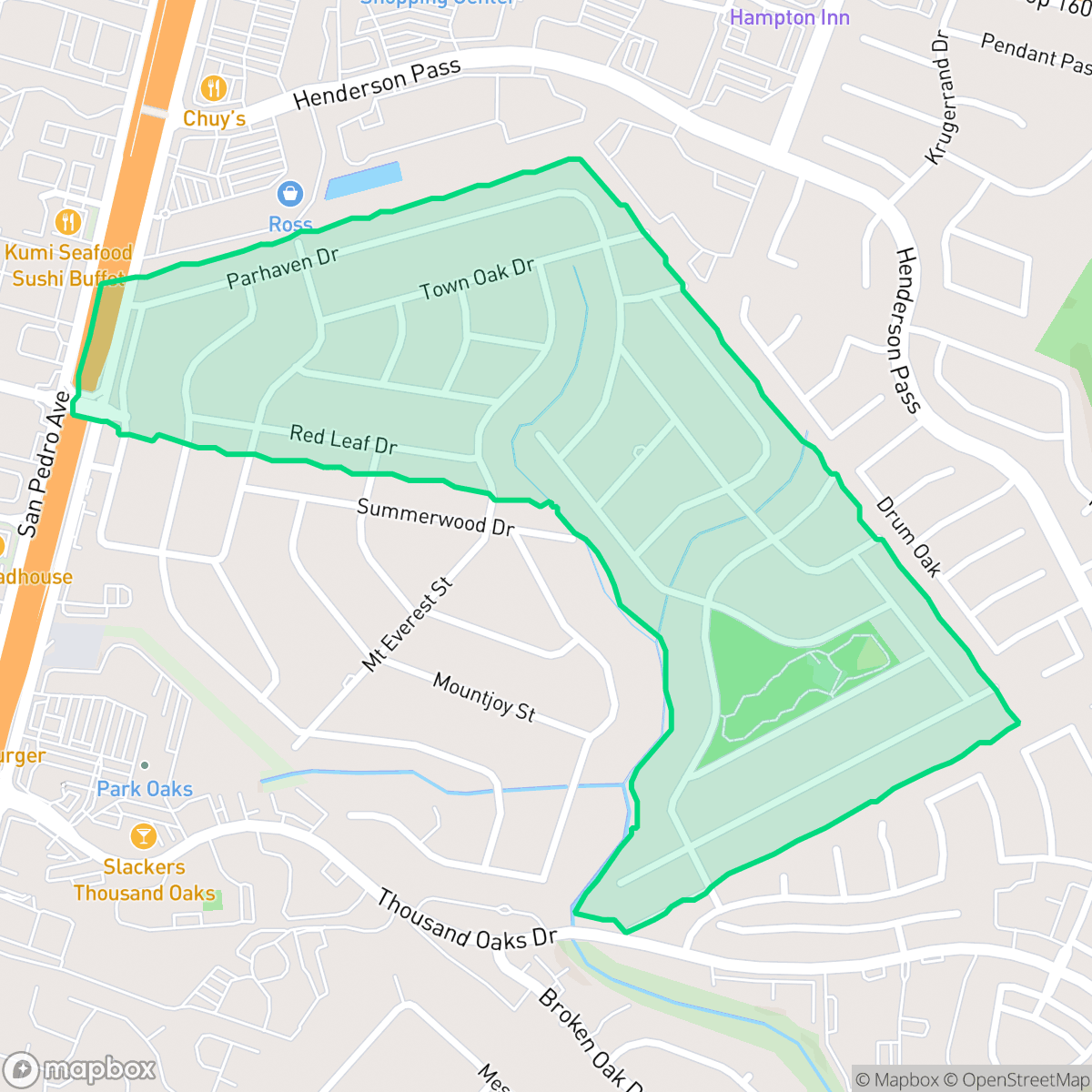
Established in earnest during the late 1950s and early 1960s, Oak Haven Heights is a secluded neighborhood on San Antonio’s Northeast Side, built on former farmland south of Loop 1604. Comprising roughly 450 properties, the community is characterized by a rustic, country-like charm within the city, defined by winding streets without curbs or sidewalks, dry creek beds, and a dense canopy of mature oak trees. The neighborhood's natural setting is home to a prominent, free-roaming herd of white-tailed deer. Its residential stock consists primarily of custom-built mid-century and 1970s homes, including a notable modern redwood residence built in 1973 by the late prolific Texas school architect David Earl Bradley as his personal homestead.
The area functions as a low-density residential enclave that prioritizes aesthetic character over urban convenience. With a visual appeal score significantly higher than the city average according to iHuus data, the neighborhood maintains a distinct identity through its natural landscaping and the absence of traditional suburban infrastructure like curbs. Residents benefit from high health insurance coverage rates and proximity to the North East Independent School District, which remains a stable educational option despite current fiscal challenges and budget adjustments within the district.
Living in this part of San Antonio requires a reliance on personal vehicles due to moderate walkability levels. Prospective residents should note that the neighborhood faces challenges regarding acoustic comfort, as road traffic noise levels are notably higher than the city average according to iHuus data. Furthermore, while the environment is free from industrial hazards, the area has lower flood safety ratings compared to other parts of the city, making it a location best suited for those who prioritize a specific aesthetic and natural environment over proximity to major transit or absolute quiet.
Neighborhood Scores Across 15 Qualities
Residential spacing offers a moderate level of separation between homes, sitting slightly above the San Antonio average. Residents may encounter shared walls in multi-family sections, but most houses maintain a buffer of several meters from their neighbors.
Sidewalks and safe crossings are widely available, making this area more walkable than much of San Antonio. Residential cul-de-sacs and a comprehensive sidewalk network provide a high level of safety for pedestrians, according to iHuus data.
Large residential properties and frequent private amenities, such as pools and tennis courts, create a highly polished landscape that is notably more visually appealing than the San Antonio average. According to iHuus data, the area features wide driveways and well-maintained recreational spaces characteristic of an affluent community.
Wide grassy verges and connected green spaces provide ample walking areas for pets. According to iHuus data, the availability of traffic-safe paths in this area is higher than the San Antonio average.
Frequent open land and scattered homes amid woodlands characterize the area. This landscape aligns with the typical urban-rural balance found throughout San Antonio.
Diverse dining options and social hubs provide more activity than the typical San Antonio area, though much of this energy is concentrated near major highways. While the presence of varied restaurants creates a vibrant atmosphere, the low-density layout and car-dependent streets mean most amenities require a vehicle to reach.
Frequent noise from nearby transit corridors and industrial infrastructure makes this area significantly louder than the San Antonio average. According to iHuus data, proximity to major highways and rail lines creates a persistent acoustic disturbance.
Frequent unhealthy air quality levels pose a significant risk to sensitive groups. According to iHuus data, conditions in this area are worse than the San Antonio average.
Industrial activity and large warehouses are absent from this area, providing a cleaner environment than most of San Antonio. According to iHuus data, the neighborhood consists entirely of residential and light commercial spaces without any nearby hazardous zones.
Health insurance accessibility is significantly higher here than the San Antonio average, according to iHuus data. Most residents in this area maintain active health coverage.
Political leanings in this area are closely divided between conservative and liberal perspectives. This neighborhood maintains a more balanced ideological split than the broader San Antonio area, according to iHuus data.
Residents live alongside a balanced spread of young adults, families, and older individuals. According to iHuus data, this demographic variety is slightly more varied than the typical San Antonio population profile.
Flood risk is elevated in this area as parts of the neighborhood sit within a designated floodplain. According to iHuus data, this level of risk is higher than the San Antonio average and may necessitate flood insurance.
Address-Level Insights for Oak Haven Heights


iHuus Neighborhood Intelligence Insights
Get address-level neighborhood insights for Oak Haven Heights
- Street-level scores — see how individual blocks compare, not just neighborhood averages
- Micro-zone boundaries — identify quiet pockets, flood boundaries, and walkable clusters before you visit
- 15 dimensions in full — walkability, noise, air quality, school quality, insurance coverage, population age profile, urban/rural index, and more
- Boundary risk alerts — know if your address sits near a block boundary where scores drop, the kind of detail no listing will ever mention
- School insights — individual school ratings and insights, not just district-level data
- Compare before you commit — side-by-side data across neighborhoods, down to block precision
No credit card required
Compare with Any Neighborhood
| Dimension | Oak Haven Heights | 145 Association |
|---|---|---|
| 🚶 Walkabilityavg 6.44 | ||
| 🔊 Acoustic Comfortavg 4.07 | ||
| 🤫 Privacy Indexavg 5.75 | ||
| 🎨 Visual Appealavg 6.11 | ||
| 🐕 Dog Friendlinessavg 5.91 | ||
| 🗺️ Urban-Rural Indexavg 6.87 | ||
| ✨ Neighborhood Vibeavg 4.35 | ||
| 🏥 Health Insurance Coverageavg 5.94 | ||
| 🌿 Air Qualityavg 2.27 | ||
| 🏭 Industrial Proximityavg 8.31 | ||
| 🌊 Flood Safetyavg 4.2 | ||
| 🗳️ Ideological Leanavg 7.37 | ||
| 👥 Population Age Profileavg 4.68 | ||
| 🔥 Fire Safety | ||
| 🏫 School Quality |
Oak Haven Heights Rankings
School Districts Serving Oak Haven Heights
School Insights for Oak Haven Heights
Below average outcomes; significant attendance and academic challenges.
School Insights
See what's really behind every school rating near Oak Haven Heights
- Individual school ratings — each school's own score with outcome context, not just a district average
- Enrollment & class size data — student-to-teacher ratio and how it compares to the state average
- Full demographics breakdown — ethnicity and gender composition for every school in the enrollment zone
- Every school in the district — all schools within the enrollment boundary ranked by rating, not just the closest one
- Grade levels & benchmarks — elementary through high school, with below/above state-average flags
No credit card required