Northern Hills, San Antonio
Updated · 4,199 residents
Northern Hills is defined by its namesake golf course, which serves as a central hub for this established suburban community. The area features high walkability and visual appeal, characterized by mature trees and well-maintained single-family homes. Residents benefit from a quiet acoustic environment and access to the North East Independent School District.
Key Highlights
About Northern Hills
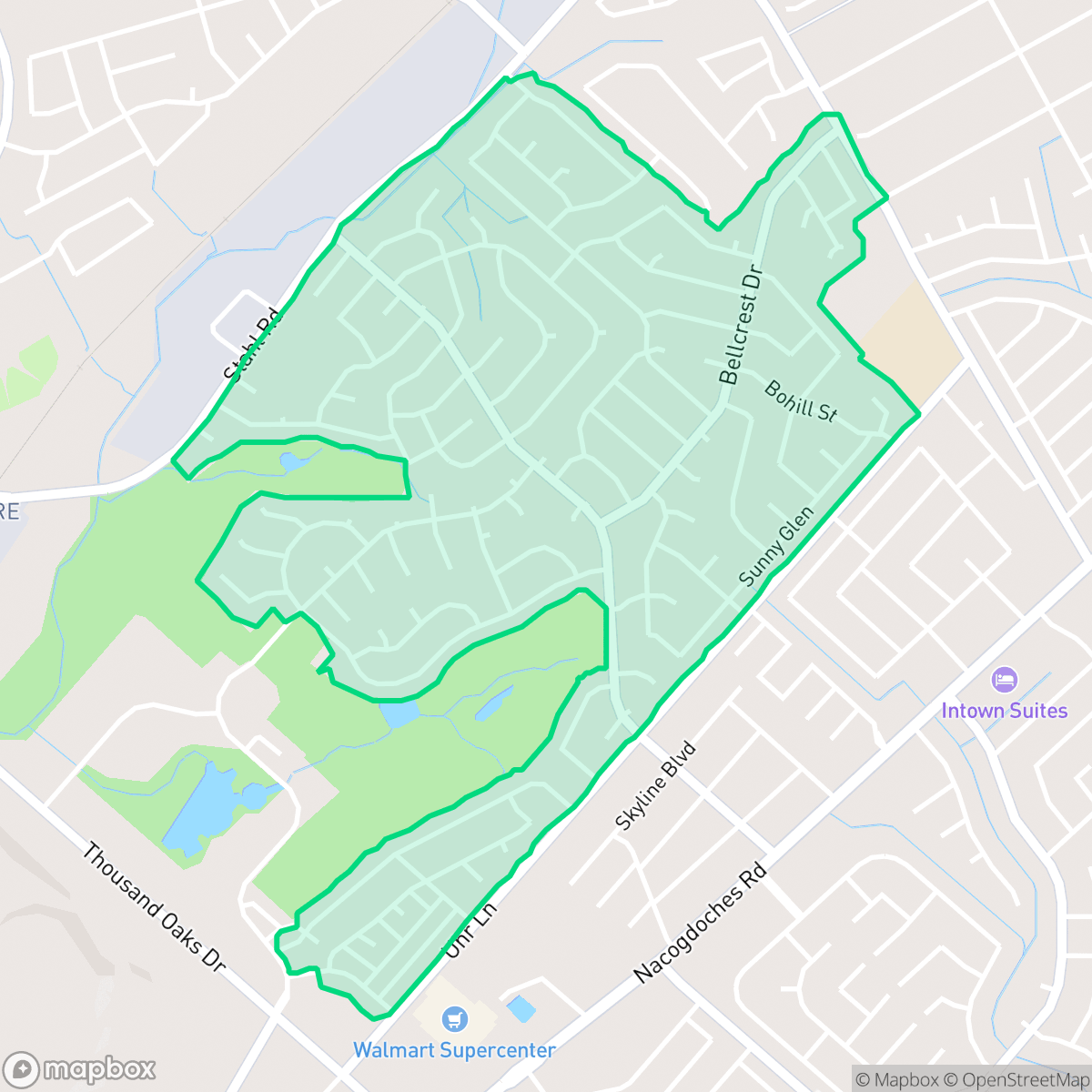
Situated in northeast San Antonio, the Northern Hills neighborhood is deeply tied to Texas history. It is bordered by Nacogdoches Road, which follows the historic El Camino Real de los Tejas trail. In the 1740s, the land served as Rancho Monte Galvan, where vaqueros and mission Indians grazed livestock for the Alamo. Developed primarily in the 1970s and 1980s with traditional ranch-style homes, the suburban community is defined by the Northern Hills Golf Course. Originally a private facility, the course was saved from apartment developers when local residents successfully campaigned for the City of San Antonio to purchase and preserve it as a municipal landmark. Today, the golf course remains the neighborhood's central guidepost and a source of community pride.
The neighborhood offers a stable residential environment marked by its mid-density layout and consistent architectural style. With a strong emphasis on pedestrian access, the community provides a network of sidewalks that connect residents to local green spaces and the central golf course. The area maintains a calm atmosphere, benefiting from moderate noise levels and a significant tree canopy that enhances the local visual appeal. Residents enjoy a sense of privacy in a setting that balances suburban quiet with convenient access to local infrastructure.
Prospective residents will find a car-oriented lifestyle that prioritizes daily convenience and proximity to established amenities. While the area is primarily residential, its inclusion in the North East Independent School District makes it a notable option for families seeking stable educational opportunities. Those considering the neighborhood should note its quiet, suburban nature, which offers high acoustic comfort and a sense of seclusion despite its location near major transit corridors.
Neighborhood Scores Across 15 Qualities
Residential spacing is typical for established suburban tracts, offering a moderate buffer between neighbors that is slightly higher than the San Antonio average. According to iHuus data, houses in some areas are closely packed, though many structures maintain a standard distance from one another.
Low traffic residential streets and dense sidewalk networks offer safe navigation for walkers, which is slightly above the San Antonio average. Some large commercial parking lots may act as barriers to movement in certain parts of the neighborhood.
Spacious properties featuring manicured landscapes and private pools contribute to a visual quality that is above the San Antonio average. According to iHuus data, the presence of large homes and upscale amenities defines much of the neighborhood's landscape.
Access to a large golf course and connected green corridors provides excellent walking space for pets. This neighborhood offers more accessible pet walking routes than the San Antonio average due to its nearby green corridors and sidewalk verges.
Residential pockets feature a mix of single-family homes and apartment complexes situated near commercial strips. This layout is slightly less open than the San Antonio average, according to iHuus data.
A mix of quiet green spaces and active commercial pockets provides a more vibrant atmosphere than the San Antonio average. While certain blocks offer local dining and wellness shops, the area remains largely car-dependent due to the spread of businesses.
Steady sounds from nearby busy streets are present, though acoustic comfort levels remain higher than the San Antonio average according to iHuus data.
Air quality fluctuates between acceptable and unhealthy levels, though conditions are notably better than the San Antonio average according to iHuus data. Sensitive groups should remain aware of occasional periods of concern.
Residential life remains largely undisturbed by heavy industry, though a rail corridor and small storage yards in certain sections may introduce occasional noise. This area maintains a slightly lower level of industrial activity compared to the San Antonio average.
Health insurance coverage rates in this area are higher than the San Antonio average. According to iHuus data, a majority of residents possess medical coverage.
Political leanings in this area are relatively split between conservative and liberal views. This represents a more moderate ideological landscape than the more strongly partisan city average, according to iHuus data.
A balanced mix of young adults, families, and older residents characterizes the area. This demographic distribution is nearly in line with the broader San Antonio average, according to iHuus data.
Flood risk in this area is notably lower than the San Antonio average, though some residual risk remains due to its location within a 500-year floodplain. According to iHuus data, the neighborhood stays primarily outside the most high-risk flood zones.
Address-Level Insights for Northern Hills


iHuus Neighborhood Intelligence Insights
Get address-level neighborhood insights for Northern Hills
- Street-level scores — see how individual blocks compare, not just neighborhood averages
- Micro-zone boundaries — identify quiet pockets, flood boundaries, and walkable clusters before you visit
- 15 dimensions in full — walkability, noise, air quality, school quality, insurance coverage, population age profile, urban/rural index, and more
- Boundary risk alerts — know if your address sits near a block boundary where scores drop, the kind of detail no listing will ever mention
- School insights — individual school ratings and insights, not just district-level data
- Compare before you commit — side-by-side data across neighborhoods, down to block precision
No credit card required
Compare with Any Neighborhood
| Dimension | Northern Hills | 145 Association |
|---|---|---|
| 🚶 Walkabilityavg 6.44 | ||
| 🔊 Acoustic Comfortavg 4.07 | ||
| 🤫 Privacy Indexavg 5.75 | ||
| 🎨 Visual Appealavg 6.11 | ||
| 🐕 Dog Friendlinessavg 5.91 | ||
| 🗺️ Urban-Rural Indexavg 6.87 | ||
| ✨ Neighborhood Vibeavg 4.35 | ||
| 🏥 Health Insurance Coverageavg 5.94 | ||
| 🌿 Air Qualityavg 2.27 | ||
| 🏭 Industrial Proximityavg 8.31 | ||
| 🌊 Flood Safetyavg 4.2 | ||
| 🗳️ Ideological Leanavg 7.37 | ||
| 👥 Population Age Profileavg 4.68 | ||
| 🔥 Fire Safety | ||
| 🏫 School Quality |
Northern Hills Rankings
School Districts Serving Northern Hills
School Insights for Northern Hills
Below average outcomes; significant attendance and academic challenges.
School Insights
See what's really behind every school rating near Northern Hills
- Individual school ratings — each school's own score with outcome context, not just a district average
- Enrollment & class size data — student-to-teacher ratio and how it compares to the state average
- Full demographics breakdown — ethnicity and gender composition for every school in the enrollment zone
- Every school in the district — all schools within the enrollment boundary ranked by rating, not just the closest one
- Grade levels & benchmarks — elementary through high school, with below/above state-average flags
No credit card required