Monte Vista, San Antonio
Updated · 5,555 residents
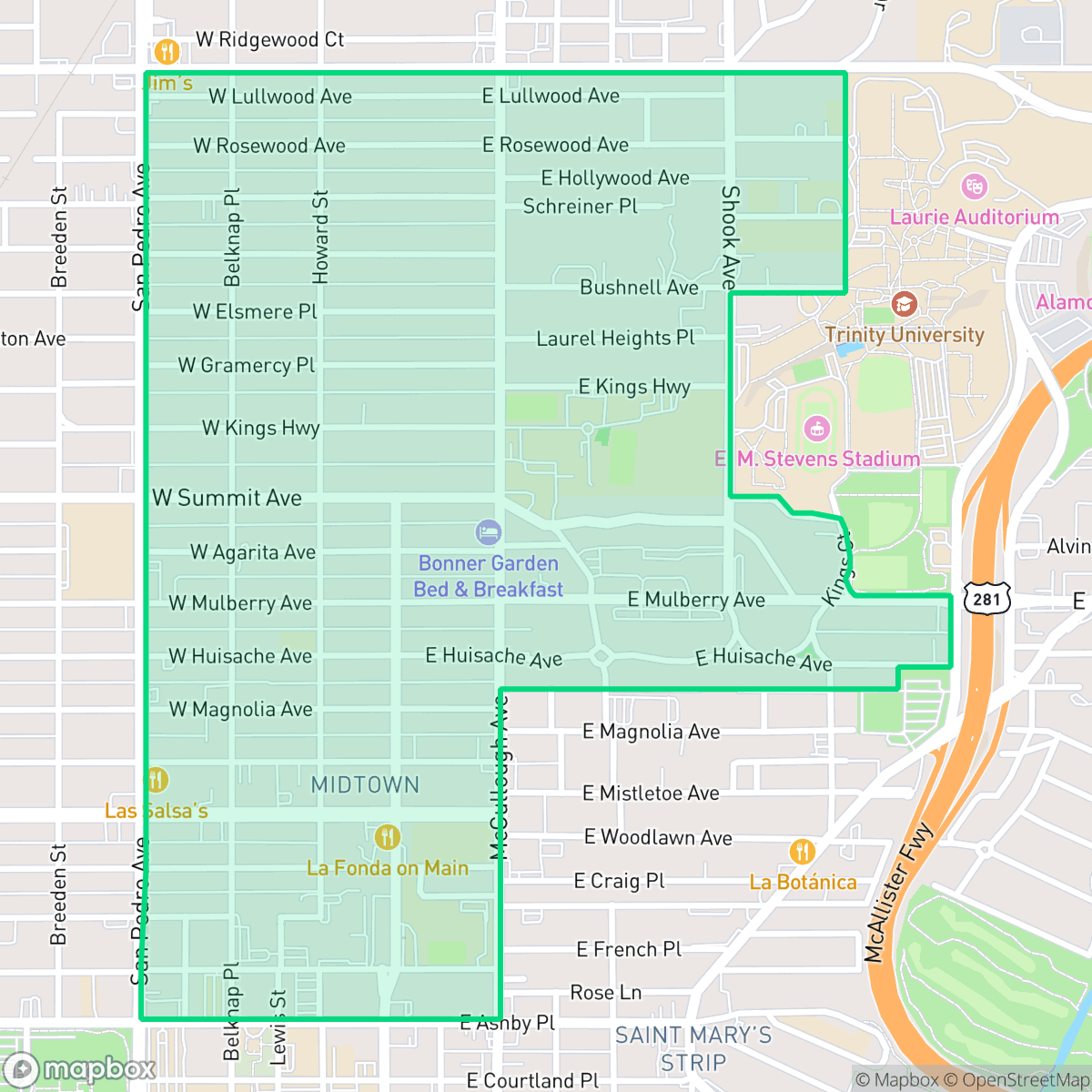
Monte Vista is a highly walkable neighborhood defined by its historic grid layout, mature tree canopy, and affluent residential character. It offers a calm, urban atmosphere with convenient access to local dining and institutional landmarks, though residents should note the limited public green space.
Key Highlights
About Monte Vista
Developed starting in 1889 on former goat pasture north of downtown San Antonio, Monte Vista blossomed during the city's "Gilded Age" (1890–1930). Prominent oilmen and cattle barons built grand estates along Kings Highway, known as the "Avenue of the Cattle Barons". The neighborhood boasts an eclectic mix of architectural styles—including Georgian Revival, Spanish Eclectic, Tudor, and Victorian—crafted by renowned architects like Atlee B. Ayres and J. Riely Gordon. Notable residents included Congressman Maury Maverick. Key landmarks include the eight-story Bushnell Apartments and the 1928 Mediterranean-style Landa Library, which was donated to the city in 1946. To protect these historic structures from demolition, residents organized to secure local historic district designation in 1975.
The neighborhood maintains a distinct urban identity characterized by a dense, low-rise grid and high walkability. Residents benefit from a quiet, residential environment free from industrial hazards, with local social hubs such as La Fonda on Main and Barbaro providing diverse dining options. According to data, the area is noted for its visual appeal, featuring large homes and well-maintained landscaping that contribute to a stable and affluent atmosphere. The infrastructure supports pedestrian activity, with consistent sidewalks and shaded streets that connect the community to its various institutional and social anchors.
Living in this area involves balancing high walkability and strong health insurance coverage against specific trade-offs, such as moderate road traffic noise and a reliance on private yards for outdoor space. Prospective residents should consider the educational landscape, which includes both the local San Antonio Independent School District and the higher-rated Great Hearts Monte Vista North charter school. While the neighborhood provides a peaceful living environment with excellent proximity to local amenities, the overall experience is best suited for those who value architectural heritage and a central, pedestrian-friendly urban location.
Neighborhood Scores Across 15 Qualities
Residential spacing is slightly higher than the San Antonio average, providing a modest buffer between homes through mature trees and fencing. While some houses are closely packed, most structures maintain a standard suburban distance from one another.
Pedestrian navigation is easy due to a consistent grid system and mature tree canopy that provides shade. Sidewalks and safe crossings are much more prevalent here than across the rest of San Antonio.
Mature tree canopies and large, well-maintained homes create a visually pleasing environment that sits above the San Antonio average. According to iHuus data, the presence of private pools and expansive landscaping contributes to an upscale aesthetic throughout much of the area.
Large public parks and sports fields provide ample space for exercise, offering a higher level of dog friendliness than the San Antonio average. Wide green verges between sidewalks and roads offer additional safe walking areas throughout most residential blocks.
Residential blocks feature a dense low-rise grid with a significant tree canopy and scattered institutional buildings. This setting is slightly more developed than the San Antonio average, providing a mix of single-family homes and low-density urban structures.
Social activity is noticeably higher than the San Antonio average, characterized by a diverse concentration of local eateries and community landmarks. While many blocks remain calm and suburban, several pockets feature lively clusters of cafes and dining establishments near transit corridors.
Steady traffic sounds from nearby busy streets are present, though levels remain more tranquil than the San Antonio average. According to iHuus data, the area experiences a consistent but manageable hum from local transit.
Frequent unhealthy air quality levels pose a significant risk to sensitive groups. According to iHuus data, the air quality in Monte Vista is slightly worse than the San Antonio average.
Residential and institutional land uses dominate this area, with no visible warehouses or heavy industrial hazards detected. This lack of industrial activity is even more pronounced than the average for San Antonio, according to iHuus data.
Health insurance access among residents is notably higher than the San Antonio average, according to iHuus data.
Voting patterns and census indicators show a predominantly liberal leaning, which is significantly more pronounced here than the San Antonio average.
A varied demographic of young adults, families, and seniors creates a balanced age profile that is largely consistent with the San Antonio average. According to iHuus data, no single age group dominates the residential landscape.
Flood risk in this area remains uncertain because official FEMA studies are not yet complete. This level of risk appears slightly higher than the average for San Antonio, according to iHuus data.
Address-Level Insights for Monte Vista


iHuus Neighborhood Intelligence Insights
Get address-level neighborhood insights for Monte Vista
- Street-level scores — see how individual blocks compare, not just neighborhood averages
- Micro-zone boundaries — identify quiet pockets, flood boundaries, and walkable clusters before you visit
- 15 dimensions in full — walkability, noise, air quality, school quality, insurance coverage, population age profile, urban/rural index, and more
- Boundary risk alerts — know if your address sits near a block boundary where scores drop, the kind of detail no listing will ever mention
- School insights — individual school ratings and insights, not just district-level data
- Compare before you commit — side-by-side data across neighborhoods, down to block precision
No credit card required
Compare with Any Neighborhood
| Dimension | Monte Vista | 145 Association |
|---|---|---|
| 🚶 Walkabilityavg 6.44 | ||
| 🔊 Acoustic Comfortavg 4.07 | ||
| 🤫 Privacy Indexavg 5.75 | ||
| 🎨 Visual Appealavg 6.11 | ||
| 🐕 Dog Friendlinessavg 5.91 | ||
| 🗺️ Urban-Rural Indexavg 6.87 | ||
| ✨ Neighborhood Vibeavg 4.35 | ||
| 🏥 Health Insurance Coverageavg 5.94 | ||
| 🌿 Air Qualityavg 2.27 | ||
| 🏭 Industrial Proximityavg 8.31 | ||
| 🌊 Flood Safetyavg 4.2 | ||
| 🗳️ Ideological Leanavg 7.37 | ||
| 👥 Population Age Profileavg 4.68 | ||
| 🔥 Fire Safety | ||
| 🏫 School Quality |
Monte Vista Rankings
School Districts Serving Monte Vista
School Insights for Monte Vista
Below average outcomes; significant attendance and academic challenges.
School Insights
See what's really behind every school rating near Monte Vista
- Individual school ratings — each school's own score with outcome context, not just a district average
- Enrollment & class size data — student-to-teacher ratio and how it compares to the state average
- Full demographics breakdown — ethnicity and gender composition for every school in the enrollment zone
- Every school in the district — all schools within the enrollment boundary ranked by rating, not just the closest one
- Grade levels & benchmarks — elementary through high school, with below/above state-average flags
No credit card required