Mission San Jose, San Antonio
Updated · 5,914 residents
Mission San Jose is a culturally rich South Side neighborhood defined by its namesake UNESCO World Heritage Site and a blend of residential and light industrial zones. While the area offers a quiet, suburban atmosphere with diverse local dining, residents should expect a car-dependent lifestyle due to limited pedestrian infrastructure.
Key Highlights
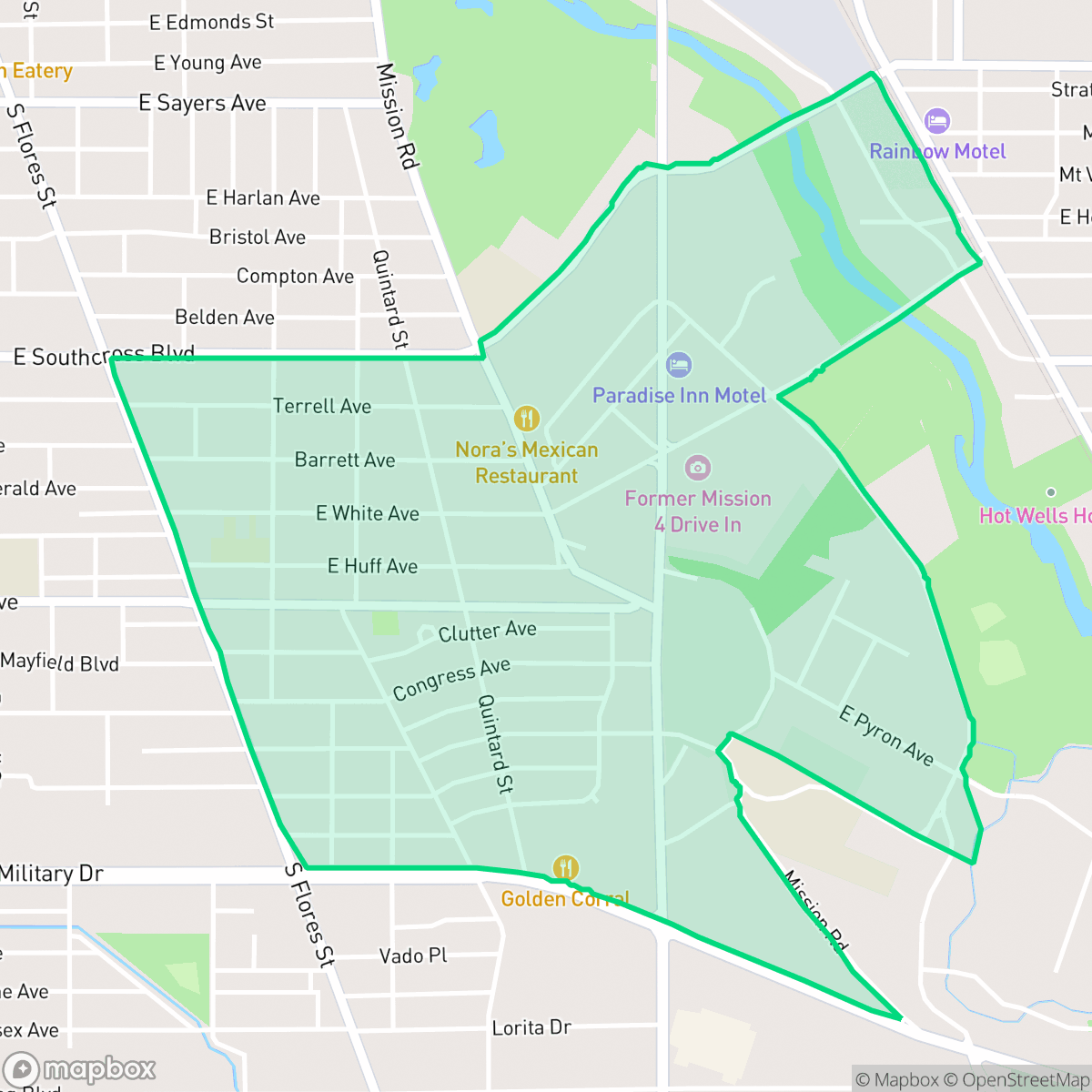
About Mission San Jose
Located on San Antonio’s South Side, the Mission San Jose neighborhood is anchored by Mission San José y San Miguel de Aguayo, founded in 1720 by Franciscan Father Antonio Margil de Jesús. Known as the “Queen of the Missions,” this UNESCO World Heritage Site features stunning Spanish Colonial Baroque architecture, including a church completed in 1782 and the famous Rose Window. During the 1930s, the Works Progress Administration (WPA) restored the complex, which includes Texas’s oldest gristmill. The neighborhood’s cultural identity is deeply rooted in its multi-generational families and community spaces like the Mission Marquee Plaza. Originally opened in 1948 as the Mission Drive-In Theatre—the city's last drive-in to close—the plaza was revitalized in 2014 and now serves as a vibrant public hub for open-air markets, festivals, and outdoor film screenings.
The neighborhood functions as a dense suburban grid where single-story homes sit alongside light industrial blocks. It maintains a distinct identity through its mix of long-standing family residences and accessible local eateries such as Lupita's Cafe and Bar-B-Q Republic. According to iHuus data, the area provides a calm environment, though it is characterized by road traffic noise and a reliance on vehicle travel to reach daily amenities. The layout reflects a mix of residential life and active commercial daytime traffic, creating a unique, albeit industrial-adjacent, suburban character.
Prospective residents should consider the specific trade-offs of living in this sector. While the community benefits from proximity to green corridors and historic landmarks, the infrastructure presents challenges for those seeking high walkability. The area is best suited for individuals who prioritize a suburban, community-focused lifestyle and are comfortable with a car-dependent environment, as the current grid and industrial proximity make it less conducive to pedestrian-only living.
Neighborhood Scores Across 15 Qualities
Residential spacing is slightly higher than the San Antonio average, offering a balance between closely packed homes and open riparian corridors. Some areas feature narrow side yards, but overall there is a moderate buffer between neighbors.
Quiet residential streets allow for low-speed walking, though the lack of consistent sidewalks makes the area slightly less walkable than the San Antonio average. According to iHuus data, pedestrian infrastructure is particularly sparse near the larger industrial zones.
Modest tract housing and older mobile homes define the landscape, which offers less visual variety than the San Antonio average. According to iHuus data, the area features simple roof geometries and dense residential lots with few luxury amenities or private pools.
Public green space is concentrated near river-adjacent trails, though many residential streets lack wide verges or accessible parks. This area is slightly below the San Antonio average for dog-friendly outdoor infrastructure, as much of the neighborhood's greenery is contained within private yards.
Residential street grids and industrial blocks combine with scattered open land to create a landscape that is slightly less rural than the San Antonio average. According to iHuus data, the area features a blend of dense single-family housing and larger commercial spaces.
Steady activity from local dining and light industrial pockets provides a calm atmosphere that is slightly more active than the San Antonio average. While various eateries and parks are present, the area remains largely car-dependent due to the low-density, suburban street layout.
Local traffic from nearby busy streets creates a steady hum of sound. According to iHuus data, acoustic levels here are notably higher than the San Antonio average.
Frequent unhealthy AQI levels pose a significant risk to sensitive groups. According to iHuus data, air quality in Mission San Jose is slightly worse than the San Antonio average.
Residential tranquility prevails due to the absence of heavy manufacturing or large-scale warehouses. According to iHuus data, the area has slightly more industrial activity than the San Antonio average, though it remains primarily composed of homes and light commercial services.
Health insurance coverage among residents is lower than the San Antonio average, according to iHuus data. This indicates a higher proportion of uninsured individuals compared to many other parts of the city.
Voting patterns and census indicators show a strong liberal leaning that is more pronounced than the San Antonio average. According to iHuus data, the political landscape here aligns more closely with progressive-leaning districts.
Residents live alongside a balanced variety of young adults, families, and older populations. This age distribution is roughly in line with the San Antonio average, according to iHuus data.
Flood vulnerability is significantly higher here than the San Antonio average, as much of the area sits within designated floodplains. Residents should be aware that flood insurance is typically required for properties in this neighborhood according to iHuus data.
Address-Level Insights for Mission San Jose


iHuus Neighborhood Intelligence Insights
Get address-level neighborhood insights for Mission San Jose
- Street-level scores — see how individual blocks compare, not just neighborhood averages
- Micro-zone boundaries — identify quiet pockets, flood boundaries, and walkable clusters before you visit
- 15 dimensions in full — walkability, noise, air quality, school quality, insurance coverage, population age profile, urban/rural index, and more
- Boundary risk alerts — know if your address sits near a block boundary where scores drop, the kind of detail no listing will ever mention
- School insights — individual school ratings and insights, not just district-level data
- Compare before you commit — side-by-side data across neighborhoods, down to block precision
No credit card required
Compare with Any Neighborhood
| Dimension | Mission San Jose | 145 Association |
|---|---|---|
| 🚶 Walkabilityavg 6.44 | ||
| 🔊 Acoustic Comfortavg 4.07 | ||
| 🤫 Privacy Indexavg 5.75 | ||
| 🎨 Visual Appealavg 6.11 | ||
| 🐕 Dog Friendlinessavg 5.91 | ||
| 🗺️ Urban-Rural Indexavg 6.87 | ||
| ✨ Neighborhood Vibeavg 4.35 | ||
| 🏥 Health Insurance Coverageavg 5.94 | ||
| 🌿 Air Qualityavg 2.27 | ||
| 🏭 Industrial Proximityavg 8.31 | ||
| 🌊 Flood Safetyavg 4.2 | ||
| 🗳️ Ideological Leanavg 7.37 | ||
| 👥 Population Age Profileavg 4.68 | ||
| 🔥 Fire Safety | ||
| 🏫 School Quality |
Mission San Jose Rankings
School Districts Serving Mission San Jose
School Insights for Mission San Jose
Below average outcomes; significant attendance and academic challenges.
School Insights
See what's really behind every school rating near Mission San Jose
- Individual school ratings — each school's own score with outcome context, not just a district average
- Enrollment & class size data — student-to-teacher ratio and how it compares to the state average
- Full demographics breakdown — ethnicity and gender composition for every school in the enrollment zone
- Every school in the district — all schools within the enrollment boundary ranked by rating, not just the closest one
- Grade levels & benchmarks — elementary through high school, with below/above state-average flags
No credit card required