Mahncke Park, San Antonio
Updated · 3,726 residents
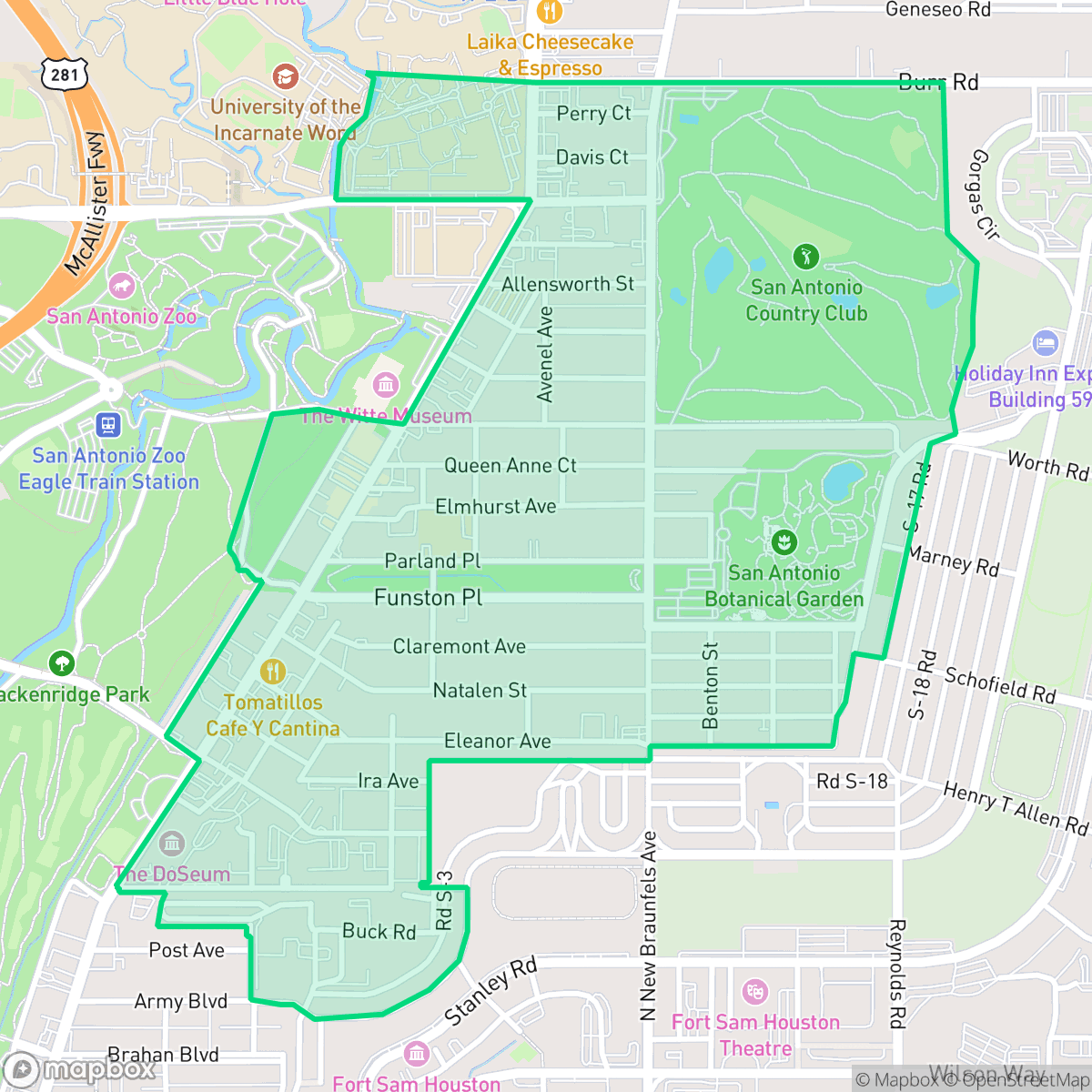
Mahncke Park is a highly walkable and exceptionally dog-friendly neighborhood located in the heart of Midtown San Antonio. Residents enjoy a blend of historic residential architecture and convenient access to cultural landmarks like the San Antonio Botanical Garden and The Doseum.
Key Highlights
About Mahncke Park
Mahncke Park, located in Midtown San Antonio, has its origins in the 19th-century holdings of the privately owned Water Works Company, managed by philanthropist George W. Brackenridge. In 1905, Brackenridge donated 25 acres of this land to the city, requesting it be named after his close friend and San Antonio's first paid parks commissioner, Ludwig Mahncke. A bronze bust of Mahncke, sculpted by Pompeo Coppini, stands at the park's entrance on Broadway. Built up primarily between the 1920s and 1950s, the surrounding residential neighborhood features an eclectic mix of American Foursquare, Tudor, and Mission-style bungalows, alongside post-war ranch homes. In 1983, Mahncke Park made history as the first San Antonio neighborhood to have its Master Plan formally adopted by the City Council, and it remains protected today under a Neighborhood Conservation District zoning overlay.
The neighborhood maintains a distinct residential character defined by its quiet, tree-lined streets and proximity to major city amenities. With high marks for walkability, residents can easily access diverse dining options along Broadway, including local favorites like Smoke Shack and Commonwealth Coffeehouse. The area is characterized by its lack of industrial activity, providing a peaceful environment that is well-suited for those who prioritize community access and outdoor leisure. According to iHuus data, the area benefits from high levels of health insurance coverage, reflecting a stable and established population base.
Prospective residents should consider a few livability trade-offs, including moderate noise levels primarily driven by road traffic and a relatively high flood risk compared to the city average. While the neighborhood offers an excellent quality of life, the acoustic environment and environmental safety are important factors to evaluate. Families may find the proximity to highly rated districts like Alamo Heights Independent School District and Fort Sam Houston Independent School District to be a significant advantage, though they should carefully verify specific school zoning as the area is also served by the San Antonio Independent School District.
Neighborhood Scores Across 15 Qualities
Residential spacing provides a moderate level of separation between neighbors, which is slightly higher than the San Antonio average according to iHuus data.
Sidewalks and safe crossings are widely available, making pedestrian travel much more accessible here than in the rest of San Antonio. Most local trips can be completed safely on foot according to iHuus data.
Large homes and frequent upscale amenities contribute to a visual landscape that is more polished than the San Antonio average. Spatially, the area features expansive driveways and well-maintained properties according to iHuus data.
Extensive parklands, trails, and open green spaces make this area exceptionally well suited for dog owners. This level of accessibility to outdoor recreation is significantly higher than the San Antonio average, according to iHuus data.
Frequent open land and scattered homes amidst woodlands characterize this area. This landscape is slightly more developed than the city average, providing a balance between nature and residential density according to iHuus data.
Suburban streets and green spaces provide a steady but low-key atmosphere with a slightly higher level of activity than the San Antonio average. Residents can access a moderate variety of local dining and essential services, though many businesses are situated within a short drive rather than immediate walking distance.
Steady traffic sounds from nearby busy streets are present, though acoustic comfort remains higher than the San Antonio average according to iHuus data.
Frequent unhealthy air quality levels pose significant risks to sensitive groups; this neighborhood experiences worse air quality than the San Antonio average, according to iHuus data.
No warehouses, industrial facilities, or hazard sites are present within the neighborhood. This area is significantly more free of industrial activity than the San Antonio average, consisting entirely of residential and light commercial spaces.
Health insurance access is exceptionally high among residents, significantly surpassing the San Antonio average according to iHuus data.
Political leanings in this area trend slightly more liberal than the San Antonio average. According to iHuus data, the community maintains a liberal majority with a modest presence of opposing views.
A diverse mix of young adults, families, and seniors resides here. According to iHuus data, the population is slightly more concentrated with specific age groups compared to the broader San Antonio area.
Significant flood hazards and potential for wave action exist in this area, which is much higher than the San Antonio average. According to iHuus data, residents should prepare for elevated or potentially prohibitive flood insurance costs.
Address-Level Insights for Mahncke Park


iHuus Neighborhood Intelligence Insights
Get address-level neighborhood insights for Mahncke Park
- Street-level scores — see how individual blocks compare, not just neighborhood averages
- Micro-zone boundaries — identify quiet pockets, flood boundaries, and walkable clusters before you visit
- 15 dimensions in full — walkability, noise, air quality, school quality, insurance coverage, population age profile, urban/rural index, and more
- Boundary risk alerts — know if your address sits near a block boundary where scores drop, the kind of detail no listing will ever mention
- School insights — individual school ratings and insights, not just district-level data
- Compare before you commit — side-by-side data across neighborhoods, down to block precision
No credit card required
Compare with Any Neighborhood
| Dimension | Mahncke Park | 145 Association |
|---|---|---|
| 🚶 Walkabilityavg 6.44 | ||
| 🔊 Acoustic Comfortavg 4.07 | ||
| 🤫 Privacy Indexavg 5.75 | ||
| 🎨 Visual Appealavg 6.11 | ||
| 🐕 Dog Friendlinessavg 5.91 | ||
| 🗺️ Urban-Rural Indexavg 6.87 | ||
| ✨ Neighborhood Vibeavg 4.35 | ||
| 🏥 Health Insurance Coverageavg 5.94 | ||
| 🌿 Air Qualityavg 2.27 | ||
| 🏭 Industrial Proximityavg 8.31 | ||
| 🌊 Flood Safetyavg 4.2 | ||
| 🗳️ Ideological Leanavg 7.37 | ||
| 👥 Population Age Profileavg 4.68 | ||
| 🔥 Fire Safety | ||
| 🏫 School Quality |
Mahncke Park Rankings
School Districts Serving Mahncke Park
School Insights for Mahncke Park
Below average outcomes; significant attendance and academic challenges.
School Insights
See what's really behind every school rating near Mahncke Park
- Individual school ratings — each school's own score with outcome context, not just a district average
- Enrollment & class size data — student-to-teacher ratio and how it compares to the state average
- Full demographics breakdown — ethnicity and gender composition for every school in the enrollment zone
- Every school in the district — all schools within the enrollment boundary ranked by rating, not just the closest one
- Grade levels & benchmarks — elementary through high school, with below/above state-average flags
No credit card required