Los Jardines, San Antonio
Updated · 4,416 residents
Los Jardines is a quiet, low-density residential community in west San Antonio defined by its mid-century housing and strong Mexican-American cultural identity. While the area offers a peaceful acoustic environment, residents face challenges with limited pedestrian infrastructure and significant flood risk.
Key Highlights
About Los Jardines
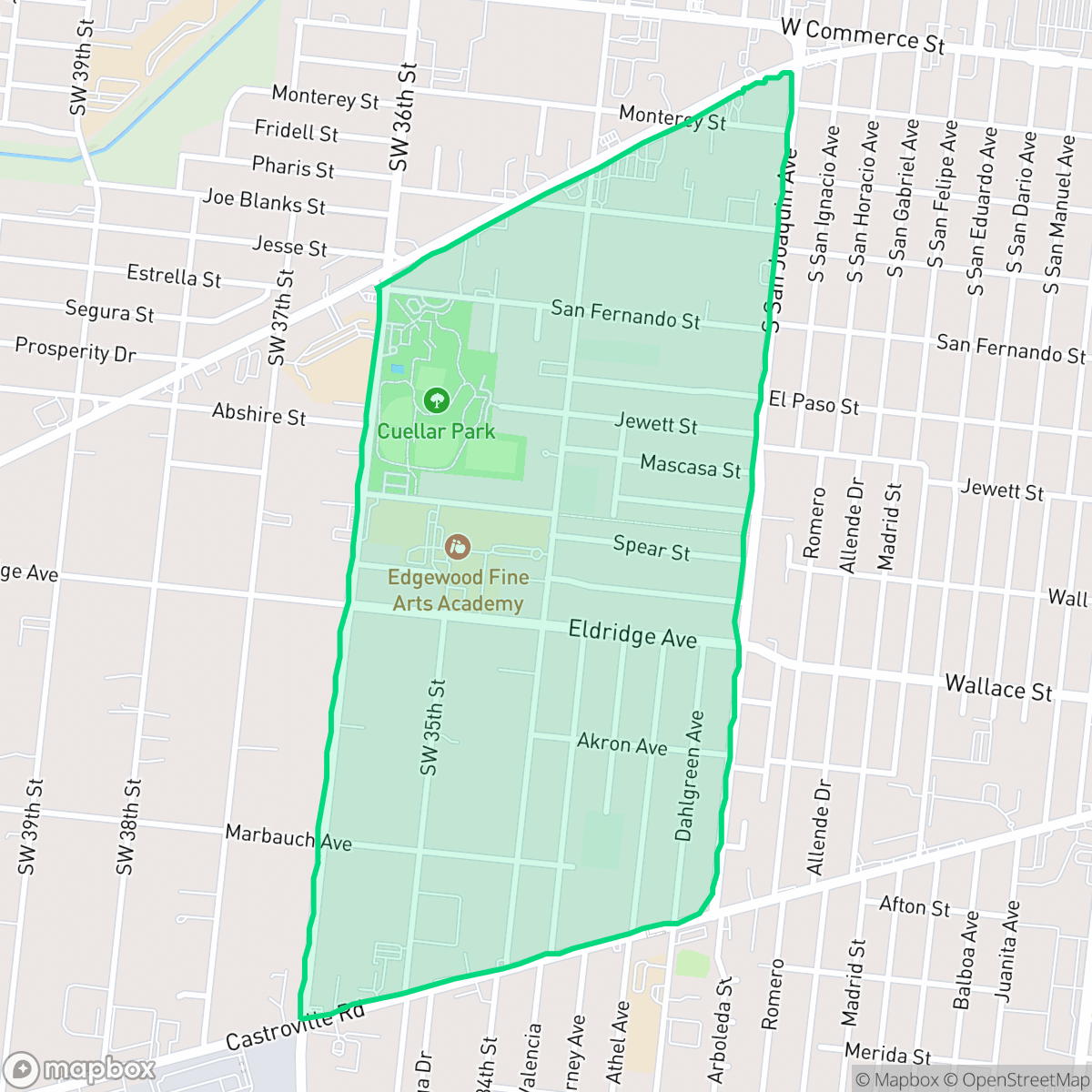
Located in west San Antonio, the Los Jardines neighborhood originated in July 1908 when J. C. Clapton requested to subdivide the land into a 32-block farming community. The neighborhood’s name, meaning "The Gardens," reflects the agricultural fields and farmhouses that remained active in the area well into the 1950s. Bounded by Old Highway 90 and Castroville Road, the area transitioned into a residential community starting in the 1940s. Its mid-century housing stock, built primarily between 1940 and 1969, grew alongside the nearby Kelly and Lackland Air Force Bases. Today, Los Jardines maintains a strong Mexican-American cultural identity. At its heart lies Cuellar Park and Community Center on Southwest 36th Street, serving as a vital gathering space for local families and community-led initiatives.
The area maintains a suburban feel with a mix of single-family homes and open spaces. Local amenities such as Mario's Bakery and China Express provide essential services, while Cuellar Park serves as a central hub for outdoor recreation and community gatherings. The neighborhood is characterized by a low-density urban layout that transitions into semi-rural pockets, offering a calm atmosphere despite the lack of consistent sidewalk connectivity. Prospective residents should consider the trade-offs of living in this part of the city. While the neighborhood is free from heavy industrial hazards and maintains a quiet noise profile, it faces notable environmental challenges, including poor air quality and a high risk of flooding. Educational options within the Edgewood Independent School District are inconsistent, though specialized programs like the STEAM Fine Arts Academy offer higher-rated alternatives. According to iHuus data, the area is well-suited for those prioritizing a low-density, quiet environment over high-walkability or proximity to modern urban infrastructure.
Neighborhood Scores Across 15 Qualities
Residential spacing is slightly higher than the San Antonio average, offering a mix of closely packed mid-century lots and areas with more significant distance between structures. According to iHuus data, the neighborhood provides a moderate level of buffer between neighbors.
Quiet residential streets provide a calm environment for walking, but the lack of continuous sidewalks and presence of dirt shoulders make pedestrian travel more difficult than the San Antonio average.
Dense housing layouts and modest lot sizes create a utilitarian landscape with limited greenery or private amenities. This lack of aesthetic variety and visible upkeep is notably lower than the San Antonio average, according to iHuus data.
Publicly accessible green space for pets is below the San Antonio average, as much of the area's greenery is confined to private backyards. While some sections offer access to large parks with baseball fields, many parts of the neighborhood lack sidewalks and public park proximity.
Land use here varies from dense suburban grids to low-density areas featuring large unbuilt lots and scattered woodland. This landscape aligns with the overall urban-rural balance found across San Antonio.
Residential life and local dining establishments maintain a consistent but low-density pace, mirroring the city average for activity levels. While various eateries and churches provide a steady presence, much of the area remains car-dependent with scattered industrial and suburban pockets.
Steady hum from nearby busy streets characterizes the area, though acoustic levels remain notably calmer than the San Antonio average.
Frequent unhealthy air quality levels pose significant risks to sensitive groups. According to iHuus data, the air quality in this area is slightly worse than the San Antonio average.
Minimal heavy industry is present, though some light commercial and storage areas exist near the western edge. This area maintains a lower concentration of industrial activity compared to the San Antonio average, according to iHuus data.
Health insurance coverage is significantly lower than the San Antonio average, according to iHuus data. Residents in this area may face greater challenges accessing employer-sponsored or private medical coverage.
Voting patterns and census indicators reflect a significantly more liberal political leaning than the San Antonio average, according to iHuus data.
Residents live alongside a balanced mix of young adults, families, and seniors. This demographic spread is very similar to the broader San Antonio area according to iHuus data.
Significant flood hazards exist here, which is much higher than the San Antonio average. Residents should expect elevated insurance costs and potential risks from wave action according to iHuus data.
Address-Level Insights for Los Jardines


iHuus Neighborhood Intelligence Insights
Get address-level neighborhood insights for Los Jardines
- Street-level scores — see how individual blocks compare, not just neighborhood averages
- Micro-zone boundaries — identify quiet pockets, flood boundaries, and walkable clusters before you visit
- 15 dimensions in full — walkability, noise, air quality, school quality, insurance coverage, population age profile, urban/rural index, and more
- Boundary risk alerts — know if your address sits near a block boundary where scores drop, the kind of detail no listing will ever mention
- School insights — individual school ratings and insights, not just district-level data
- Compare before you commit — side-by-side data across neighborhoods, down to block precision
No credit card required
Compare with Any Neighborhood
| Dimension | Los Jardines | 145 Association |
|---|---|---|
| 🚶 Walkabilityavg 6.44 | ||
| 🔊 Acoustic Comfortavg 4.07 | ||
| 🤫 Privacy Indexavg 5.75 | ||
| 🎨 Visual Appealavg 6.11 | ||
| 🐕 Dog Friendlinessavg 5.91 | ||
| 🗺️ Urban-Rural Indexavg 6.87 | ||
| ✨ Neighborhood Vibeavg 4.35 | ||
| 🏥 Health Insurance Coverageavg 5.94 | ||
| 🌿 Air Qualityavg 2.27 | ||
| 🏭 Industrial Proximityavg 8.31 | ||
| 🌊 Flood Safetyavg 4.2 | ||
| 🗳️ Ideological Leanavg 7.37 | ||
| 👥 Population Age Profileavg 4.68 | ||
| 🔥 Fire Safety | ||
| 🏫 School Quality |
Los Jardines Rankings
School Districts Serving Los Jardines
School Insights for Los Jardines
Below average outcomes; significant attendance and academic challenges.
School Insights
See what's really behind every school rating near Los Jardines
- Individual school ratings — each school's own score with outcome context, not just a district average
- Enrollment & class size data — student-to-teacher ratio and how it compares to the state average
- Full demographics breakdown — ethnicity and gender composition for every school in the enrollment zone
- Every school in the district — all schools within the enrollment boundary ranked by rating, not just the closest one
- Grade levels & benchmarks — elementary through high school, with below/above state-average flags
No credit card required