Longs Creek, San Antonio
Updated · 4,101 residents
Longs Creek is a quiet, affluent suburban community in northeast San Antonio characterized by modern single-family homes and abundant private backyard pools. Residents benefit from high levels of health insurance coverage and a peaceful residential atmosphere, while remaining conveniently positioned near major highway corridors for regional access.
Key Highlights
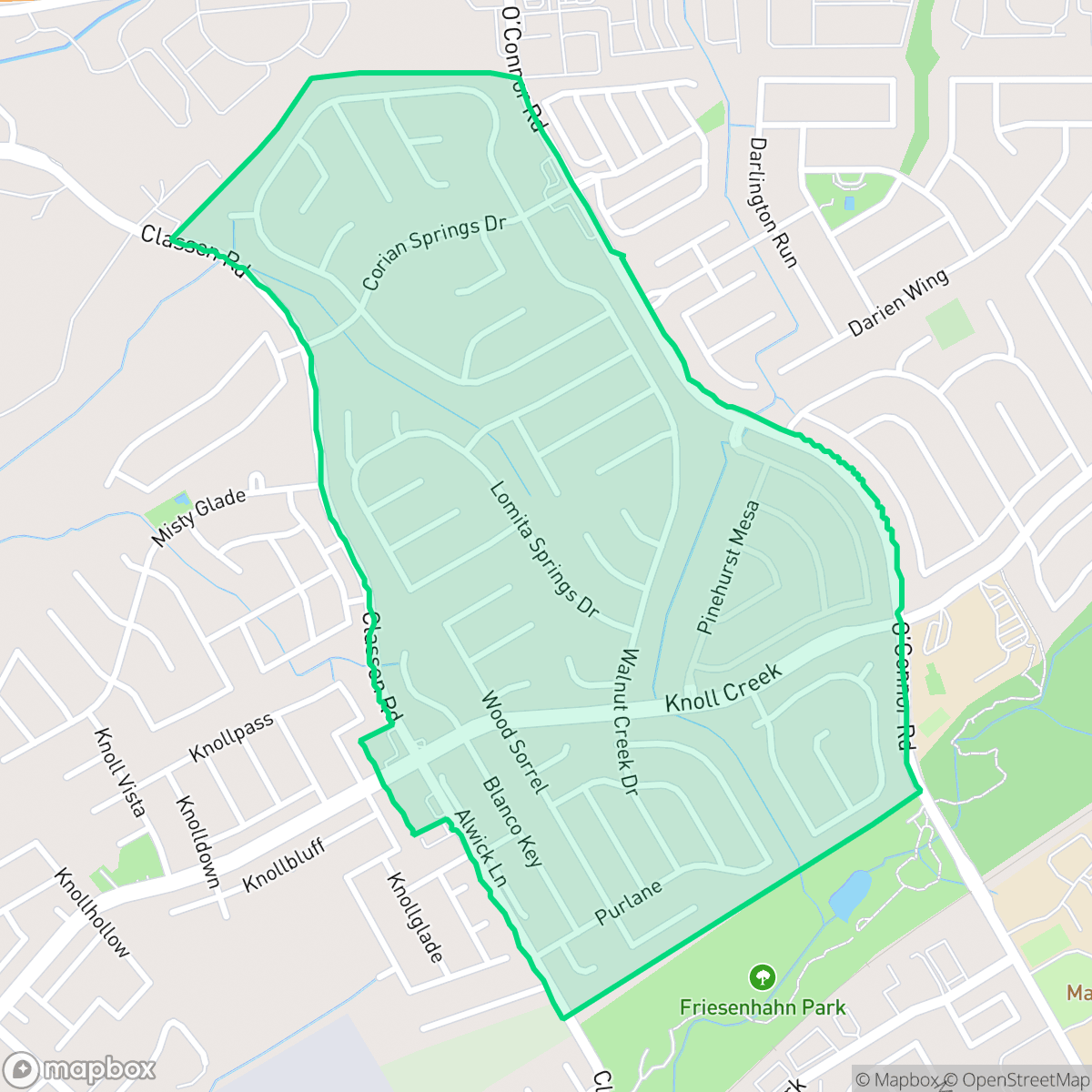
About Longs Creek
Developed primarily between 1991 and 2006, the Longs Creek neighborhood in northeast San Antonio is characterized by modern single-family homes. However, the community retains a deep connection to its late 19th-century agricultural roots through the preservation of the Alig-Tampke House. Built around 1880 for Bavarian immigrants Benedict and Catherine Alig, this single-story, vernacular stone, salt-box style residence originally anchored a 160-acre ranch. The property was later managed by the Tampke family, who continued ranching the land until the mid-1960s. In 2020, the Alig-Tampke House was designated a San Antonio Historic Landmark. Today, the historic ranch house and its low-stacked stone walls are preserved and maintained by the Longs Creek Homeowners Association, serving as a unique historical centerpiece within the suburban development.
The area offers a classic suburban experience defined by its well-maintained, detached single-family residences and significant tree cover. With a strong focus on residential stability, the neighborhood maintains a calm environment that ranks well for acoustic comfort. The proximity to major thoroughfares provides residents with efficient transit options, balancing the quiet, suburban lifestyle with easy access to the broader amenities of San Antonio.
Families and professionals are drawn to the area for its high health insurance coverage and access to the North East Independent School District, which is recognized for its strong academic and extracurricular programs. While the neighborhood is not highly walkable, its green verges and suburban streets provide adequate space for dog owners and pedestrians. It is best suited for those seeking a stable, visually appealing community with a focus on private home life and reliable access to city resources.
Neighborhood Scores Across 15 Qualities
Detached homes feature moderate setbacks and side-yard spacing that offer slightly more separation than the San Antonio average. According to iHuus data, residents can expect a balanced amount of buffer between neighboring structures.
Low-traffic streets and consistent sidewalks make for a safe walking environment. This neighborhood offers better walkability than the San Antonio average, though some paths are partially obscured by the local tree canopy.
Large homes with complex rooflines and private pools characterize this area, making the visual landscape significantly more polished than the San Antonio average. According to iHuus data, the presence of well-maintained lots and expansive driveways contributes to a high level of aesthetic appeal.
Continuous green belts and wide lawns provide ample space for exercise, while green verges between sidewalks and roads offer safe walking paths that are notably more accessible than the San Antonio average.
Open land and woodland patches provide a sense of space, though this area is slightly less rural than the San Antonio average. Residential pockets of mature tree canopy transition into industrial zones and highway corridors near the neighborhood edges.
Residential life here is characterized by a calm, car-oriented atmosphere with limited access to walkable shops or services. Most areas consist of quiet streets and green spaces, presenting a level of activity that is roughly in line with the San Antonio average.
Audible noise from nearby busy streets creates a moderate acoustic environment. According to iHuus data, this level of activity is notably higher than the average found throughout San Antonio.
Air quality levels in Longs Creek fluctuate between acceptable and unhealthy ranges, though conditions are notably better than the San Antonio average according to iHuus data. Sensitive groups should remain aware of occasional days with higher pollutant concentrations.
Heavy industrial presence is virtually nonexistent here, making the area significantly cleaner of industrial hazards than the San Antonio average. Residents can expect a landscape dominated by residential streets and light commercial uses, though a large quarry operation is visible on the northern edge of the neighborhood.
Health insurance accessibility is significantly higher than the San Antonio average, according to iHuus data. Most residents in this area have access to medical coverage.
Political leanings in this area are evenly split between conservative and liberal residents. This reflects a more moderate ideological landscape than the broader San Antonio area, according to iHuus data.
A balanced demographic of young adults, families, and seniors characterizes the area. This age distribution is slightly lower than the San Antonio average, according to iHuus data.
Residual flood risk exists within the area as some parts of the neighborhood fall within a 500-year floodplain. According to iHuus data, this level of safety is notably higher than the San Antonio city average.
Address-Level Insights for Longs Creek


iHuus Neighborhood Intelligence Insights
Get address-level neighborhood insights for Longs Creek
- Street-level scores — see how individual blocks compare, not just neighborhood averages
- Micro-zone boundaries — identify quiet pockets, flood boundaries, and walkable clusters before you visit
- 15 dimensions in full — walkability, noise, air quality, school quality, insurance coverage, population age profile, urban/rural index, and more
- Boundary risk alerts — know if your address sits near a block boundary where scores drop, the kind of detail no listing will ever mention
- School insights — individual school ratings and insights, not just district-level data
- Compare before you commit — side-by-side data across neighborhoods, down to block precision
No credit card required
Compare with Any Neighborhood
| Dimension | Longs Creek | 145 Association |
|---|---|---|
| 🚶 Walkabilityavg 6.44 | ||
| 🔊 Acoustic Comfortavg 4.07 | ||
| 🤫 Privacy Indexavg 5.75 | ||
| 🎨 Visual Appealavg 6.11 | ||
| 🐕 Dog Friendlinessavg 5.91 | ||
| 🗺️ Urban-Rural Indexavg 6.87 | ||
| ✨ Neighborhood Vibeavg 4.35 | ||
| 🏥 Health Insurance Coverageavg 5.94 | ||
| 🌿 Air Qualityavg 2.27 | ||
| 🏭 Industrial Proximityavg 8.31 | ||
| 🌊 Flood Safetyavg 4.2 | ||
| 🗳️ Ideological Leanavg 7.37 | ||
| 👥 Population Age Profileavg 4.68 | ||
| 🔥 Fire Safety | ||
| 🏫 School Quality |
Longs Creek Rankings
School Districts Serving Longs Creek
School Insights for Longs Creek
Below average outcomes; significant attendance and academic challenges.
School Insights
See what's really behind every school rating near Longs Creek
- Individual school ratings — each school's own score with outcome context, not just a district average
- Enrollment & class size data — student-to-teacher ratio and how it compares to the state average
- Full demographics breakdown — ethnicity and gender composition for every school in the enrollment zone
- Every school in the district — all schools within the enrollment boundary ranked by rating, not just the closest one
- Grade levels & benchmarks — elementary through high school, with below/above state-average flags
No credit card required