Loma Vista, San Antonio
Updated · 3,454 residents
Loma Vista is a dense, grid-based neighborhood on San Antonio’s West Side, defined by its modest, early-to-mid-20th-century residential character. While it offers a walkable street network and access to local green corridors, residents should be aware of high noise levels from nearby road traffic and significant flood risks.
Key Highlights
About Loma Vista
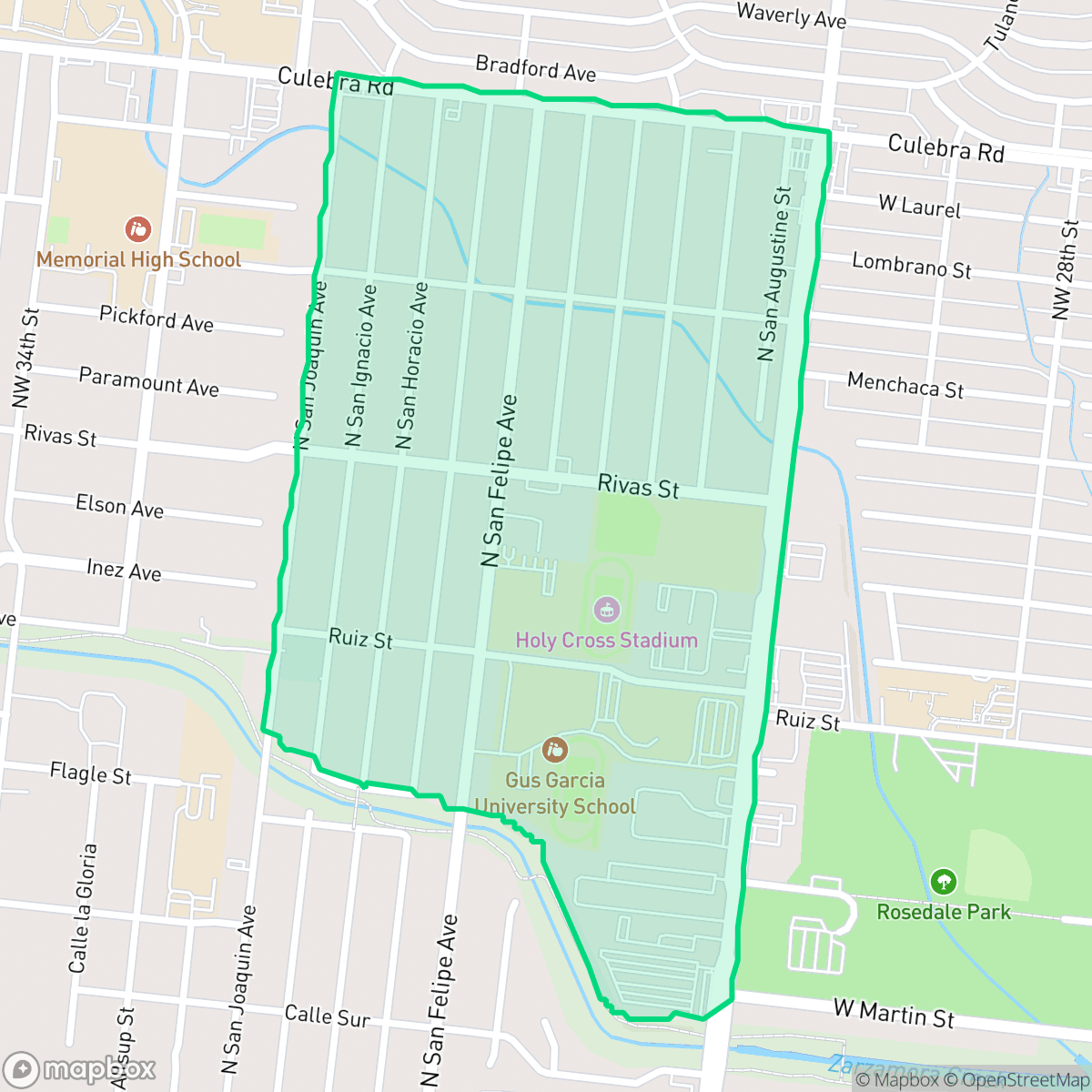
Loma Vista is a historic neighborhood on San Antonio’s West Side, originally established in the early 1910s as a "colonia". It was developed by Alamo Home Builders, a pioneering real estate firm led by B.G. Irish, which built and financed modest, five-room wood-frame "cottages" to offer affordable homeownership. The subdivision's development coincided with a wave of migration during the Mexican Revolution (1910s–1920s). To appeal to these new residents, developers gave the area its Spanish name. Today, Loma Vista remains a culturally distinct, predominantly Mexican-American neighborhood characterized by its early-to-mid-20th-century residential architecture and deep-rooted working-class identity.
The neighborhood is characterized by a dense, suburban-style layout with closely spaced single-family homes. Its grid-based street network provides decent pedestrian connectivity, which is further supported by local green utility corridors and school athletic fields that serve as primary outdoor recreation spaces. While local commercial options are limited, the area retains a distinct local identity with established businesses like La Amistad Tortilleria serving the community. The dense residential fabric creates a close-knit environment, though it results in minimal private backyard space and limited setbacks between properties.
Living in the area involves several trade-offs, particularly regarding environmental and institutional factors. Residents experience higher-than-average noise levels primarily due to proximity to major road traffic, alongside challenges with local air quality. The neighborhood is served by the Edgewood Independent School District, which is currently navigating a period of significant institutional transition and academic inconsistency. Prospective residents should also account for the area's low flood safety rating when considering long-term housing stability. This location is best suited for those who prioritize a culturally established, tight-knit community over modern, low-density suburban amenities.
Neighborhood Scores Across 15 Qualities
Homes are positioned with varying degrees of separation, featuring some areas of closely packed structures alongside more buffered lots. This level of density is roughly in line with the average found across San Antonio.
Low traffic volumes on residential streets allow for easy walking, though the lack of consistent sidewalks makes it slightly less pedestrian friendly than the San Antonio average.
Residential views consist of dense, single-story housing with simple rooflines and limited private greenery. This neighborhood offers less visual variety and fewer luxury landscape features than the San Antonio average, according to iHuus data.
Extensive green utility corridors and school athletic fields provide ample space for exercise, making the area slightly more dog friendly than the San Antonio average. While some residential streets lack wide sidewalks, the presence of paved trails offers reliable walking routes for pets.
Residential pockets feature a mix of dense suburban grids and larger institutional campuses. This layout provides a more developed feel than the more rural outskirts of San Antonio, according to iHuus data.
Suburban streets and green spaces offer a peaceful environment, but limited local business density means most dining and retail requires a vehicle. This level of activity is slightly below the San Antonio average according to iHuus data.
Persistent noise from nearby heavy transit corridors, including a major freeway and railroad, makes this area significantly louder than the San Antonio average. According to iHuus data, these acoustic disturbances are a notable feature of the local environment.
Frequent unhealthy air quality levels pose a significant risk to sensitive groups. According to iHuus data, the air quality in Loma Vista is slightly worse than the San Antonio average.
Residential life remains undisturbed by heavy industry, as the area consists primarily of housing, green spaces, and institutional buildings. While some light commercial activity exists along main roads, the lack of large warehouses makes this area slightly cleaner than the San Antonio average according to iHuus data.
Health insurance enrollment is significantly lower here than the San Antonio average, according to iHuus data. Residents may face greater challenges accessing employer-sponsored or subsidized medical plans.
Voting patterns and census indicators show a significantly more liberal leaning than the San Antonio average, according to iHuus data.
A balanced mix of young adults, families, and older residents characterizes the community. This demographic distribution is consistent with the broader San Antonio area, according to iHuus data.
Significant flood hazards and coastal wave action characterize this area, making it much more prone to flooding than the San Antonio average. Residents should anticipate elevated or potentially prohibitive flood insurance costs according to iHuus data.
Address-Level Insights for Loma Vista


iHuus Neighborhood Intelligence Insights
Get address-level neighborhood insights for Loma Vista
- Street-level scores — see how individual blocks compare, not just neighborhood averages
- Micro-zone boundaries — identify quiet pockets, flood boundaries, and walkable clusters before you visit
- 15 dimensions in full — walkability, noise, air quality, school quality, insurance coverage, population age profile, urban/rural index, and more
- Boundary risk alerts — know if your address sits near a block boundary where scores drop, the kind of detail no listing will ever mention
- School insights — individual school ratings and insights, not just district-level data
- Compare before you commit — side-by-side data across neighborhoods, down to block precision
No credit card required
Compare with Any Neighborhood
| Dimension | Loma Vista | 145 Association |
|---|---|---|
| 🚶 Walkabilityavg 6.44 | ||
| 🔊 Acoustic Comfortavg 4.07 | ||
| 🤫 Privacy Indexavg 5.75 | ||
| 🎨 Visual Appealavg 6.11 | ||
| 🐕 Dog Friendlinessavg 5.91 | ||
| 🗺️ Urban-Rural Indexavg 6.87 | ||
| ✨ Neighborhood Vibeavg 4.35 | ||
| 🏥 Health Insurance Coverageavg 5.94 | ||
| 🌿 Air Qualityavg 2.27 | ||
| 🏭 Industrial Proximityavg 8.31 | ||
| 🌊 Flood Safetyavg 4.2 | ||
| 🗳️ Ideological Leanavg 7.37 | ||
| 👥 Population Age Profileavg 4.68 | ||
| 🔥 Fire Safety | ||
| 🏫 School Quality |
Loma Vista Rankings
School Districts Serving Loma Vista
School Insights for Loma Vista
Below average outcomes; significant attendance and academic challenges.
School Insights
See what's really behind every school rating near Loma Vista
- Individual school ratings — each school's own score with outcome context, not just a district average
- Enrollment & class size data — student-to-teacher ratio and how it compares to the state average
- Full demographics breakdown — ethnicity and gender composition for every school in the enrollment zone
- Every school in the district — all schools within the enrollment boundary ranked by rating, not just the closest one
- Grade levels & benchmarks — elementary through high school, with below/above state-average flags
No credit card required