Lavaca, San Antonio
Updated · 1,878 residents
Lavaca is a historic San Antonio neighborhood defined by its collection of modest Victorian cottages and craftsman bungalows within the Southtown arts district. While it offers a vibrant local atmosphere with proximity to diverse dining and cultural venues, residents experience a dense urban environment characterized by tightly packed homes and significant road traffic noise.
Key Highlights
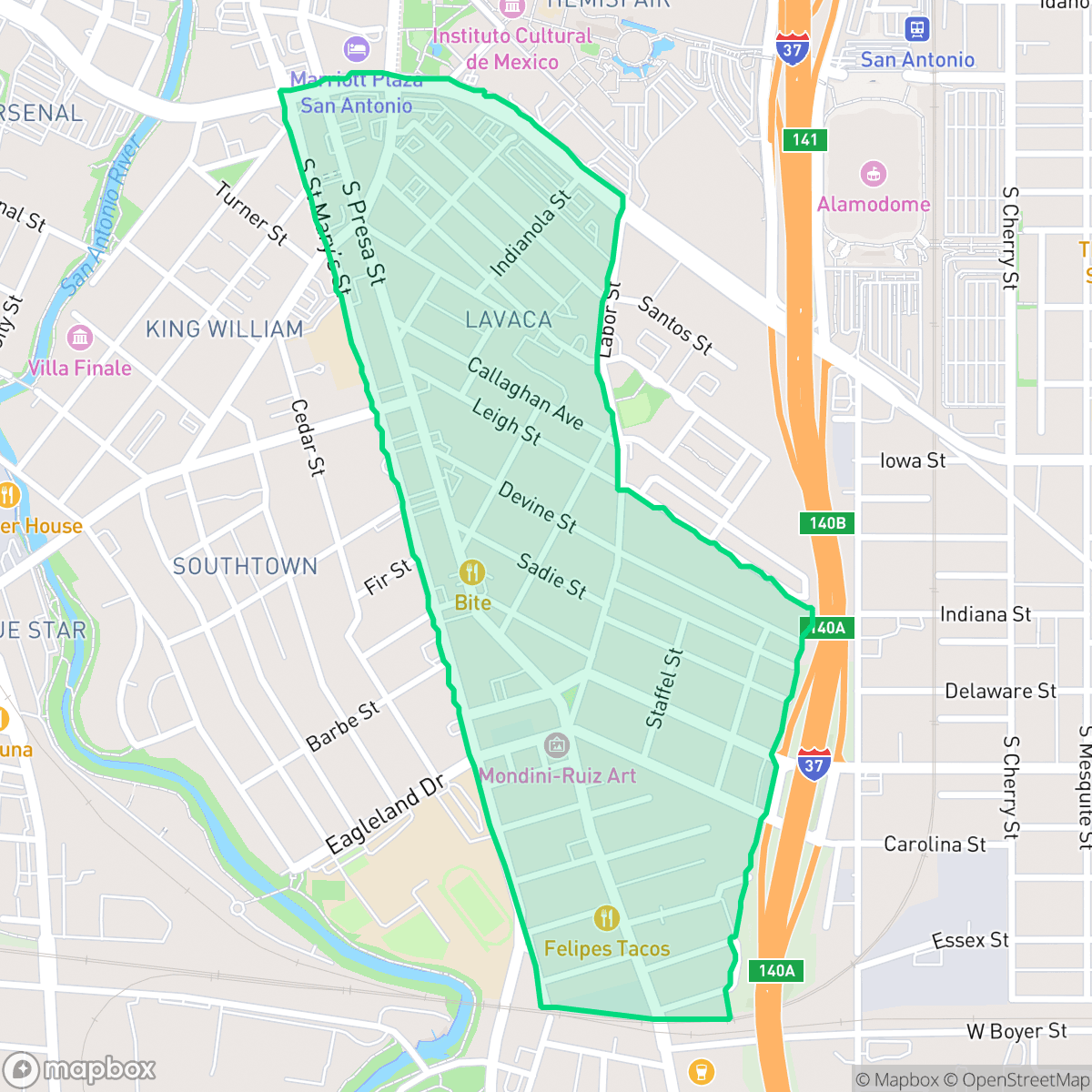
About Lavaca
As one of San Antonio’s oldest residential areas, Lavaca originated as the 18th-century "Labor de Afuera" farmlands of Mission San Antonio de Valero (the Alamo). Following mid-19th-century land speculation by figures like Sam Maverick, the neighborhood developed in the 1870s as a working-class enclave of carpenters, stonemasons, and laborers. This contrasted with the affluent, neighboring King William district. Lavaca’s early population was highly diverse, including German, Polish, Hispanic, and African American families. The eastern section, known as the "Baptist Settlement," was anchored by historic Black churches until it was razed in 1941 for public housing. Today, Lavaca is celebrated for its preservation of modest Victorian cottages, craftsman bungalows, and iconic shotgun houses, serving as a core neighborhood of San Antonio's vibrant Southtown arts district.
The neighborhood serves as a central hub for the Southtown area, blending historic residential architecture with institutional buildings and commercial corridors. According to iHuus data, the area maintains a distinct urban grid, though it remains notably car-dependent due to its layout and proximity to major highways. The neighborhood features a mix of institutional anchors and local dining spots, contributing to a lively, active atmosphere that contrasts with its quiet, residential origins.
Prospective residents should note the high density of the area, which results in minimal privacy between properties and limited public green space for pets. Acoustic comfort is impacted by consistent road traffic, and air quality metrics suggest a need for careful consideration by those sensitive to environmental factors. While the local school district is currently undergoing significant structural changes, the neighborhood remains a stable option for those prioritizing access to the arts district and a strong sense of community, supported by high local health insurance coverage rates.
Neighborhood Scores Across 15 Qualities
Residential structures are closely situated with minimal distance between neighbors. This level of density is notably higher than the San Antonio average, according to iHuus data.
Pedestrian access is available via grid streets with safe crossings, though some residential blocks lack continuous sidewalks. This level of walkability is slightly higher than the San Antonio average according to iHuus data.
Standard single-family homes and apartment complexes feature simple architecture and small yards. This area offers a more utilitarian aesthetic than the typical San Antonio neighborhood, according to iHuus data.
Public park access and wide grassy verges are scarce in this area. Most greenery is confined to small private yards, making the neighborhood less dog friendly than the San Antonio average.
A blend of dense urban grids and institutional structures defines the area, providing a more suburban feel than the city average. According to iHuus data, the neighborhood offers a consistent balance of street coverage and open space.
A notable concentration of dining, museums, and social hubs creates a high-energy atmosphere that is significantly more active than the San Antonio average. According to iHuus data, the area features a diverse mix of high-rise density and local eateries ranging from sushi spots to Tex-Mex.
Frequent noise from nearby rail lines and heavy freeway traffic characterizes this area. According to iHuus data, acoustic comfort levels in Lavaca are slightly below the San Antonio city average.
Frequent unhealthy air quality levels pose significant risks to sensitive groups. According to iHuus data, air conditions in this area are worse than the San Antonio average.
Residential life is largely uninterrupted by heavy industry, though some light commercial activity and warehouse proximity exist near the neighborhood edges. According to iHuus data, the area has slightly more commercial-related activity than the San Antonio average.
Health insurance coverage levels in Lavaca are consistent with the San Antonio average. Residents may find that access to coverage is neither particularly high nor low compared to the rest of the city, according to iHuus data.
Voting patterns and census indicators show a significantly more liberal political leaning than the San Antonio average, according to iHuus data.
Residents live alongside a balanced mix of young professionals, families, and seniors. According to iHuus data, the age distribution in Lavaca is slightly more varied than the San Antonio average.
Flood risk levels in Lavaca are slightly higher than the San Antonio average, though detailed FEMA studies for this specific area remain incomplete. According to iHuus data, the precise level of vulnerability is currently undetermined.
Address-Level Insights for Lavaca


iHuus Neighborhood Intelligence Insights
Get address-level neighborhood insights for Lavaca
- Street-level scores — see how individual blocks compare, not just neighborhood averages
- Micro-zone boundaries — identify quiet pockets, flood boundaries, and walkable clusters before you visit
- 15 dimensions in full — walkability, noise, air quality, school quality, insurance coverage, population age profile, urban/rural index, and more
- Boundary risk alerts — know if your address sits near a block boundary where scores drop, the kind of detail no listing will ever mention
- School insights — individual school ratings and insights, not just district-level data
- Compare before you commit — side-by-side data across neighborhoods, down to block precision
No credit card required
Compare with Any Neighborhood
| Dimension | Lavaca | 145 Association |
|---|---|---|
| 🚶 Walkabilityavg 6.44 | ||
| 🔊 Acoustic Comfortavg 4.07 | ||
| 🤫 Privacy Indexavg 5.75 | ||
| 🎨 Visual Appealavg 6.11 | ||
| 🐕 Dog Friendlinessavg 5.91 | ||
| 🗺️ Urban-Rural Indexavg 6.87 | ||
| ✨ Neighborhood Vibeavg 4.35 | ||
| 🏥 Health Insurance Coverageavg 5.94 | ||
| 🌿 Air Qualityavg 2.27 | ||
| 🏭 Industrial Proximityavg 8.31 | ||
| 🌊 Flood Safetyavg 4.2 | ||
| 🗳️ Ideological Leanavg 7.37 | ||
| 👥 Population Age Profileavg 4.68 | ||
| 🔥 Fire Safety | ||
| 🏫 School Quality |
Lavaca Rankings
School Districts Serving Lavaca
School Insights for Lavaca
Below average outcomes; significant attendance and academic challenges.
School Insights
See what's really behind every school rating near Lavaca
- Individual school ratings — each school's own score with outcome context, not just a district average
- Enrollment & class size data — student-to-teacher ratio and how it compares to the state average
- Full demographics breakdown — ethnicity and gender composition for every school in the enrollment zone
- Every school in the district — all schools within the enrollment boundary ranked by rating, not just the closest one
- Grade levels & benchmarks — elementary through high school, with below/above state-average flags
No credit card required