Las Lomas-Stone Oak, San Antonio
Updated · 537 residents
Las Lomas-Stone Oak is a vibrant, highly walkable residential enclave in northern San Antonio known for its well-maintained suburban aesthetic and proximity to local community hubs. Residents benefit from high levels of health insurance coverage and a balanced environment that integrates quiet residential streets with accessible neighborhood amenities.
Key Highlights
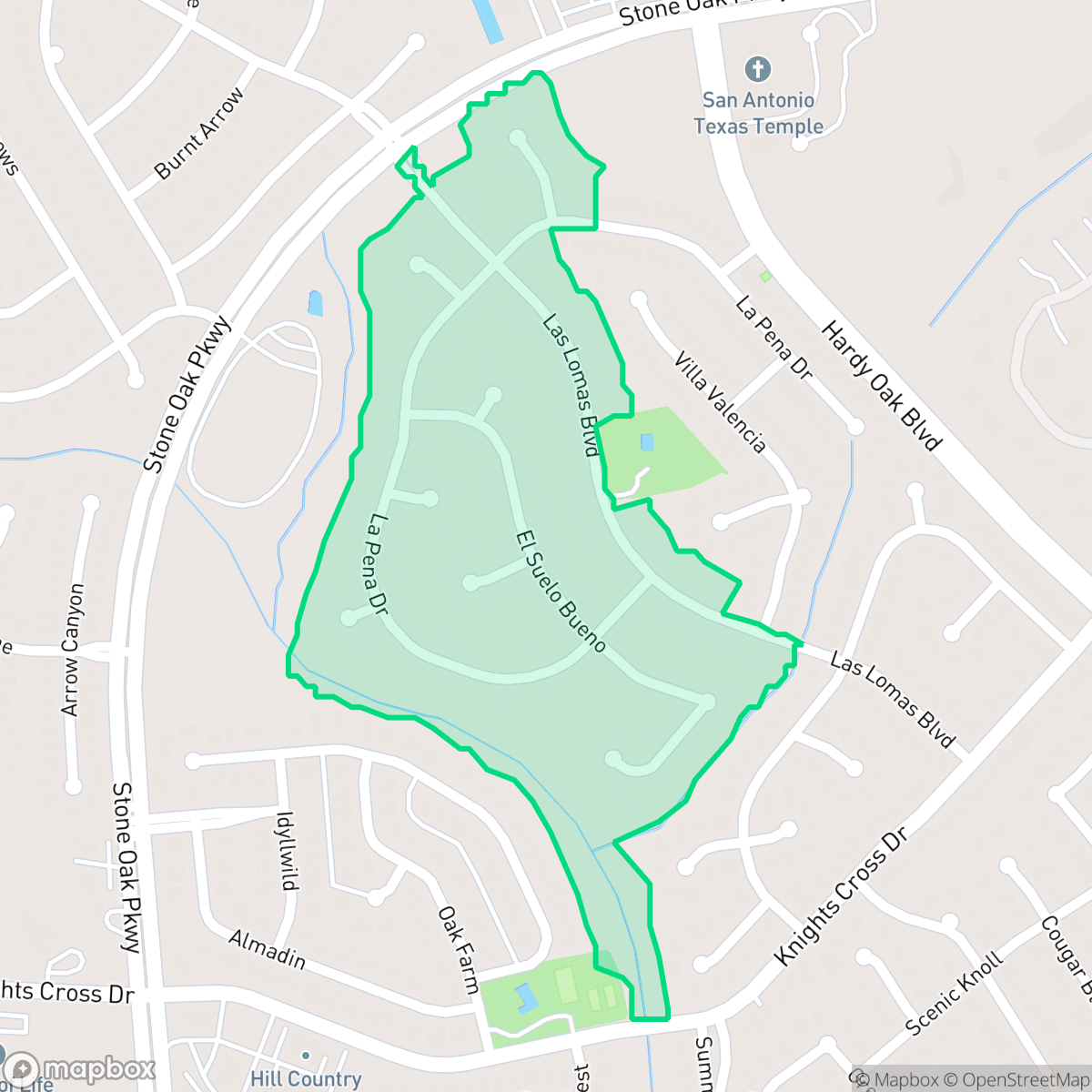
About Las Lomas-Stone Oak
Las Lomas-Stone Oak is an upscale residential community situated within Stone Oak, Bexar County’s first master-planned development in northern San Antonio. The broader Stone Oak area originated in the early 1980s when developers led by Dan Parman acquired approximately 5,000 acres of historic Texas Hill Country ranchland. Unveiled in 1985, the highly detailed master plan transformed the former pastures into a cohesive mix of residential subdivisions, commercial zones, and open spaces. Despite development pauses during the Savings and Loan Crisis, the area grew rapidly after its phased annexation by San Antonio beginning in 1997. Las Lomas emerged during this late-1990s expansion era, characterized by single-family homes built between 1997 and 2007. Today, the neighborhood maintains its planned aesthetic through strict architectural guidelines overseen by the Las Lomas-Stone Oak Owners Association.
The neighborhood stands out for its high walkability and strong visual appeal, offering a polished suburban environment that balances residential density with open green spaces. It maintains a lively atmosphere compared to the city average, supported by local institutions like Iglesia Vida Nueva Stone Oak and neighborhood cafes. The area is served by the North East Independent School District, which provides access to stable, high-performing educational facilities in a district currently managing significant fiscal transitions.
While the area offers excellent flood safety and comprehensive health insurance coverage, prospective residents should note that ambient noise levels are influenced by nearby road traffic. Air quality metrics indicate a need for awareness, though the neighborhood remains a top choice for those seeking a structured, master-planned lifestyle with reliable infrastructure. It is particularly well-suited for families and professionals who value community cohesion and proximity to northern San Antonio commercial corridors.
Neighborhood Scores Across 15 Qualities
Residential spacing is mixed, offering some buffer between neighbors. This level of privacy is slightly higher than the San Antonio average according to iHuus data.
Pedestrian travel is supported by sidewalks on one side of the street and safe crossings throughout the area. This level of walkability is notably higher than the San Antonio average, according to iHuus data.
Manicured landscapes, large-scale residences, and premium amenities define the area. According to iHuus data, the visual quality of this neighborhood is significantly higher than the San Antonio average.
Accessible green spaces and wide paths provide safe environments for walking dogs. According to iHuus data, this area offers more opportunities for pet owners than the typical San Antonio neighborhood.
Open land and wooded areas are common throughout the neighborhood, providing a slightly more rural feel than the typical San Antonio landscape according to iHuus data.
A notable concentration of local dining and social spots creates a much more lively atmosphere than the typical San Antonio neighborhood. While some residential blocks remain calm, the area features a diverse variety of nearby services and leisure destinations according to iHuus data.
Steady traffic sounds from nearby thoroughfares are present, though acoustic comfort levels remain higher than the San Antonio average according to iHuus data.
Frequent unhealthy air quality levels pose a significant risk to sensitive groups. According to iHuus data, the air quality in this area is slightly worse than the San Antonio average.
Residential life is undisturbed by warehouses or manufacturing facilities, as this area contains no detectable industrial activity. According to iHuus data, the neighborhood is purely residential and lacks the heavy industrial presence found in other parts of San Antonio.
Health insurance access is exceptionally high in this area, significantly surpassing the San Antonio average. According to iHuus data, the vast majority of residents are covered by a health plan.
Conservative political leanings characterize this area, representing a notable departure from the more progressive tilt found across San Antonio. According to iHuus data, the neighborhood maintains a conservative majority with a modest opposing presence.
Residents experience a diverse age distribution that matches the San Antonio average, featuring a stable mix of young adults, families, and older populations. According to iHuus data, this demographic spread creates a multi-generational community atmosphere.
Residual flood risk exists within some areas of the neighborhood, though safety levels are notably higher than the San Antonio average according to iHuus data.
Address-Level Insights for Las Lomas-Stone Oak


iHuus Neighborhood Intelligence Insights
Get address-level neighborhood insights for Las Lomas-Stone Oak
- Street-level scores — see how individual blocks compare, not just neighborhood averages
- Micro-zone boundaries — identify quiet pockets, flood boundaries, and walkable clusters before you visit
- 15 dimensions in full — walkability, noise, air quality, school quality, insurance coverage, population age profile, urban/rural index, and more
- Boundary risk alerts — know if your address sits near a block boundary where scores drop, the kind of detail no listing will ever mention
- School insights — individual school ratings and insights, not just district-level data
- Compare before you commit — side-by-side data across neighborhoods, down to block precision
No credit card required
Compare with Any Neighborhood
| Dimension | Las Lomas-Stone Oak | 145 Association |
|---|---|---|
| 🚶 Walkabilityavg 6.44 | ||
| 🔊 Acoustic Comfortavg 4.07 | ||
| 🤫 Privacy Indexavg 5.75 | ||
| 🎨 Visual Appealavg 6.11 | ||
| 🐕 Dog Friendlinessavg 5.91 | ||
| 🗺️ Urban-Rural Indexavg 6.87 | ||
| ✨ Neighborhood Vibeavg 4.35 | ||
| 🏥 Health Insurance Coverageavg 5.94 | ||
| 🌿 Air Qualityavg 2.27 | ||
| 🏭 Industrial Proximityavg 8.31 | ||
| 🌊 Flood Safetyavg 4.2 | ||
| 🗳️ Ideological Leanavg 7.37 | ||
| 👥 Population Age Profileavg 4.68 | ||
| 🔥 Fire Safety | ||
| 🏫 School Quality |
Las Lomas-Stone Oak Rankings
School Districts Serving Las Lomas-Stone Oak
School Insights for Las Lomas-Stone Oak
Below average outcomes; significant attendance and academic challenges.
School Insights
See what's really behind every school rating near Las Lomas-Stone Oak
- Individual school ratings — each school's own score with outcome context, not just a district average
- Enrollment & class size data — student-to-teacher ratio and how it compares to the state average
- Full demographics breakdown — ethnicity and gender composition for every school in the enrollment zone
- Every school in the district — all schools within the enrollment boundary ranked by rating, not just the closest one
- Grade levels & benchmarks — elementary through high school, with below/above state-average flags
No credit card required