King William, San Antonio
Updated · 2,089 residents
King William is a highly walkable historic district known for its blend of grand architecture and an active local dining scene. While it offers a vibrant atmosphere and strong health insurance coverage, residents should expect moderate noise levels from traffic and limited privacy in this dense urban environment.
Key Highlights
About King William
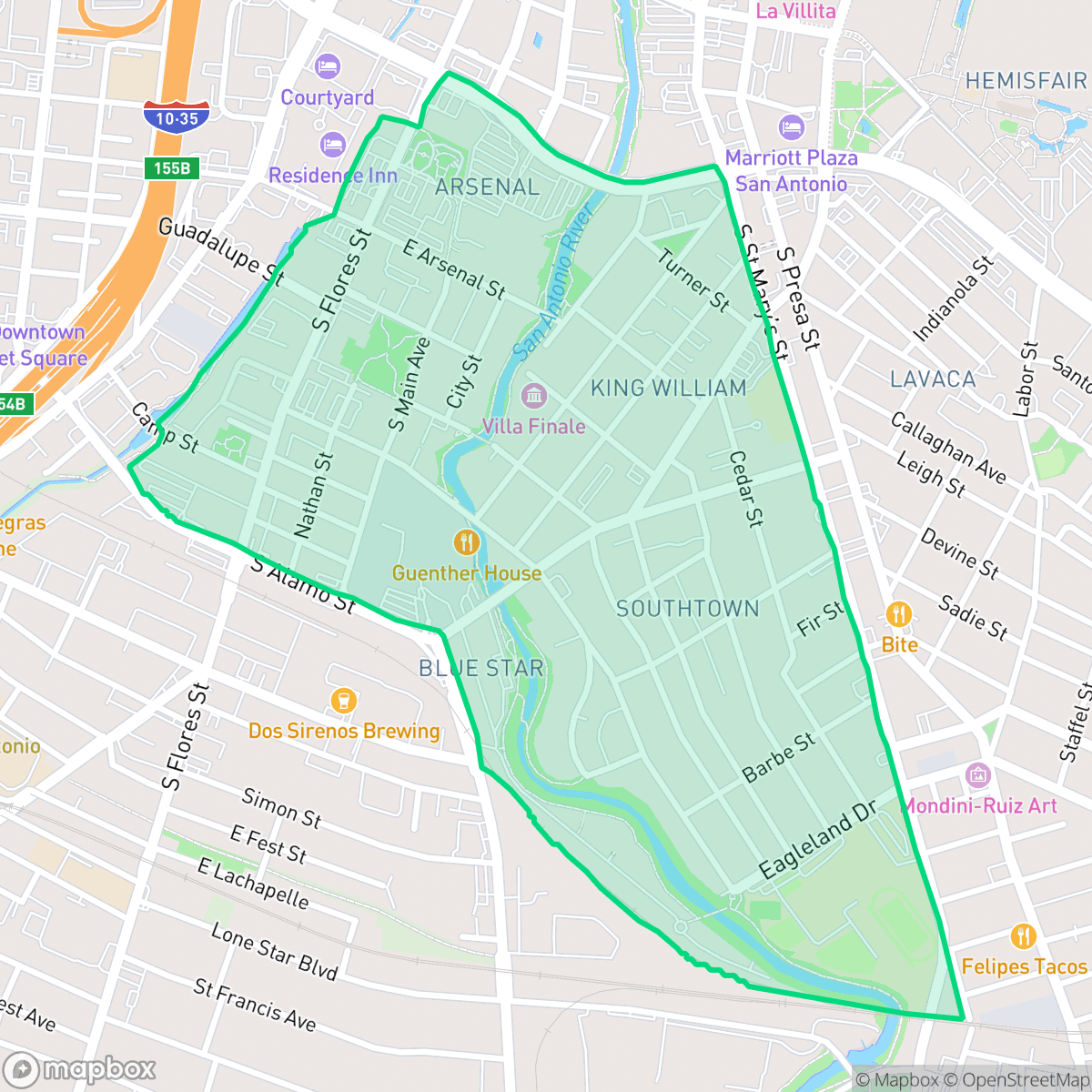
Originally farmland belonging to Mission San Antonio de Valero (the Alamo), the King William neighborhood was subdivided in the 1850s and developed into a prestigious enclave by prosperous German immigrants. In 1866, early resident Ernst Hermann Altgelt named its main thoroughfare after King Wilhelm I of Prussia. Known colloquially as "Sauerkraut Bend"—and temporarily renamed Pershing Avenue during World War I due to anti-German sentiment—the neighborhood is celebrated for its grand Greek Revival, Victorian, and Italianate mansions. Many of these homes, such as the Edward Steves Homestead and Villa Finale, were designed by prominent architects like Alfred Giles. Other local landmarks include the historic Carl Guenther House and Mill. In 1968, King William was designated as Texas’s first residential historic district.
The neighborhood serves as a central hub for those seeking a pedestrian-friendly lifestyle near the heart of San Antonio. Beyond its historic appeal, the area features a lively mix of light industrial spaces and social hubs, such as Southbound Coffee and various local eateries. Residents benefit from high levels of health insurance coverage and a strong sense of community, with an ideological lean that reflects the area's progressive character. According to iHuus data, the community maintains a distinct identity that balances its role as a residential enclave with its proximity to central commercial zones.
Prospective residents should consider the trade-offs associated with this urban environment. The area experiences moderate noise from road traffic and railroad activity, which can impact acoustic comfort. The proximity to commercial zones and the density of the district also result in lower privacy scores and air quality concerns compared to suburban alternatives. This neighborhood is best suited for individuals who prioritize walkability and cultural access over quiet, secluded living.
Neighborhood Scores Across 15 Qualities
Residential structures are frequently positioned close to one another with minimal setbacks. According to iHuus data, this density results in less separation between neighbors than is typical for the city average.
Pedestrian access is generally accessible via grid streets with safe crossings, though some residential blocks lack continuous sidewalks. This level of walkability sits slightly above the San Antonio average according to iHuus data.
Standard single-family homes and mid-sized apartments define the area, which offers slightly less visual variety than the San Antonio average. Residential lots feature tidy but small yards and simple architectural styles.
Public park access and wide, grassy verges are scarce in this area, as greenery is primarily confined to small private yards. According to iHuus data, the availability of communal dog-friendly spaces is below the San Antonio average.
Street layouts feature a blend of greenery and dense low-rise structures, offering a more suburban feel than the city average. Significant grey cover and multi-story institutional buildings characterize the area's urban grid according to iHuus data.
Concentrated pockets of dining, coffee shops, and social venues create a sense of activity that is notably higher than the San Antonio average. While some areas near the highway and rail lines remain car-dependent, the neighborhood contains several distinct clusters of local hubs according to iHuus data.
Consistent sound from nearby busy thoroughfares creates a moderate level of ambient noise. This acoustic environment is slightly more active than the average for San Antonio.
Frequent unhealthy air quality levels pose a significant risk to sensitive groups. According to iHuus data, the air quality in King William is lower than the San Antonio average.
Residential life dominates the area with very little heavy industry, though proximity to a major highway and some nearby warehouses introduces slightly more commercial activity than is typical for the city average.
Health insurance access is notably higher than the San Antonio average, according to iHuus data. Residents in this area benefit from greater access to medical coverage than most of the surrounding city.
Voting patterns and census indicators show a significantly more liberal leaning than the San Antonio average, according to iHuus data.
A balanced mix of young professionals, families, and older residents characterizes the area. According to iHuus data, this demographic variety is more widespread than in most other parts of San Antonio.
Flood risk in this area is higher than the San Antonio average, though a lack of detailed FEMA studies means the specific level of danger remains undetermined. Residents should exercise caution during heavy rain events, as indicated by iHuus data.
Address-Level Insights for King William


iHuus Neighborhood Intelligence Insights
Get address-level neighborhood insights for King William
- Street-level scores — see how individual blocks compare, not just neighborhood averages
- Micro-zone boundaries — identify quiet pockets, flood boundaries, and walkable clusters before you visit
- 15 dimensions in full — walkability, noise, air quality, school quality, insurance coverage, population age profile, urban/rural index, and more
- Boundary risk alerts — know if your address sits near a block boundary where scores drop, the kind of detail no listing will ever mention
- School insights — individual school ratings and insights, not just district-level data
- Compare before you commit — side-by-side data across neighborhoods, down to block precision
No credit card required
Compare with Any Neighborhood
| Dimension | King William | 145 Association |
|---|---|---|
| 🚶 Walkabilityavg 6.44 | ||
| 🔊 Acoustic Comfortavg 4.07 | ||
| 🤫 Privacy Indexavg 5.75 | ||
| 🎨 Visual Appealavg 6.11 | ||
| 🐕 Dog Friendlinessavg 5.91 | ||
| 🗺️ Urban-Rural Indexavg 6.87 | ||
| ✨ Neighborhood Vibeavg 4.35 | ||
| 🏥 Health Insurance Coverageavg 5.94 | ||
| 🌿 Air Qualityavg 2.27 | ||
| 🏭 Industrial Proximityavg 8.31 | ||
| 🌊 Flood Safetyavg 4.2 | ||
| 🗳️ Ideological Leanavg 7.37 | ||
| 👥 Population Age Profileavg 4.68 | ||
| 🔥 Fire Safety | ||
| 🏫 School Quality |
King William Rankings
School Districts Serving King William
School Insights for King William
Below average outcomes; significant attendance and academic challenges.
School Insights
See what's really behind every school rating near King William
- Individual school ratings — each school's own score with outcome context, not just a district average
- Enrollment & class size data — student-to-teacher ratio and how it compares to the state average
- Full demographics breakdown — ethnicity and gender composition for every school in the enrollment zone
- Every school in the district — all schools within the enrollment boundary ranked by rating, not just the closest one
- Grade levels & benchmarks — elementary through high school, with below/above state-average flags
No credit card required