Jefferson, San Antonio
Updated · 4,083 residents
Jefferson is defined by its diverse historic architecture and established suburban layout on San Antonio's near northwest side. While the area offers a quiet residential environment, residents experience tightly packed housing with limited privacy and moderate walkability that varies between main thoroughfares and residential streets.
Key Highlights
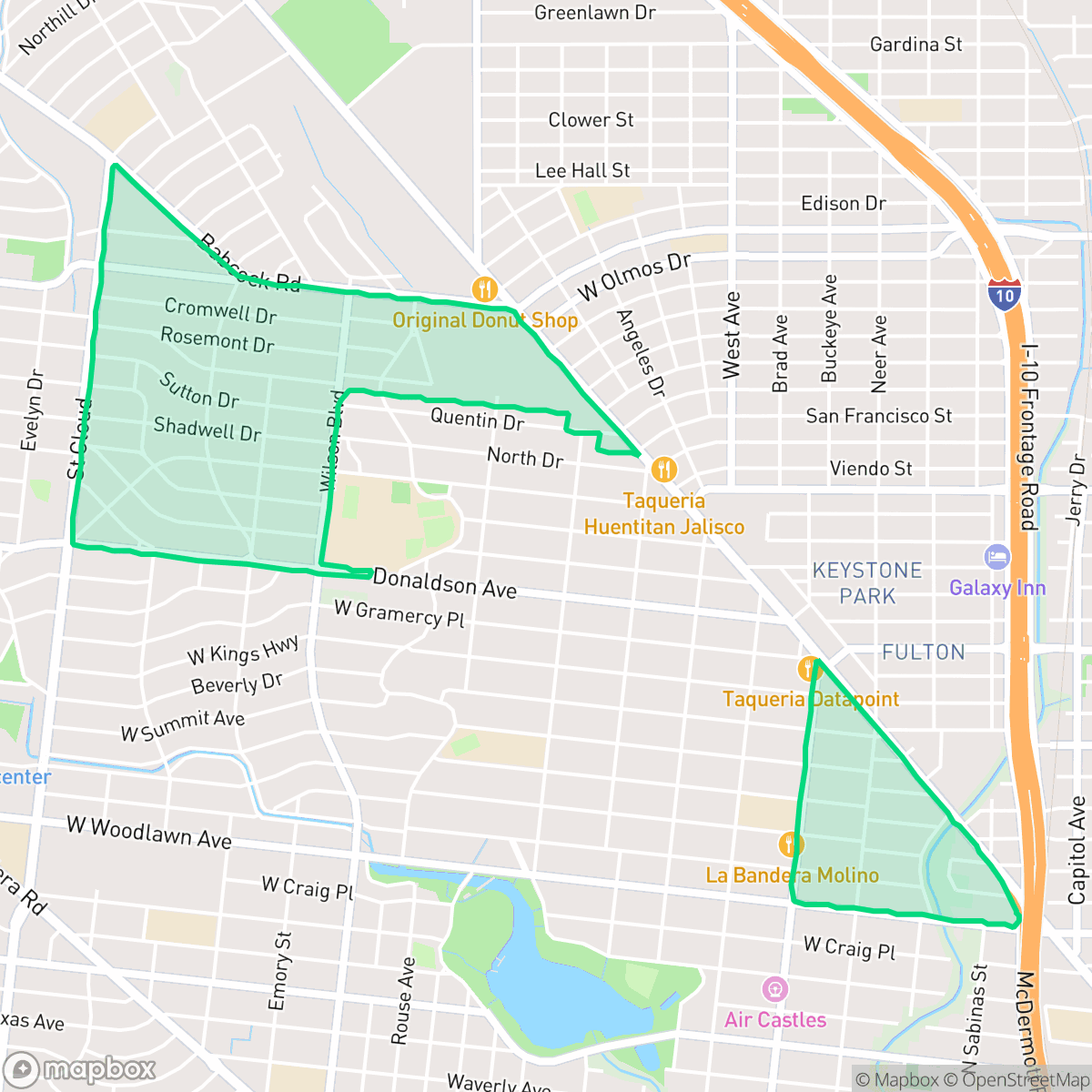
About Jefferson
Developed primarily between the 1920s and 1960s on San Antonio's near northwest side, the Jefferson neighborhood is celebrated for its rich architectural diversity and historic landmarks. The community is anchored by Thomas Jefferson High School, a Spanish Baroque masterpiece completed in 1932 that is listed on the National Register of Historic Places. Nearby, Woodlawn Lake Park, dating to the mid-1800s, serves as a scenic local gathering space. The neighborhood is also home to Jefferson Village; opened in 1948, it was one of the nation's first commercial strip shopping centers, winning a national design award in 1949. A defining local business, Vee’s Hair and Spa, has operated continuously in the center since its grand opening. Today, the Jefferson Neighborhood Conservation District preserves this distinct character, featuring eclectic styles from Tudor Revival to Art Moderne.
The neighborhood maintains a distinct suburban atmosphere characterized by a mix of single-family homes and commercial complexes. According to iHuus data, the area benefits from relatively good acoustic comfort, with average noise levels around 54 decibels, primarily driven by road traffic. While the eastern edge is bordered by industrial warehouses and large parking lots, the internal streets remain largely shielded from heavy transit noise, contributing to a stable, low-key environment. Residents enjoy a location that is highly resilient to flooding, providing a sense of security in a well-established part of the city.
Prospective residents should note that the area presents specific trade-offs regarding privacy and school access. Homes are situated on small lots with minimal spacing, and the local San Antonio Independent School District faces ongoing challenges, including a low district rating and significant campus consolidation efforts. While the area provides a stable location for those valuing historic character, it may be less suitable for pet owners seeking immediate public park access or families prioritizing top-rated public school systems.
Neighborhood Scores Across 15 Qualities
Residential spacing is varied, with some closely packed houses on narrow lots and others maintaining moderate distances between neighbors. This level of separation is slightly lower than the San Antonio average, according to iHuus data.
Low-traffic residential streets allow for safe movement, though the sidewalk network is fragmented and interrupted by major high-speed highways. According to iHuus data, walkability in this area is slightly below the San Antonio city average.
Standard tract housing and multi-family units define the landscape, featuring small yards and simple roof geometries. The area presents a less varied aesthetic than the San Antonio average due to the lack of luxury amenities or large private lots.
Public spaces for pets are somewhat limited, as much of the neighborhood's greenery is confined to private fenced backyards. While some residents benefit from proximity to riverside parks and greenway trails, the overall availability of accessible public dog areas is below the San Antonio average.
Residential pockets consist of single-family homes and apartment clusters interspersed with small commercial corridors. This landscape is slightly more developed than the San Antonio average, offering a transition between urban density and open space.
Steady activity from local dining and parks provides a more active atmosphere than the San Antonio average. While some areas near Woodlawn Lake Park offer walkable social hubs, other sections remain quiet and more reliant on vehicles for errands.
Local traffic from nearby busy streets creates a persistent hum. This level of acoustic activity is slightly higher than the San Antonio average, according to iHuus data.
Frequent unhealthy air quality levels pose a significant risk to sensitive groups. This area experiences lower air quality than the San Antonio average, according to iHuus data.
Residential and light commercial uses dominate the area, with no heavy industrial facilities or large warehouses detected. This neighborhood provides a cleaner environment than the San Antonio average due to the absence of significant industrial activity or heavy trucking depots.
Health insurance coverage levels are lower than the San Antonio average. According to iHuus data, fewer residents in this area have access to employer-sponsored or private health plans.
Voting patterns and census indicators reflect a strong liberal leaning that is notably higher than the San Antonio average, according to iHuus data.
Residents will find a balanced demographic spread of young adults, families, and older individuals. According to iHuus data, this age distribution is slightly more varied than the typical San Antonio profile.
Significant flood risk exists here due to the area's location within a 100-year floodplain, which is considerably higher than the San Antonio average. Residents should expect that flood insurance will likely be a requirement for properties in this neighborhood according to iHuus data.
Address-Level Insights for Jefferson


iHuus Neighborhood Intelligence Insights
Get address-level neighborhood insights for Jefferson
- Street-level scores — see how individual blocks compare, not just neighborhood averages
- Micro-zone boundaries — identify quiet pockets, flood boundaries, and walkable clusters before you visit
- 15 dimensions in full — walkability, noise, air quality, school quality, insurance coverage, population age profile, urban/rural index, and more
- Boundary risk alerts — know if your address sits near a block boundary where scores drop, the kind of detail no listing will ever mention
- School insights — individual school ratings and insights, not just district-level data
- Compare before you commit — side-by-side data across neighborhoods, down to block precision
No credit card required
Compare with Any Neighborhood
| Dimension | Jefferson | 145 Association |
|---|---|---|
| 🚶 Walkabilityavg 6.44 | ||
| 🔊 Acoustic Comfortavg 4.07 | ||
| 🤫 Privacy Indexavg 5.75 | ||
| 🎨 Visual Appealavg 6.11 | ||
| 🐕 Dog Friendlinessavg 5.91 | ||
| 🗺️ Urban-Rural Indexavg 6.87 | ||
| ✨ Neighborhood Vibeavg 4.35 | ||
| 🏥 Health Insurance Coverageavg 5.94 | ||
| 🌿 Air Qualityavg 2.27 | ||
| 🏭 Industrial Proximityavg 8.31 | ||
| 🌊 Flood Safetyavg 4.2 | ||
| 🗳️ Ideological Leanavg 7.37 | ||
| 👥 Population Age Profileavg 4.68 | ||
| 🔥 Fire Safety | ||
| 🏫 School Quality |
Jefferson Rankings
School Districts Serving Jefferson
School Insights for Jefferson
Below average outcomes; significant attendance and academic challenges.
School Insights
See what's really behind every school rating near Jefferson
- Individual school ratings — each school's own score with outcome context, not just a district average
- Enrollment & class size data — student-to-teacher ratio and how it compares to the state average
- Full demographics breakdown — ethnicity and gender composition for every school in the enrollment zone
- Every school in the district — all schools within the enrollment boundary ranked by rating, not just the closest one
- Grade levels & benchmarks — elementary through high school, with below/above state-average flags
No credit card required