Jefferson-Woodlawn Lake, San Antonio
Updated · 5,512 residents
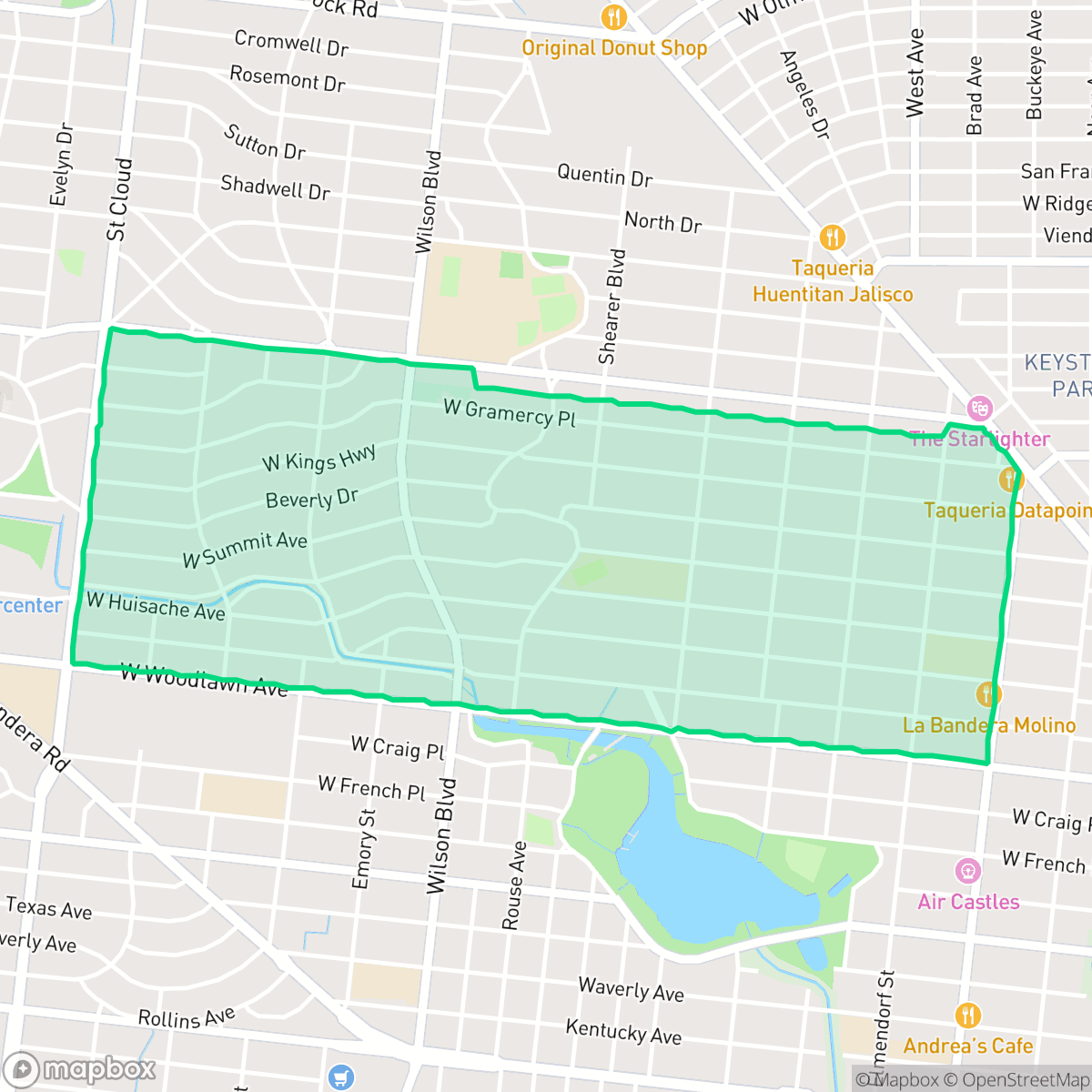
Jefferson-Woodlawn Lake is a quiet, residential enclave defined by its grid-based street layout and proximity to the expansive Woodlawn Lake Park. The area offers a peaceful atmosphere with notably low noise levels, making it a calm retreat within the broader San Antonio urban landscape.
Key Highlights
About Jefferson-Woodlawn Lake
Developed starting in 1887 by the West End Town Company, the Jefferson-Woodlawn Lake area began as a streetcar suburb built around a man-made lake created by damming Alazan Creek. Originally called "West End," the neighborhood was renamed after the 62-acre Woodlawn Lake Park was deeded to San Antonio in 1918. The neighborhood grew rapidly between the 1920s and 1960s, showcasing diverse architectural styles including Spanish Revival, Tudor Revival, Art Deco, and Craftsman bungalows. Its crowning jewel is Thomas Jefferson High School, a Spanish Baroque masterpiece built in 1932 that is listed on the National Register of Historic Places. Other local landmarks include the 1931 Basilica of the National Shrine of the Little Flower, the historic Cool Crest Miniature Golf Course, and Jefferson Village, one of the city's earliest 1950s shopping centers.
The neighborhood maintains a steady, low-key rhythm, characterized by its grid street layout and access to essential green spaces. Residents benefit from significantly lower noise levels than the city average, providing a tranquil living environment that is well-suited for those seeking a respite from urban congestion. According to iHuus data, the area is entirely residential with no industrial activity, which contributes to the overall sense of calm. Local dining options and the nearby park facilities provide community touchpoints, though residents should expect a limited number of businesses within immediate walking distance.
Living in this part of San Antonio involves specific trade-offs regarding infrastructure and environmental factors. While the community offers a pleasant, low-density suburban feel, prospective residents should be aware of the low air quality scores and significant flood risks associated with the local geography. The neighborhood falls under the San Antonio Independent School District, which is currently navigating a period of systemic transformation and academic inconsistency. Despite these challenges, the area remains an attractive option for those who prioritize a quiet and stable environment over proximity to commercial hubs or high-performing school zones.
Neighborhood Scores Across 15 Qualities
Residential spacing varies between closely packed houses on narrow lots and detached homes with small yards. This level of privacy is roughly in line with the San Antonio average, according to iHuus data.
Quiet residential streets allow for safe walking, though fragmented sidewalks and nearby high traffic arterials create occasional barriers for pedestrians. According to iHuus data, the area's walkability is slightly below the San Antonio average.
Standard single-family homes feature simple rooflines and small yards. This area presents a more functional landscape than the San Antonio average, with very few private luxury amenities or large lots visible according to iHuus data.
Access to dedicated walking paths and riverside parks provides decent space for pets, though the neighborhood trails and street verges are slightly below the San Antonio average. While green drainage corridors offer utility for exercise, much of the local greenery is limited to private backyards.
Largely comprised of a suburban grid with single-family homes, this area feels slightly less open than the San Antonio average. iHuus data indicates a landscape characterized by small commercial clusters and residential plots rather than expansive open land.
Suburban streets and green spaces provide a balanced setting with a steady flow of local dining and social hubs. According to iHuus data, this area offers a slightly more active rhythm of services than the San Antonio average.
A steady hum from local traffic is present near busy streets, though acoustic comfort levels are higher than the San Antonio average according to iHuus data.
Frequent unhealthy air quality levels pose a significant risk to sensitive groups. According to iHuus data, the air quality in this area is slightly worse than the San Antonio average.
No warehouses, heavy industrial facilities, or large-scale pollution sources are present within the neighborhood. According to iHuus data, this area is notably cleaner and more residential than the San Antonio average.
Health insurance coverage among residents is slightly lower than the San Antonio average, according to iHuus data. This indicates a notable portion of the population lacks employer-sponsored or private medical coverage.
Voting patterns and census indicators reflect a much more liberal political leaning than the San Antonio average, according to iHuus data.
Residents live alongside a balanced distribution of young professionals, families, and older adults. This demographic spread is slightly more varied than the average seen across San Antonio, according to iHuus data.
Flood risk is significantly higher than the San Antonio average, as much of the area sits within a designated 100-year floodplain. According to iHuus data, residents should expect a higher likelihood of flooding and may find flood insurance is a standard requirement for properties here.
Address-Level Insights for Jefferson-Woodlawn Lake


iHuus Neighborhood Intelligence Insights
Get address-level neighborhood insights for Jefferson-Woodlawn Lake
- Street-level scores — see how individual blocks compare, not just neighborhood averages
- Micro-zone boundaries — identify quiet pockets, flood boundaries, and walkable clusters before you visit
- 15 dimensions in full — walkability, noise, air quality, school quality, insurance coverage, population age profile, urban/rural index, and more
- Boundary risk alerts — know if your address sits near a block boundary where scores drop, the kind of detail no listing will ever mention
- School insights — individual school ratings and insights, not just district-level data
- Compare before you commit — side-by-side data across neighborhoods, down to block precision
No credit card required
Compare with Any Neighborhood
| Dimension | Jefferson-Woodlawn Lake | 145 Association |
|---|---|---|
| 🚶 Walkabilityavg 6.44 | ||
| 🔊 Acoustic Comfortavg 4.07 | ||
| 🤫 Privacy Indexavg 5.75 | ||
| 🎨 Visual Appealavg 6.11 | ||
| 🐕 Dog Friendlinessavg 5.91 | ||
| 🗺️ Urban-Rural Indexavg 6.87 | ||
| ✨ Neighborhood Vibeavg 4.35 | ||
| 🏥 Health Insurance Coverageavg 5.94 | ||
| 🌿 Air Qualityavg 2.27 | ||
| 🏭 Industrial Proximityavg 8.31 | ||
| 🌊 Flood Safetyavg 4.2 | ||
| 🗳️ Ideological Leanavg 7.37 | ||
| 👥 Population Age Profileavg 4.68 | ||
| 🔥 Fire Safety | ||
| 🏫 School Quality |
Jefferson-Woodlawn Lake Rankings
School Districts Serving Jefferson-Woodlawn Lake
School Insights for Jefferson-Woodlawn Lake
Below average outcomes; significant attendance and academic challenges.
School Insights
See what's really behind every school rating near Jefferson-Woodlawn Lake
- Individual school ratings — each school's own score with outcome context, not just a district average
- Enrollment & class size data — student-to-teacher ratio and how it compares to the state average
- Full demographics breakdown — ethnicity and gender composition for every school in the enrollment zone
- Every school in the district — all schools within the enrollment boundary ranked by rating, not just the closest one
- Grade levels & benchmarks — elementary through high school, with below/above state-average flags
No credit card required