Jefferson-Monticello Park, San Antonio
Updated · 1,876 residents
Jefferson-Monticello Park is a historic San Antonio enclave known for its diverse architectural styles and tree-lined streets. Residents benefit from high walkability and a notably quiet acoustic environment, making it a peaceful residential choice near the city center.
Key Highlights
About Jefferson-Monticello Park
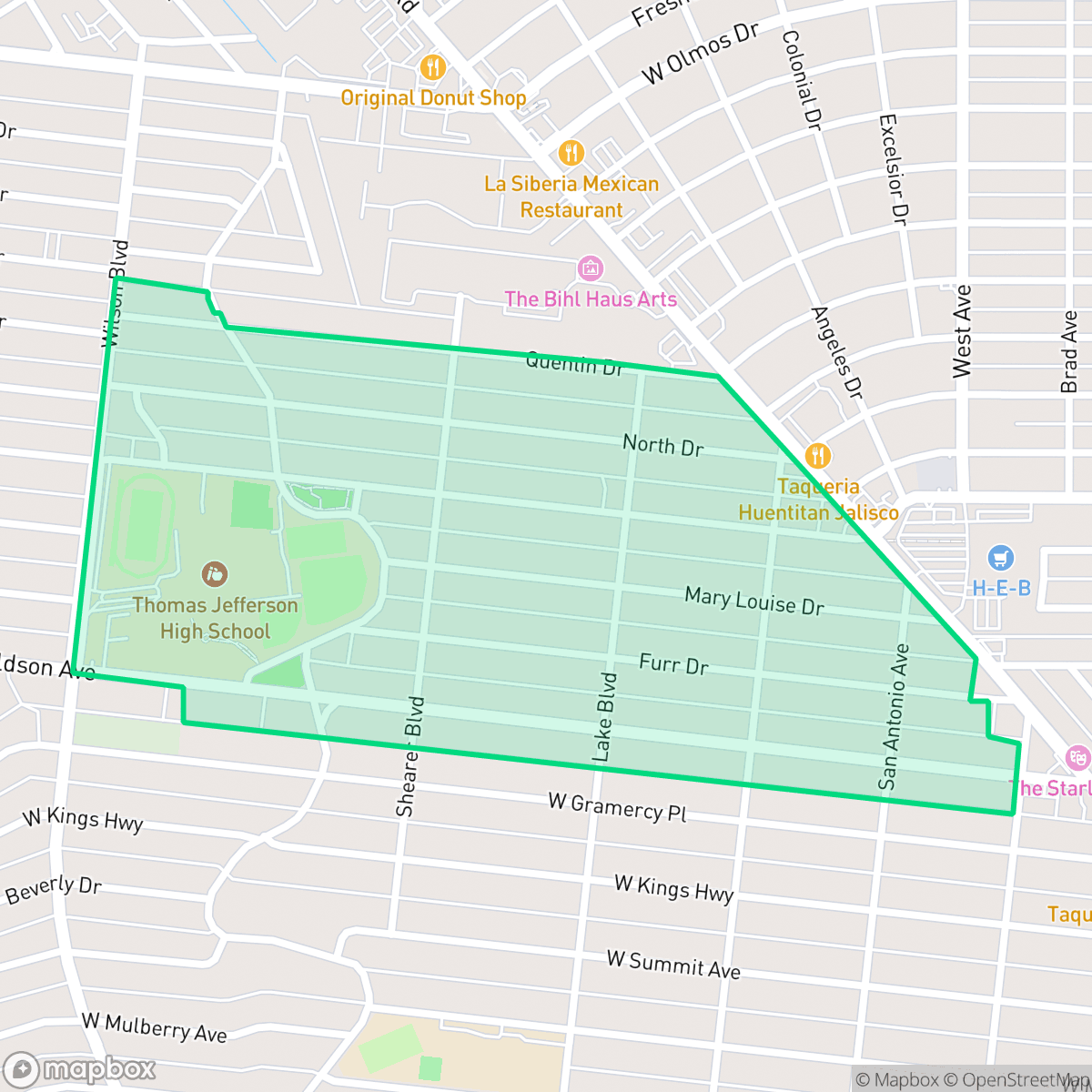
Developed in the late 1920s on former dairy farm land owned by George Calvert, San Antonio’s historic Jefferson-Monticello Park neighborhood was designed as a premier suburb named after Thomas Jefferson’s Virginia estate. The neighborhood showcases a rich array of architectural styles, including Spanish Revival, Tudor Revival, and Art Moderne, with many homes designed by prominent architect N. Straus Nayfach. Its crown jewel, Thomas Jefferson High School, opened in 1932; the Spanish Baroque/Moorish masterpiece was designed by Max Frederick on land originally slated for a luxury country club before the Great Depression. Known locally as the "neighborhood of mayors," it has been home to San Antonio leaders like Lila Cockrell and Phil Hardberger. Signature streets like Mary Louise Drive are celebrated for their wide, tree-lined lawns and distinct historic character.
The neighborhood maintains a distinct residential character defined by its quiet streets and established green spaces. With an acoustic comfort level well above the city average, it offers a serene living environment that is rare for such a central location. The area is highly walkable, allowing residents easy access to local amenities and the iconic Thomas Jefferson High School, which remains a central landmark for the community. While the immediate surroundings are primarily residential, the neighborhood benefits from strong infrastructure and high levels of local health insurance coverage among its residents.
Potential residents should consider that the area is relatively tranquil, with a lower-than-average liveliness score, suggesting it is better suited for those seeking a quiet suburban atmosphere rather than an active nightlife. While the neighborhood boasts excellent flood safety and minimal industrial proximity, the broader school district is currently undergoing significant administrative restructuring. The area is ideal for families and individuals who value historic charm and a walkable, low-noise environment over proximity to commercial hubs.
Neighborhood Scores Across 15 Qualities
Residential structures feature mixed spacing with some neighbors situated quite close together. This level of density is slightly higher than the San Antonio average, according to iHuus data.
Low traffic levels on residential streets allow for safe walking, though some areas lack a continuous sidewalk network. This level of walkability is roughly in line with the San Antonio average, according to iHuus data.
Standard tract housing with consistent roof geometries and small yards defines the local landscape. According to iHuus data, the visual variety in this area is roughly in line with the San Antonio average.
Public green space and accessible parkland are sparse in this area, with most greenery confined to private, fenced backyards. According to iHuus data, the availability of walking verges and open parkland is below the San Antonio average.
Residential pockets feature a mix of single-family homes and small commercial clusters, presenting a slightly more developed feel than the city average. According to iHuus data, the area maintains a dense suburban environment with limited open land.
A calm, suburban rhythm prevails with a balance of green space and residential streets. While certain social hubs and local eateries provide pockets of activity, the overall level of liveliness is slightly above the San Antonio average.
Steady sounds from nearby busy streets are present, though the acoustic environment is noticeably calmer than the San Antonio average according to iHuus data.
Frequent unhealthy air quality levels pose a significant risk to sensitive groups. According to iHuus data, pollution levels in this area are slightly worse than the San Antonio average.
Residents can enjoy a landscape free of heavy warehouses or industrial hazards, which is notably better than the San Antonio average. According to iHuus data, the area is primarily composed of residential streets and light commercial zones without large scale pollution sources.
Health insurance enrollment in this area is below the San Antonio average. According to iHuus data, fewer residents in this neighborhood possess active health coverage compared to the rest of the city.
Voting patterns and census indicators show a significantly more liberal leaning than the San Antonio average, according to iHuus data.
Residents live alongside a balanced mix of young adults, families, and older individuals. According to iHuus data, this demographic distribution is slightly more varied than the San Antonio average.
Frequent flood risks exist within this area because it is located inside a designated floodplain. According to iHuus data, the vulnerability to flooding is notably higher than the San Antonio average.
Address-Level Insights for Jefferson-Monticello Park


iHuus Neighborhood Intelligence Insights
Get address-level neighborhood insights for Jefferson-Monticello Park
- Street-level scores — see how individual blocks compare, not just neighborhood averages
- Micro-zone boundaries — identify quiet pockets, flood boundaries, and walkable clusters before you visit
- 15 dimensions in full — walkability, noise, air quality, school quality, insurance coverage, population age profile, urban/rural index, and more
- Boundary risk alerts — know if your address sits near a block boundary where scores drop, the kind of detail no listing will ever mention
- School insights — individual school ratings and insights, not just district-level data
- Compare before you commit — side-by-side data across neighborhoods, down to block precision
No credit card required
Compare with Any Neighborhood
| Dimension | Jefferson-Monticello Park | 145 Association |
|---|---|---|
| 🚶 Walkabilityavg 6.44 | ||
| 🔊 Acoustic Comfortavg 4.07 | ||
| 🤫 Privacy Indexavg 5.75 | ||
| 🎨 Visual Appealavg 6.11 | ||
| 🐕 Dog Friendlinessavg 5.91 | ||
| 🗺️ Urban-Rural Indexavg 6.87 | ||
| ✨ Neighborhood Vibeavg 4.35 | ||
| 🏥 Health Insurance Coverageavg 5.94 | ||
| 🌿 Air Qualityavg 2.27 | ||
| 🏭 Industrial Proximityavg 8.31 | ||
| 🌊 Flood Safetyavg 4.2 | ||
| 🗳️ Ideological Leanavg 7.37 | ||
| 👥 Population Age Profileavg 4.68 | ||
| 🔥 Fire Safety | ||
| 🏫 School Quality |
Jefferson-Monticello Park Rankings
School Districts Serving Jefferson-Monticello Park
School Insights for Jefferson-Monticello Park
Below average outcomes; significant attendance and academic challenges.
School Insights
See what's really behind every school rating near Jefferson-Monticello Park
- Individual school ratings — each school's own score with outcome context, not just a district average
- Enrollment & class size data — student-to-teacher ratio and how it compares to the state average
- Full demographics breakdown — ethnicity and gender composition for every school in the enrollment zone
- Every school in the district — all schools within the enrollment boundary ranked by rating, not just the closest one
- Grade levels & benchmarks — elementary through high school, with below/above state-average flags
No credit card required