Ingram Hills, San Antonio
Updated · 3,976 residents
Ingram Hills is a quiet, residential enclave in northwest San Antonio characterized by its mid-century charm and proximity to local green spaces like Joan Price Park. While the area offers a peaceful environment with high flood safety, residents should be aware of elevated road noise and environmental concerns regarding nearby industrial sites.
Key Highlights
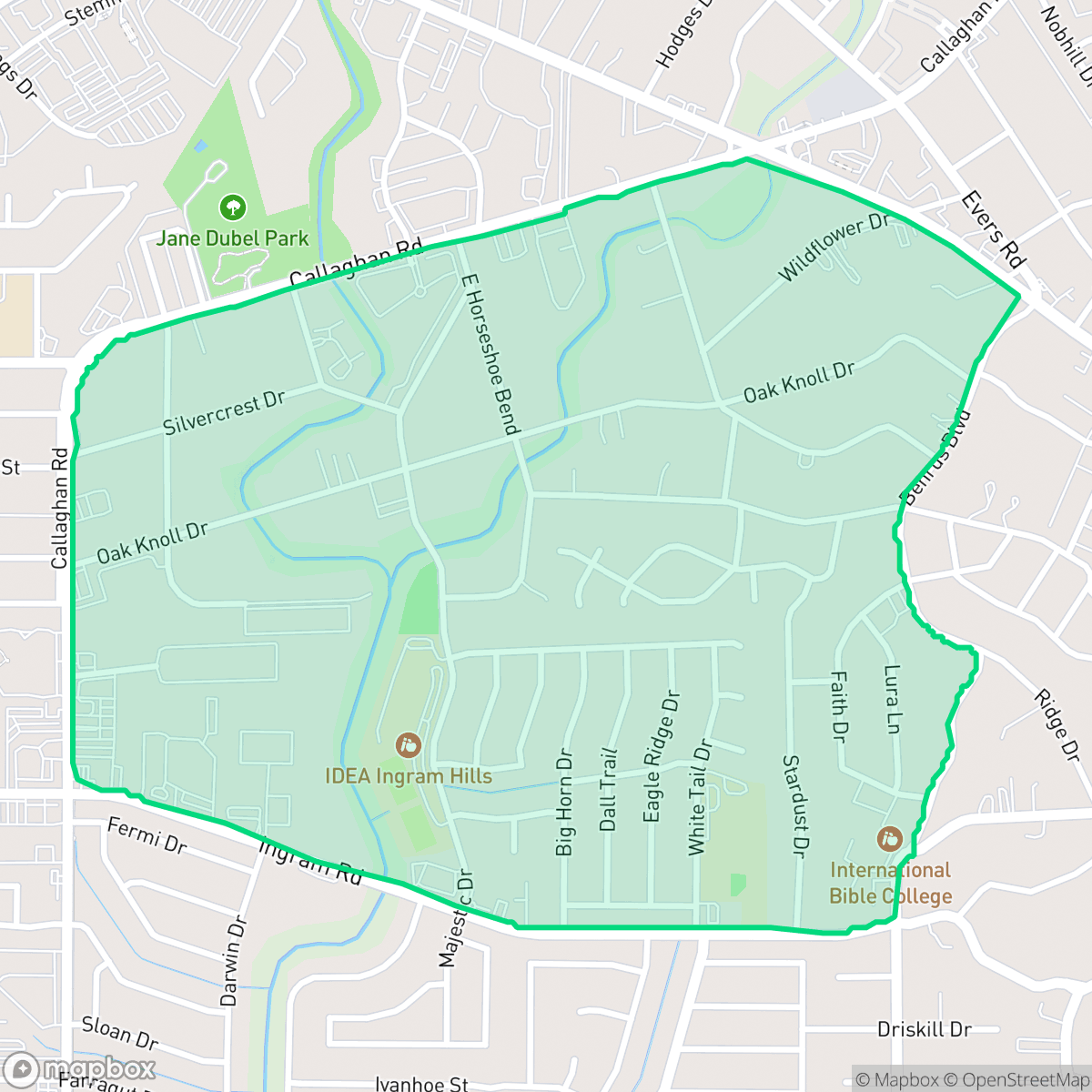
About Ingram Hills
Dating back to the 1920s and 1930s as a rural ranching area, Ingram Hills in northwest San Antonio began transitioning during World War II, notably hosting the Trahan Poultry Farm, which operated 24 hours a day to supply the U.S. Army. The neighborhood experienced residential development from the 1940s through the 1970s, characterized by mid-century modern and ranch-style homes built on spacious half-acre lots. Originally organized in 1988 as the Woodlawn Hills Neighborhood Action Association, the local neighborhood association has historically fought to preserve the area's tranquil, semi-pastoral character. Today, the community features Joan Price Park, named in honor of the neighborhood association's longtime president who fought encroaching density, alongside local landmarks like Chunks Burgers, famous for its spiciest-burger challenge featured on the Travel Channel.
The neighborhood serves as a primarily residential pocket in northwest San Antonio, maintaining a semi-pastoral atmosphere through its mix of mid-century homes and accessible green spaces. Residents enjoy a stable community environment with notable access to local dining, such as Maya Cafe and Los Habaneros, alongside recreational amenities like Joan Price Park. According to iHuus data, the area benefits from high flood safety ratings and strong health insurance coverage among its population, making it a stable choice for families seeking a grounded suburban experience. Living in this area involves specific trade-offs regarding environmental and acoustic factors. The neighborhood experiences significant road traffic noise and faces challenges with air quality, which are important considerations for prospective residents. Additionally, while the area is largely residential, its proximity to an EPA Superfund site requires awareness of potential soil and groundwater impacts. Despite these concerns, the community remains a distinct, ideologically cohesive pocket of the city that values its established character and local landmarks.
Neighborhood Scores Across 15 Qualities
Residential spacing varies throughout the area, with some apartment complexes positioned near single-family homes. According to iHuus data, neighbor distances are slightly higher than the San Antonio average, though backyard privacy remains limited in denser sections.
Low traffic on residential streets and cul-de-sacs provides safe routes for pedestrians, though intermittent sidewalks and large commercial barriers make the area slightly less walkable than the San Antonio average. According to iHuus data, while sidewalks are sparse, the quiet nature of the neighborhood streets allows for easy walking within residential pockets.
Uniform rooflines and modest yards characterize this area. The visual landscape matches the typical appearance of residential tracts found across San Antonio.
Walking opportunities for pets are primarily restricted to private yards and specific residential greenways. According to iHuus data, the lack of wide public sidewalk verges and large public parks makes this area less dog friendly than the San Antonio average.
Open land and wooded areas are common throughout the neighborhood, though the area feels slightly more suburban than the San Antonio average according to iHuus data. Residential pockets vary from dense suburban layouts to more scattered homes situated among fields.
Suburban streets and green spaces offer a peaceful atmosphere, but a lack of nearby businesses makes the area less lively than the San Antonio average. Most dining and service options require a vehicle for access.
Steady hum from nearby busy streets provides a consistent level of ambient sound. This acoustic environment is slightly more active than the typical San Antonio residential area, according to iHuus data.
Frequent unhealthy air quality levels pose significant risks to sensitive groups; according to iHuus data, conditions in this area are slightly worse than the San Antonio average.
Residential and light commercial land uses dominate the area with no significant industrial hazards visible. While the neighborhood is comparable to the city average regarding industrial proximity, residents should be aware that a nearby EPA Superfund site may present potential environmental concerns regarding soil or groundwater.
Health insurance access among residents is roughly in line with the San Antonio average. According to iHuus data, coverage levels in the area are moderate.
Voting patterns and census indicators show a strong liberal leaning that is more pronounced than the San Antonio average. According to iHuus data, the area maintains a distinct ideological profile compared to the rest of the city.
Residents live alongside a balanced mix of young adults, families, and seniors. According to iHuus data, this demographic spread is slightly more varied than the average seen across San Antonio.
Flood risk levels in this area are currently unverified because FEMA has not completed a detailed study for this specific location. According to iHuus data, the risk profile is consistent with the average found across San Antonio.
Address-Level Insights for Ingram Hills


iHuus Neighborhood Intelligence Insights
Get address-level neighborhood insights for Ingram Hills
- Street-level scores — see how individual blocks compare, not just neighborhood averages
- Micro-zone boundaries — identify quiet pockets, flood boundaries, and walkable clusters before you visit
- 15 dimensions in full — walkability, noise, air quality, school quality, insurance coverage, population age profile, urban/rural index, and more
- Boundary risk alerts — know if your address sits near a block boundary where scores drop, the kind of detail no listing will ever mention
- School insights — individual school ratings and insights, not just district-level data
- Compare before you commit — side-by-side data across neighborhoods, down to block precision
No credit card required
Compare with Any Neighborhood
| Dimension | Ingram Hills | 145 Association |
|---|---|---|
| 🚶 Walkabilityavg 6.44 | ||
| 🔊 Acoustic Comfortavg 4.07 | ||
| 🤫 Privacy Indexavg 5.75 | ||
| 🎨 Visual Appealavg 6.11 | ||
| 🐕 Dog Friendlinessavg 5.91 | ||
| 🗺️ Urban-Rural Indexavg 6.87 | ||
| ✨ Neighborhood Vibeavg 4.35 | ||
| 🏥 Health Insurance Coverageavg 5.94 | ||
| 🌿 Air Qualityavg 2.27 | ||
| 🏭 Industrial Proximityavg 8.31 | ||
| 🌊 Flood Safetyavg 4.2 | ||
| 🗳️ Ideological Leanavg 7.37 | ||
| 👥 Population Age Profileavg 4.68 | ||
| 🔥 Fire Safety | ||
| 🏫 School Quality |
Ingram Hills Rankings
School Districts Serving Ingram Hills
School Insights for Ingram Hills
Below average outcomes; significant attendance and academic challenges.
School Insights
See what's really behind every school rating near Ingram Hills
- Individual school ratings — each school's own score with outcome context, not just a district average
- Enrollment & class size data — student-to-teacher ratio and how it compares to the state average
- Full demographics breakdown — ethnicity and gender composition for every school in the enrollment zone
- Every school in the district — all schools within the enrollment boundary ranked by rating, not just the closest one
- Grade levels & benchmarks — elementary through high school, with below/above state-average flags
No credit card required