Hot Wells, San Antonio
Updated · 6,018 residents
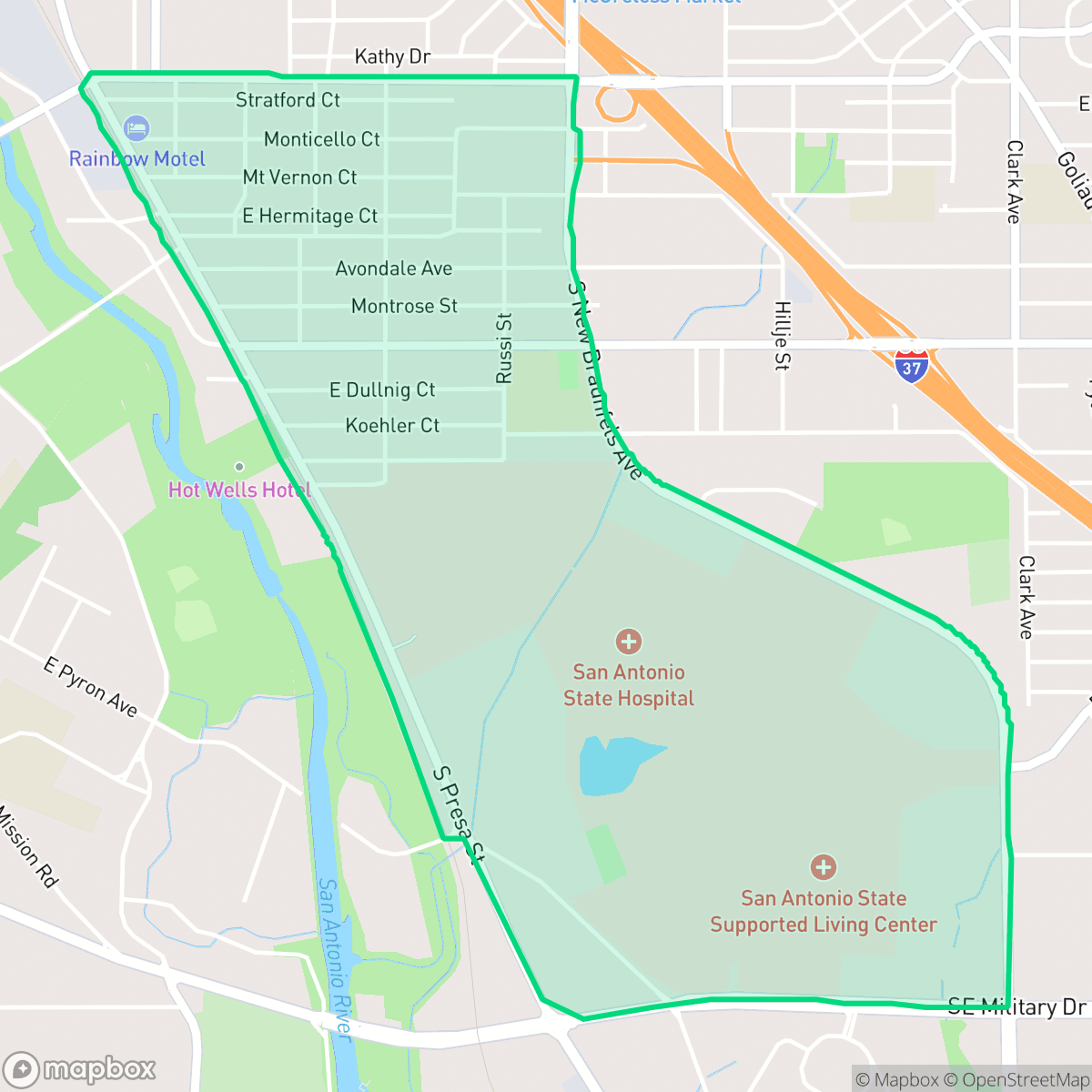
Hot Wells is a Southside San Antonio community defined by its proximity to the Mission Reach trail and historic bathhouse ruins. The area features a mix of modest, tightly spaced single-family homes and open, undeveloped land that offers a quiet, suburban atmosphere. Residents here benefit from relatively low noise levels, though the neighborhood remains car-dependent with limited walkability and few local commercial amenities.
Key Highlights
About Hot Wells
Located on San Antonio’s Southside, the Hot Wells neighborhood is historically defined by the Hot Wells resort. Originating in 1892 after the discovery of an artesian sulfur well, the site was developed into a premier Victorian-style health spa and resort by local brewer Otto Koehler in 1901. During its early 20th-century heyday, it served as a luxurious destination for celebrities like Charlie Chaplin and Teddy Roosevelt, and hosted the Star Film Company, a silent movie studio. Following devastating fires in 1925 and the late 1900s, the resort fell into ruin. In 2019, the stabilized bathhouse ruins were opened to the public as Hot Wells of Bexar County, a heritage park. Today, this landmark connects the neighborhood to the San Antonio River Walk’s Mission Reach trail and the nearby UNESCO World Heritage San Antonio Missions.
This community serves as a gateway to the San Antonio Missions, blending its unique heritage with a quiet residential landscape. The street layout consists of a low-density grid characterized by modest, single-story homes and frequent patches of open space. While the area maintains a peaceful acoustic environment, it is bordered by major transit corridors, which contributes to the presence of light industrial and warehouse facilities nearby.
Prospective residents should note that the area is primarily car-dependent, as the lack of consistent sidewalks and nearby businesses makes daily errands challenging to complete on foot. The local housing stock is dense with small lot sizes, offering limited privacy in some residential clusters. While the neighborhood provides access to significant green space and historical landmarks, families should consider that local schools within the San Antonio Independent School District face ongoing academic challenges. The area is best suited for those seeking a quiet, budget-conscious environment with easy access to the city's southern cultural sites.
Neighborhood Scores Across 15 Qualities
Residential spacing varies from closely packed homes to open scrubland, providing a sense of privacy that is slightly higher than the San Antonio average. According to iHuus data, some areas feature dense clusters while others are buffered by riparian corridors and fields.
Low traffic on residential streets allows for walking, but a lack of consistent sidewalks and nearby highway barriers make pedestrian travel more difficult than in most parts of San Antonio. According to iHuus data, the presence of large industrial zones and wide intersections significantly limits overall connectivity for those on foot.
Modest tract housing and older mobile homes define the local landscape, which offers less greenery and fewer amenities than the San Antonio average. According to iHuus data, the area features small lot sizes and some unpaved patches near industrial zones.
Large river-adjacent parks and continuous green buffers provide reliable walking space for pets, making the area slightly more dog friendly than the San Antonio average. According to iHuus data, some residential blocks also feature wide green verges suitable for outdoor activity.
Open land and scattered homes among woodlands provide a semi-rural atmosphere that is slightly less developed than the San Antonio average. According to iHuus data, the landscape features a mix of residential pockets and significant green space.
Local activity is characterized by a steady rhythm of suburban and light industrial life, though most dining and services require a vehicle to access. This level of liveliness is slightly above the San Antonio average, providing a balanced but low-density environment.
Steady hum from nearby busy streets characterizes the acoustic environment. According to iHuus data, sound levels are slightly higher than the San Antonio average.
Frequent unhealthy air quality levels pose a significant risk to sensitive groups. This area experiences worse air conditions than the San Antonio average, according to iHuus data.
Mostly residential streets define the area, though proximity to a major highway and nearby warehouses introduces more commercial traffic and noise than the San Antonio average. According to iHuus data, some eastern edges feature logistics hubs and utility buildings near residential pockets.
Health insurance accessibility is lower than the San Antonio average, meaning a smaller portion of the population has coverage. According to iHuus data, residents may face more challenges accessing employer-sponsored or private health plans compared to many other parts of the city.
Voting patterns and census indicators show a distinctly liberal leaning that is more pronounced than the San Antonio average. This political landscape is reflected in the local community demographics, according to iHuus data.
A balanced mix of young adults, families, and older residents characterizes the area. This demographic distribution is largely in line with the typical age profile found across San Antonio.
Significant flood risk exists in this area due to its location within a 100-year floodplain. According to iHuus data, this level of susceptibility is notably higher than the San Antonio average and often necessitates flood insurance.
Address-Level Insights for Hot Wells


iHuus Neighborhood Intelligence Insights
Get address-level neighborhood insights for Hot Wells
- Street-level scores — see how individual blocks compare, not just neighborhood averages
- Micro-zone boundaries — identify quiet pockets, flood boundaries, and walkable clusters before you visit
- 15 dimensions in full — walkability, noise, air quality, school quality, insurance coverage, population age profile, urban/rural index, and more
- Boundary risk alerts — know if your address sits near a block boundary where scores drop, the kind of detail no listing will ever mention
- School insights — individual school ratings and insights, not just district-level data
- Compare before you commit — side-by-side data across neighborhoods, down to block precision
No credit card required
Compare with Any Neighborhood
| Dimension | Hot Wells | 145 Association |
|---|---|---|
| 🚶 Walkabilityavg 6.44 | ||
| 🔊 Acoustic Comfortavg 4.07 | ||
| 🤫 Privacy Indexavg 5.75 | ||
| 🎨 Visual Appealavg 6.11 | ||
| 🐕 Dog Friendlinessavg 5.91 | ||
| 🗺️ Urban-Rural Indexavg 6.87 | ||
| ✨ Neighborhood Vibeavg 4.35 | ||
| 🏥 Health Insurance Coverageavg 5.94 | ||
| 🌿 Air Qualityavg 2.27 | ||
| 🏭 Industrial Proximityavg 8.31 | ||
| 🌊 Flood Safetyavg 4.2 | ||
| 🗳️ Ideological Leanavg 7.37 | ||
| 👥 Population Age Profileavg 4.68 | ||
| 🔥 Fire Safety | ||
| 🏫 School Quality |
Hot Wells Rankings
School Districts Serving Hot Wells
School Insights for Hot Wells
Below average outcomes; significant attendance and academic challenges.
School Insights
See what's really behind every school rating near Hot Wells
- Individual school ratings — each school's own score with outcome context, not just a district average
- Enrollment & class size data — student-to-teacher ratio and how it compares to the state average
- Full demographics breakdown — ethnicity and gender composition for every school in the enrollment zone
- Every school in the district — all schools within the enrollment boundary ranked by rating, not just the closest one
- Grade levels & benchmarks — elementary through high school, with below/above state-average flags
No credit card required