Historic Gardens, San Antonio
Updated · 495 residents
Historic Gardens is a compact enclave situated near the Alamodome, characterized by its dense residential grid and proximity to downtown landmarks. While the area offers immediate access to cultural hubs like St. Paul Square, residents experience limited pedestrian infrastructure and a high density of homes with minimal privacy.
Key Highlights
About Historic Gardens
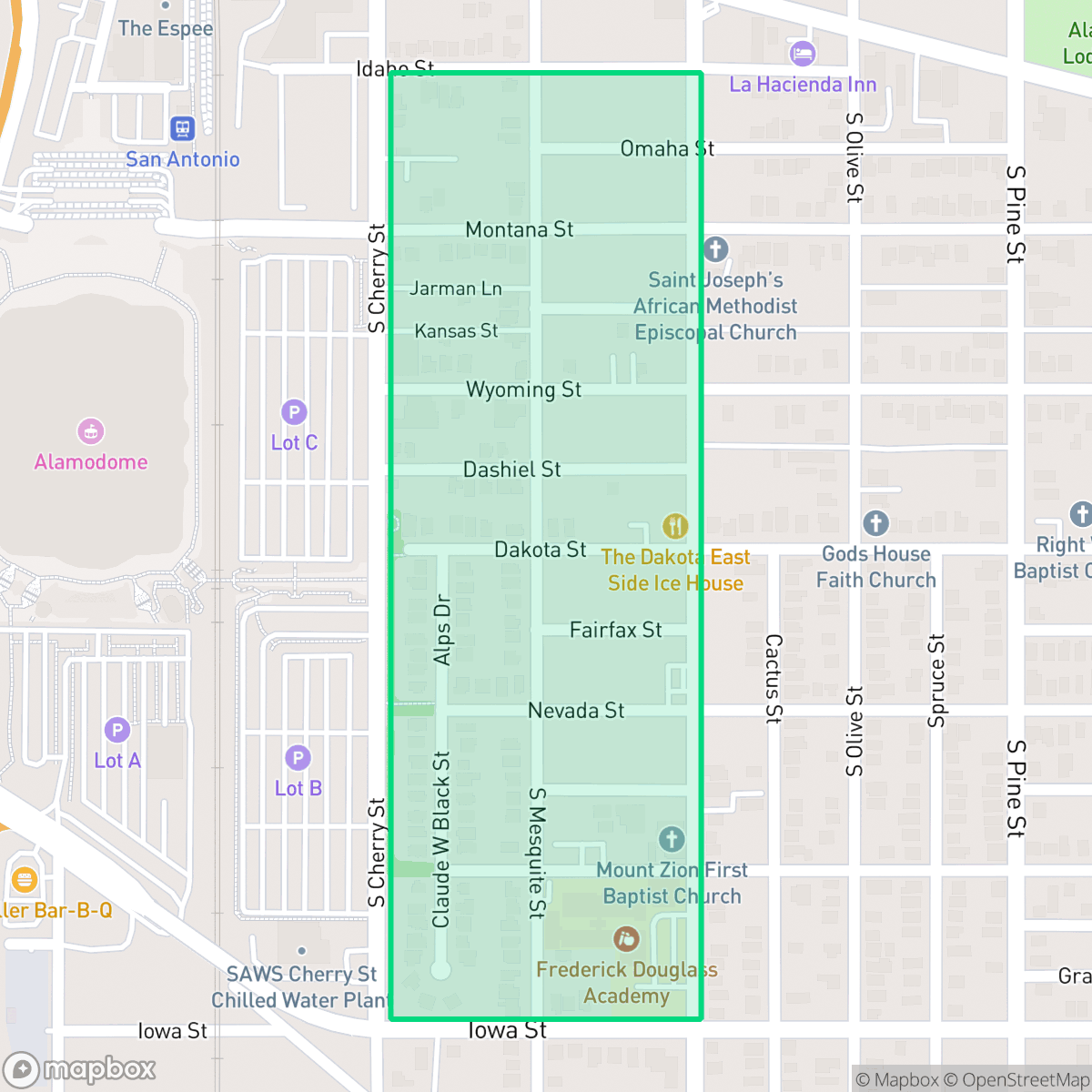
The Historic Gardens neighborhood, also known as Alamodome Gardens, is a historic enclave on San Antonio’s near East Side, situated directly parallel to the Alamodome and in the shadow of the Tower of the Americas. Dating back to the late 19th and early 20th centuries, the neighborhood features a mix of architectural styles, including classic bungalows and prominent historic residences. A notable landmark is the Queen Anne-style home at 403 Montana Street, designed in 1897 by influential architect Frederick Bowen Gaenslen for Nicholas Lee Petrich, the founder of the Petrich-Saur Lumber Company. Straddling downtown and the East Side, the neighborhood offers immediate proximity to Hemisfair, St. Paul Square, and the Hays Street Bridge, making it a culturally rich pocket that blends deep local history with modern urban development.
The area functions as a dense, low-rise urban pocket that sits adjacent to major transit corridors and stadium parking facilities. It maintains a distinct identity through its proximity to the Tower of the Americas and various local dining staples, such as Thai Lucky and Tony G's Soul Food. According to iHuus data, the neighborhood occupies a unique space between industrial-adjacent utility and residential history, offering a quiet atmosphere despite its location near significant regional landmarks.
Prospective residents should note that the area presents specific livability trade-offs, including a lack of public park space and inconsistent sidewalk connectivity that impacts overall walkability. The housing stock is tightly clustered, which results in limited privacy between properties. With a school district currently undergoing major structural changes and a low flood safety score, the neighborhood is best suited for those prioritizing central access to downtown San Antonio over traditional suburban amenities.
Neighborhood Scores Across 15 Qualities
Housing density is higher than the San Antonio average, with some areas featuring very small lots and structures positioned closely together. While some neighbors maintain a buffer, certain sections of the neighborhood feature high density living with minimal separation between buildings.
Quiet streets offer some opportunities for walking, but the lack of consistent sidewalks and the presence of high-traffic roads make the area less walkable than the San Antonio average.
Dense housing and high structure density characterize this area, which features fewer yards and amenities than the San Antonio average. According to iHuus data, the landscape is primarily composed of small, irregular rooflines and limited vegetation.
Fenced backyards are the primary feature for pets here, as the area lacks visible public parks and sidewalk verges. According to iHuus data, the availability of shared outdoor dog spaces is slightly below the San Antonio average.
Residential streets and green spaces are distributed in roughly equal measure, offering a more suburban feel than the typical San Antonio density. According to iHuus data, the area features a low-density environment characterized by a dense grid of single-story buildings.
A balanced rhythm of residential life and local services defines this area. According to iHuus data, the neighborhood features a subdued energy that is roughly comparable to the city average.
Steady traffic sounds from nearby busy streets are present, though the area remains slightly quieter than the San Antonio average according to iHuus data.
Frequent unhealthy air quality levels pose significant risks to sensitive groups. According to iHuus data, conditions in this area are slightly worse than the San Antonio average.
Residential streets and open green spaces dominate the area, with only occasional light commercial activity or low-level operational noise from nearby services. This lack of industrial density is slightly better than the San Antonio average.
Health insurance accessibility is slightly lower than the San Antonio average. According to iHuus data, fewer residents in this area have access to employer or private health plans compared to the rest of the city.
Voting patterns and census indicators reflect a predominantly liberal political leaning that is significantly more pronounced than the San Antonio average.
A balanced mix of young adults, families, and older residents characterizes this area. This demographic spread is consistent with the broader San Antonio area, according to iHuus data.
Located within a designated floodplain, this area faces a greater risk of flooding than much of San Antonio. Residents should anticipate the potential need for flood insurance according to iHuus data.
Address-Level Insights for Historic Gardens


iHuus Neighborhood Intelligence Insights
Get address-level neighborhood insights for Historic Gardens
- Street-level scores — see how individual blocks compare, not just neighborhood averages
- Micro-zone boundaries — identify quiet pockets, flood boundaries, and walkable clusters before you visit
- 15 dimensions in full — walkability, noise, air quality, school quality, insurance coverage, population age profile, urban/rural index, and more
- Boundary risk alerts — know if your address sits near a block boundary where scores drop, the kind of detail no listing will ever mention
- School insights — individual school ratings and insights, not just district-level data
- Compare before you commit — side-by-side data across neighborhoods, down to block precision
No credit card required
Compare with Any Neighborhood
| Dimension | Historic Gardens | 145 Association |
|---|---|---|
| 🚶 Walkabilityavg 6.44 | ||
| 🔊 Acoustic Comfortavg 4.07 | ||
| 🤫 Privacy Indexavg 5.75 | ||
| 🎨 Visual Appealavg 6.11 | ||
| 🐕 Dog Friendlinessavg 5.91 | ||
| 🗺️ Urban-Rural Indexavg 6.87 | ||
| ✨ Neighborhood Vibeavg 4.35 | ||
| 🏥 Health Insurance Coverageavg 5.94 | ||
| 🌿 Air Qualityavg 2.27 | ||
| 🏭 Industrial Proximityavg 8.31 | ||
| 🌊 Flood Safetyavg 4.2 | ||
| 🗳️ Ideological Leanavg 7.37 | ||
| 👥 Population Age Profileavg 4.68 | ||
| 🔥 Fire Safety | ||
| 🏫 School Quality |
Historic Gardens Rankings
School Districts Serving Historic Gardens
School Insights for Historic Gardens
Below average outcomes; significant attendance and academic challenges.
School Insights
See what's really behind every school rating near Historic Gardens
- Individual school ratings — each school's own score with outcome context, not just a district average
- Enrollment & class size data — student-to-teacher ratio and how it compares to the state average
- Full demographics breakdown — ethnicity and gender composition for every school in the enrollment zone
- Every school in the district — all schools within the enrollment boundary ranked by rating, not just the closest one
- Grade levels & benchmarks — elementary through high school, with below/above state-average flags
No credit card required