Hills and Dales, San Antonio
Updated · 3,967 residents
Hills and Dales is a quiet, low-density neighborhood on San Antonio’s northwest side that balances expansive green spaces with proximity to local institutions like the University of Texas at San Antonio. While the area offers high visual appeal and a distinct rural character, residents should expect significant noise levels from nearby road traffic.
Key Highlights
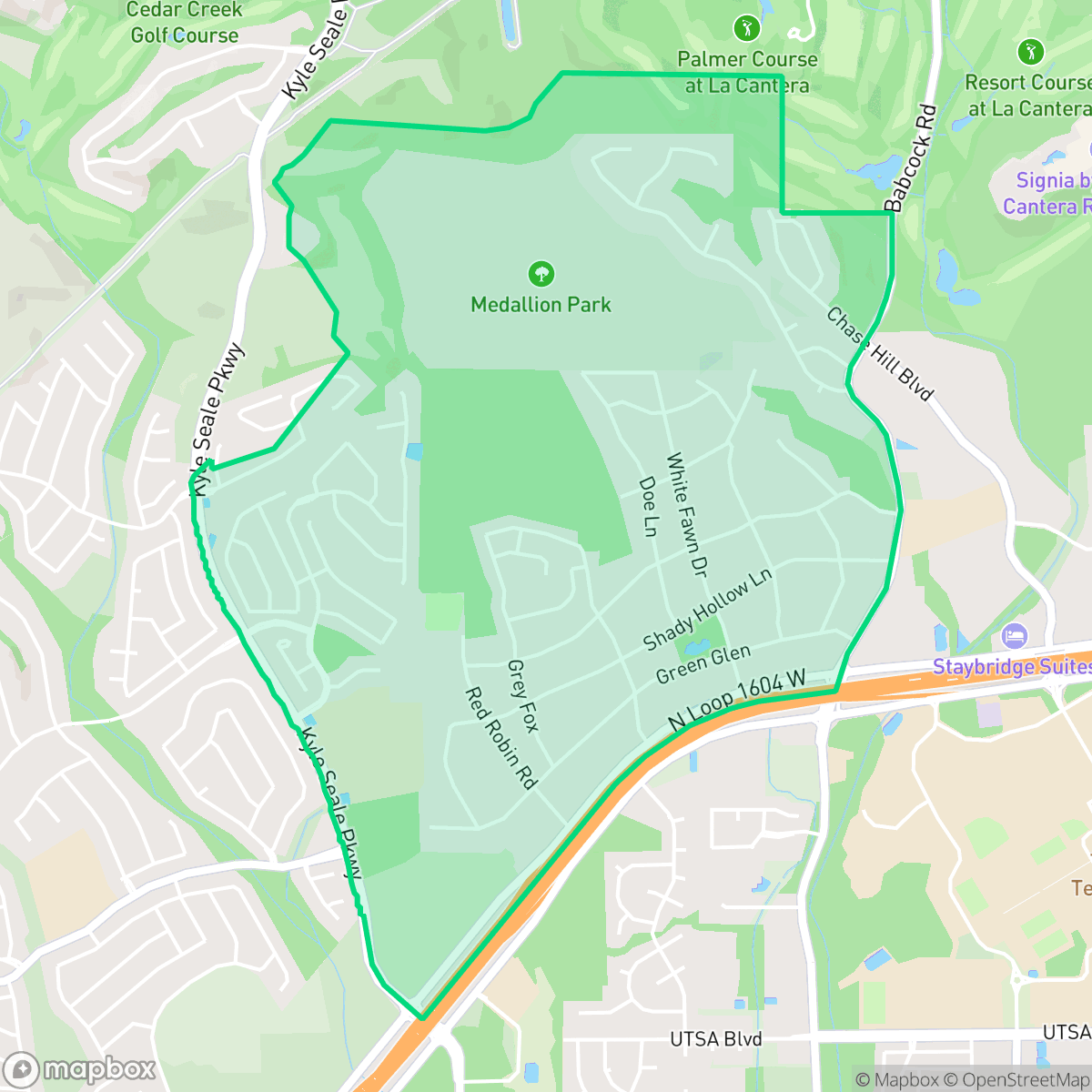
About Hills and Dales
Established in 1965 on the northwest side of San Antonio, Hills and Dales began as a quiet, rural enclave in Bexar County. The neighborhood’s development evolved alongside the growth of the nearby University of Texas at San Antonio (UTSA). Its defining local landmark is the legendary Hills & Dales Ice House on White Fawn Drive. Opened in the mid-1970s by Coleman Davenport, it originally operated as a country general store where locals bought groceries and drank beer cooled by fans blowing over ice troughs. Over the decades, the ice house transitioned from a rural general store and a popular biker hangout into a beloved, craft-beer-focused neighborhood institution known as the "Center of the Universe," popular with UTSA students, faculty, and long-time residents alike.
The neighborhood is characterized by a blend of quiet, low-density residential streets and significant open green spaces, providing a scenic environment that stands out for its visual appeal. It maintains a strong sense of separation from urban congestion, offering a rural atmosphere despite its location on the northwest side of the city. The area is primarily residential, featuring scattered structures and local landmarks like Our Lady Of The Atonement Catholic Church, which contribute to its peaceful, non-industrial environment. Residents benefit from high rates of health insurance coverage and access to quality education within the Northside Independent School District, including the highly-rated Garcia Middle School.
Living in this area requires a reliance on personal vehicles, as the neighborhood is largely car-dependent despite some walkable paths. Prospective residents should consider that the proximity to major highways results in elevated noise levels, which may impact acoustic comfort in certain sections. The neighborhood is well-suited for those who prioritize a quieter, more spacious living environment over the high-energy, dense urban lifestyle found elsewhere in San Antonio. While it lacks a high concentration of commercial services, the community remains a stable and attractive option for families and individuals seeking a balance between suburban comfort and access to nearby academic and regional resources.
Neighborhood Scores Across 15 Qualities
Residential spacing offers a balanced level of separation between neighbors. This degree of privacy is slightly higher than the typical experience across San Antonio.
Sidewalks are available on one side of the street and safe crossings are present. This level of pedestrian accessibility is slightly above the San Antonio average, according to iHuus data.
Large residential lots and well-maintained amenities provide a more polished aesthetic than the San Antonio average, according to iHuus data.
Large connected green spaces and wide, traffic-safe paths make this area significantly more accommodating for dog owners than the San Antonio average. According to iHuus data, the neighborhood provides ample opportunities for safe outdoor exercise.
Frequent open land and scattered homes amid woodland provide a more open environment than most of San Antonio. According to iHuus data, this area features a higher degree of undeveloped space compared to the city average.
Residential life here is primarily quiet and low-density, with much of the area characterized by vast open spaces and a remote feel. While some pockets offer localized dining, the neighborhood lacks the consistent commercial activity found in more active parts of San Antonio.
Frequent noise from nearby freeways and railroad lines makes this area significantly louder than the San Antonio average. Residents may experience consistent auditory disturbances due to proximity to major transit corridors.
Frequent unhealthy air quality levels pose significant risks to sensitive groups. According to iHuus data, air quality in this area is consistent with the city average.
Residential living remains undisturbed by warehouses or heavy manufacturing, offering a cleaner environment than much of San Antonio. According to iHuus data, there are no detected industrial facilities or hazardous sites within the neighborhood boundaries.
Health insurance access is significantly higher than the San Antonio average, according to iHuus data. This indicates a strong level of medical coverage among the local population.
Political leanings in this area trend toward liberal views, though the neighborhood is less progressive than the San Antonio average according to iHuus data.
Residents live alongside a balanced mix of young adults, families, and older populations. This demographic spread is slightly lower than the San Antonio average, according to iHuus data.
Flood risk in this area is higher than the San Antonio average, though official FEMA studies for this specific neighborhood remain incomplete. Residents should remain aware of potential localized flooding during heavy rain events.
Address-Level Insights for Hills and Dales


iHuus Neighborhood Intelligence Insights
Get address-level neighborhood insights for Hills and Dales
- Street-level scores — see how individual blocks compare, not just neighborhood averages
- Micro-zone boundaries — identify quiet pockets, flood boundaries, and walkable clusters before you visit
- 15 dimensions in full — walkability, noise, air quality, school quality, insurance coverage, population age profile, urban/rural index, and more
- Boundary risk alerts — know if your address sits near a block boundary where scores drop, the kind of detail no listing will ever mention
- School insights — individual school ratings and insights, not just district-level data
- Compare before you commit — side-by-side data across neighborhoods, down to block precision
No credit card required
Compare with Any Neighborhood
| Dimension | Hills and Dales | 145 Association |
|---|---|---|
| 🚶 Walkabilityavg 6.44 | ||
| 🔊 Acoustic Comfortavg 4.07 | ||
| 🤫 Privacy Indexavg 5.75 | ||
| 🎨 Visual Appealavg 6.11 | ||
| 🐕 Dog Friendlinessavg 5.91 | ||
| 🗺️ Urban-Rural Indexavg 6.87 | ||
| ✨ Neighborhood Vibeavg 4.35 | ||
| 🏥 Health Insurance Coverageavg 5.94 | ||
| 🌿 Air Qualityavg 2.27 | ||
| 🏭 Industrial Proximityavg 8.31 | ||
| 🌊 Flood Safetyavg 4.2 | ||
| 🗳️ Ideological Leanavg 7.37 | ||
| 👥 Population Age Profileavg 4.68 | ||
| 🔥 Fire Safety | ||
| 🏫 School Quality |
Hills and Dales Rankings
School Districts Serving Hills and Dales
School Insights for Hills and Dales
Below average outcomes; significant attendance and academic challenges.
School Insights
See what's really behind every school rating near Hills and Dales
- Individual school ratings — each school's own score with outcome context, not just a district average
- Enrollment & class size data — student-to-teacher ratio and how it compares to the state average
- Full demographics breakdown — ethnicity and gender composition for every school in the enrollment zone
- Every school in the district — all schools within the enrollment boundary ranked by rating, not just the closest one
- Grade levels & benchmarks — elementary through high school, with below/above state-average flags
No credit card required