Highland Park, San Antonio
Updated · 12,501 residents
Highland Park is a historic streetcar suburb in San Antonio defined by its early 20th-century architectural character and quiet, grid-based residential layout. While the area offers a serene suburban environment, residents experience notable noise levels from nearby highway traffic and limited access to public green space.
Key Highlights
About Highland Park
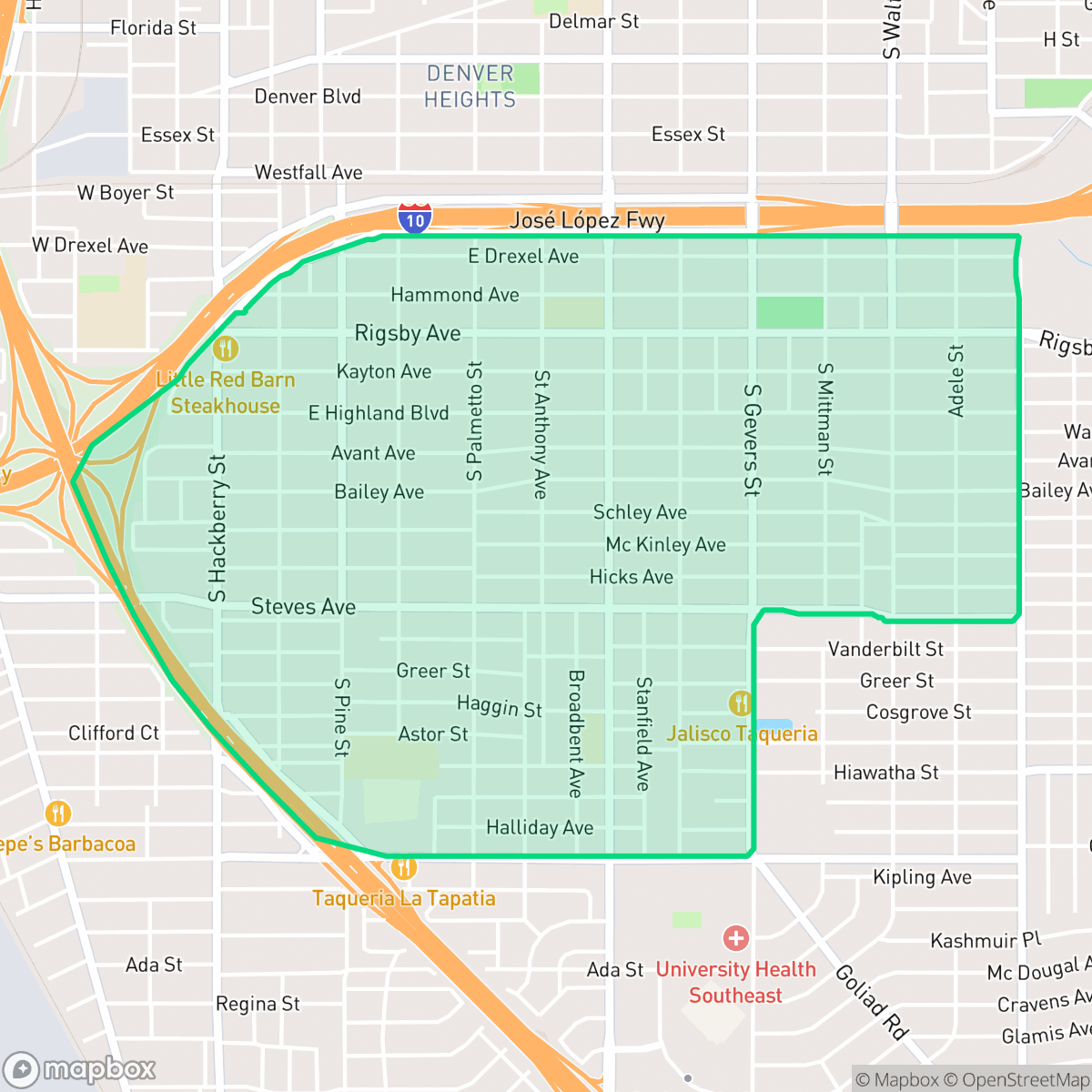
Established southeast of downtown San Antonio, Highland Park originated in 1909 when investors purchased 780 acres of former dairy pasture from Albert Steves Jr. Marketed as a premier streetcar suburb, the neighborhood grew rapidly, aided by the No. 10 trolley line. Its early 20th-century architectural character is defined by historic bungalows, Spanish Revival homes, and the landmark 1914 Highland Park Elementary School. Notable residents included pioneering panoramic photographer E.O. Goldbeck, who lived and worked in a unique three-story stone home on Drexel Avenue. In the early 1960s, strong community opposition successfully diverted Interstate 37 from cutting through the neighborhood's center, preserving its historic grid layout. Today, the 4.9-acre Highland Park and its 1932 community center remain central gathering spaces.
The neighborhood maintains a consistent suburban residential grid characterized by modest single-family homes and a lack of heavy industrial development. Although the streets are walkable, the dense tree canopy and proximity to major highway corridors create an environment that is generally quiet but impacted by road noise. Local dining options are scattered throughout the area, providing residents with steady, if limited, service options within a short distance of their homes.
Prospective residents should consider the trade-offs associated with the area, including lower acoustic comfort due to highway proximity and significant flood risks. According to iHuus data, the neighborhood features a high ideological lean and moderate health insurance coverage. While the local elementary school provides a stable educational option, the broader school district faces ongoing structural challenges. This area is best suited for those seeking a traditional, quiet residential setting who are comfortable with the inherent noise and environmental constraints of living near major transportation arteries.
Neighborhood Scores Across 15 Qualities
Housing density is typical for the area, with homes situated on standard suburban lots that offer moderate separation between neighbors. According to iHuus data, the spacing between residences is roughly in line with the San Antonio average.
Pedestrian connectivity is inconsistent because sidewalks are frequently missing on residential streets or obscured by heavy tree canopy. While the grid layout is easy to navigate, a major highway corridor acts as a significant barrier for walkers, making the area slightly less walkable than the San Antonio average.
Standard tract housing with small yards and simple roof geometries defines the landscape. According to iHuus data, the area lacks luxury amenities and presents a less visually diverse environment than the San Antonio average.
Public access to parks and wide grass verges is sparse, as most greenery is contained within private backyards. This area offers fewer opportunities for outdoor dog walking compared to the San Antonio average.
Residential layouts feature a dense suburban grid with significant tree canopy and scattered single-family homes. This setting is slightly less open than the typical San Antonio landscape, offering a more established suburban feel according to iHuus data.
Suburban streets and light industrial pockets create a steady but low-key atmosphere that is slightly below the San Antonio average for activity. While various dining and local services are present, the area remains largely car-dependent with limited walkable commercial density.
Frequent noise from nearby busy streets creates a persistent background hum that is slightly more noticeable than the typical San Antonio level. According to iHuus data, this moderate acoustic environment is primarily driven by local traffic patterns.
Frequent unhealthy air quality levels pose a significant risk to sensitive groups. According to iHuus data, conditions in Highland Park are worse than the San Antonio average.
Primarily residential and light commercial, this area lacks heavy industrial sites or large warehouses. While the neighborhood is similar to the city average, proximity to a major highway may introduce some localized noise and air pollution.
Health insurance accessibility in Highland Park is slightly lower than the San Antonio average. According to iHuus data, a significant portion of the resident population remains uninsured.
Voting patterns and census indicators show a significantly more liberal leaning than the San Antonio average, according to iHuus data.
Residents live alongside a balanced distribution of young adults, families, and older populations. This demographic spread is slightly more varied than the San Antonio average, according to iHuus data.
Frequent flooding is a significant concern in this area because it sits within a designated floodplain. According to iHuus data, the risk of flood damage here is considerably higher than the San Antonio average.
Address-Level Insights for Highland Park


iHuus Neighborhood Intelligence Insights
Get address-level neighborhood insights for Highland Park
- Street-level scores — see how individual blocks compare, not just neighborhood averages
- Micro-zone boundaries — identify quiet pockets, flood boundaries, and walkable clusters before you visit
- 15 dimensions in full — walkability, noise, air quality, school quality, insurance coverage, population age profile, urban/rural index, and more
- Boundary risk alerts — know if your address sits near a block boundary where scores drop, the kind of detail no listing will ever mention
- School insights — individual school ratings and insights, not just district-level data
- Compare before you commit — side-by-side data across neighborhoods, down to block precision
No credit card required
Compare with Any Neighborhood
| Dimension | Highland Park | 145 Association |
|---|---|---|
| 🚶 Walkabilityavg 6.44 | ||
| 🔊 Acoustic Comfortavg 4.07 | ||
| 🤫 Privacy Indexavg 5.75 | ||
| 🎨 Visual Appealavg 6.11 | ||
| 🐕 Dog Friendlinessavg 5.91 | ||
| 🗺️ Urban-Rural Indexavg 6.87 | ||
| ✨ Neighborhood Vibeavg 4.35 | ||
| 🏥 Health Insurance Coverageavg 5.94 | ||
| 🌿 Air Qualityavg 2.27 | ||
| 🏭 Industrial Proximityavg 8.31 | ||
| 🌊 Flood Safetyavg 4.2 | ||
| 🗳️ Ideological Leanavg 7.37 | ||
| 👥 Population Age Profileavg 4.68 | ||
| 🔥 Fire Safety | ||
| 🏫 School Quality |
Highland Park Rankings
School Districts Serving Highland Park
School Insights for Highland Park
Below average outcomes; significant attendance and academic challenges.
School Insights
See what's really behind every school rating near Highland Park
- Individual school ratings — each school's own score with outcome context, not just a district average
- Enrollment & class size data — student-to-teacher ratio and how it compares to the state average
- Full demographics breakdown — ethnicity and gender composition for every school in the enrollment zone
- Every school in the district — all schools within the enrollment boundary ranked by rating, not just the closest one
- Grade levels & benchmarks — elementary through high school, with below/above state-average flags
No credit card required