Greater Harmony Hills, San Antonio
Updated · 10,038 residents
Greater Harmony Hills is an established San Antonio neighborhood defined by its mid-century modern character and mature tree canopy. Residents benefit from access to high-performing schools and a stable suburban environment, though the area is primarily car-dependent and experiences noticeable road noise.
Key Highlights
About Greater Harmony Hills
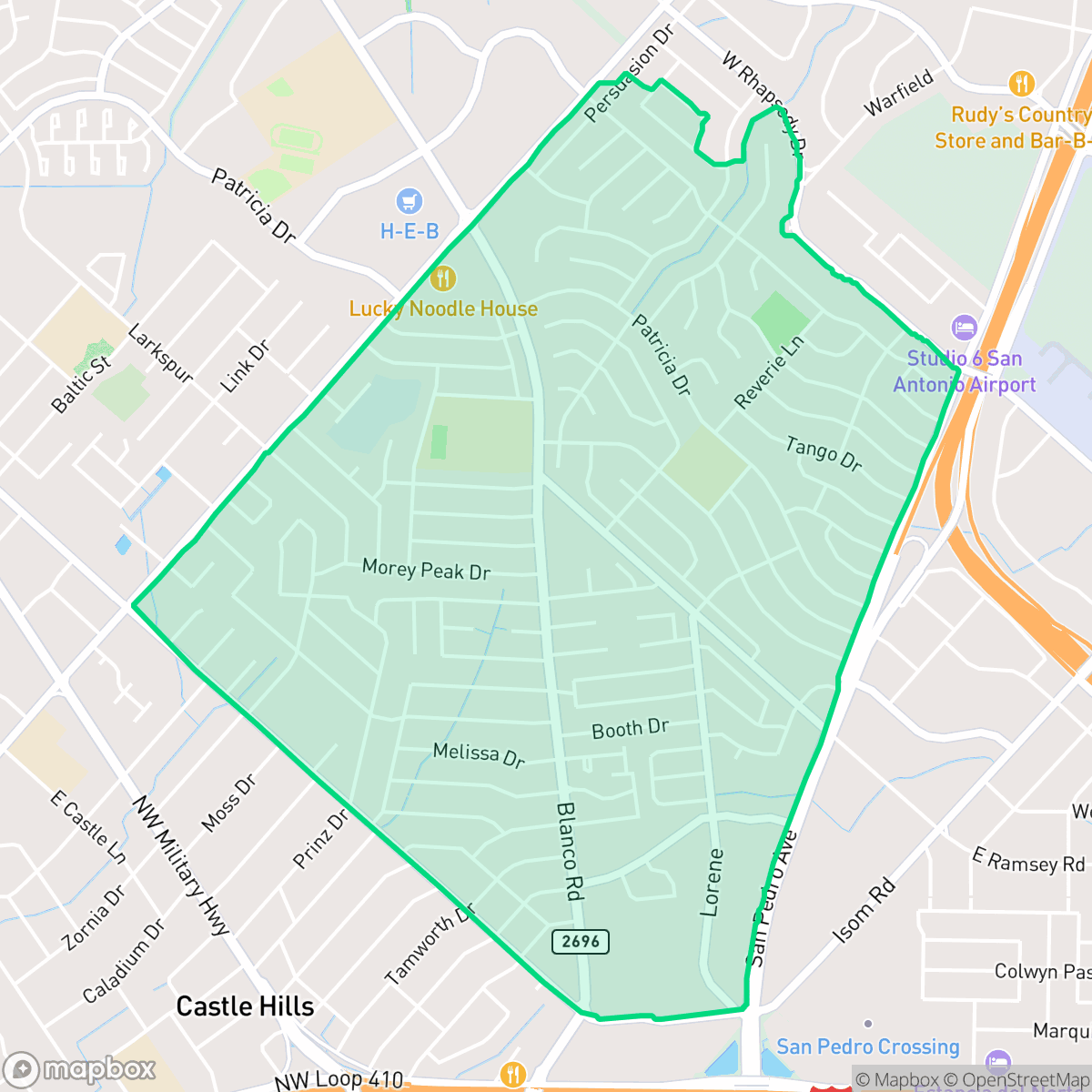
Announced in March 1959, Greater Harmony Hills was developed on 478 acres of land acquired by the H.B. Zachry Co. straddling San Pedro Avenue. Promoted as an "ultramodern subdivision" of "affordable luxury," the neighborhood was designed to appeal to active-duty military and civilian staff at nearby Fort Sam Houston and Randolph Air Force Base. Its earliest model homes, built on Serenade, Tammy, and Patricia streets, were showcased in the September 1959 Parade of Homes. This mid-century modern era defined the neighborhood's architectural identity, with over 80% of its housing stock consisting of well-preserved 1940s to 1960s ranch-style homes. Today, the neighborhood remains a distinct slice of mid-century Americana, characterized by its quiet, tree-lined streets and close-knit community.
The area offers a blend of residential comfort and regional accessibility, characterized by its well-maintained ranch-style homes and quiet, tree-lined streets. It maintains a distinct suburban atmosphere, featuring a mix of single-family residences and local retail centers that provide essential services to the community. The neighborhood is served by the North East Independent School District, which includes the highly-rated Harmony Hills Elementary, making it a stable environment for families seeking educational resources and community longevity.
While the neighborhood provides a strong sense of community and high health insurance coverage rates, potential residents should consider the trade-offs of its suburban design. The area is primarily car-dependent, and road traffic contributes to a higher noise level than some surrounding communities. However, the neighborhood offers significant flood safety and a lack of industrial hazards, creating a secure living environment for those prioritizing stability and convenient access to local dining and institutional amenities.
Neighborhood Scores Across 15 Qualities
Residential spacing is consistent with the San Antonio average, offering a mix of closely packed apartment clusters and single-family homes with typical suburban setbacks. According to iHuus data, the neighborhood provides a balanced level of separation between structures.
Residential streets are sufficiently quiet for walking, though sidewalk continuity is inconsistent. According to iHuus data, the area is slightly less walkable than the San Antonio average due to auto-centric commercial zones and major arterial roads.
Large homes and frequent upscale amenities like private backyard pools contribute to a visual landscape that is more attractive than the San Antonio average. According to iHuus data, the area features well-kept multi-car driveways and spacious residential lots.
Walking opportunities for pets vary across the area, as some sections offer wooded trails and grassy verges while others feature limited public park access. According to iHuus data, the availability of dedicated pet spaces is slightly below the San Antonio average.
Land use varies from low-density residential areas with significant tree canopy to pockets of industrial and airport infrastructure. According to iHuus data, the area presents a semi-rural feel that is closely aligned with the typical density found across San Antonio.
A diverse blend of quiet residential streets and active social hubs provides more variety in dining and community spaces than the typical San Antonio neighborhood. While many local restaurants and churches serve as notable gathering points, much of the area remains car-dependent due to the suburban layout.
Persistent noise from nearby busy streets is common here, which is slightly higher than the San Antonio average according to iHuus data.
Frequent unhealthy air quality levels pose a significant risk to sensitive groups. This area experiences lower air quality than the San Antonio average, according to iHuus data.
Industrial activity is minimal throughout the area, with most zones consisting of residential streets and light commercial spaces. While some warehouse-style structures exist on the eastern edge, the neighborhood remains largely free of heavy industry, which is consistent with the San Antonio average.
Health insurance accessibility is slightly below the San Antonio average. According to iHuus data, fewer than half of the residents in this area are covered by a health insurance plan.
Political leanings in this area trend liberal, though the community is slightly less progressive than the San Antonio average according to iHuus data.
A balanced mix of young adults, families, and older residents characterizes the area. This demographic distribution is largely consistent with the broader San Antonio population.
Flood risk in this area is higher than the San Antonio average, though specific details remain undetermined due to incomplete federal studies. According to iHuus data, residents should maintain awareness of local drainage patterns.
Address-Level Insights for Greater Harmony Hills


iHuus Neighborhood Intelligence Insights
Get address-level neighborhood insights for Greater Harmony Hills
- Street-level scores — see how individual blocks compare, not just neighborhood averages
- Micro-zone boundaries — identify quiet pockets, flood boundaries, and walkable clusters before you visit
- 15 dimensions in full — walkability, noise, air quality, school quality, insurance coverage, population age profile, urban/rural index, and more
- Boundary risk alerts — know if your address sits near a block boundary where scores drop, the kind of detail no listing will ever mention
- School insights — individual school ratings and insights, not just district-level data
- Compare before you commit — side-by-side data across neighborhoods, down to block precision
No credit card required
Compare with Any Neighborhood
| Dimension | Greater Harmony Hills | 145 Association |
|---|---|---|
| 🚶 Walkabilityavg 6.44 | ||
| 🔊 Acoustic Comfortavg 4.07 | ||
| 🤫 Privacy Indexavg 5.75 | ||
| 🎨 Visual Appealavg 6.11 | ||
| 🐕 Dog Friendlinessavg 5.91 | ||
| 🗺️ Urban-Rural Indexavg 6.87 | ||
| ✨ Neighborhood Vibeavg 4.35 | ||
| 🏥 Health Insurance Coverageavg 5.94 | ||
| 🌿 Air Qualityavg 2.27 | ||
| 🏭 Industrial Proximityavg 8.31 | ||
| 🌊 Flood Safetyavg 4.2 | ||
| 🗳️ Ideological Leanavg 7.37 | ||
| 👥 Population Age Profileavg 4.68 | ||
| 🔥 Fire Safety | ||
| 🏫 School Quality |
Greater Harmony Hills Rankings
School Districts Serving Greater Harmony Hills
School Insights for Greater Harmony Hills
Below average outcomes; significant attendance and academic challenges.
School Insights
See what's really behind every school rating near Greater Harmony Hills
- Individual school ratings — each school's own score with outcome context, not just a district average
- Enrollment & class size data — student-to-teacher ratio and how it compares to the state average
- Full demographics breakdown — ethnicity and gender composition for every school in the enrollment zone
- Every school in the district — all schools within the enrollment boundary ranked by rating, not just the closest one
- Grade levels & benchmarks — elementary through high school, with below/above state-average flags
No credit card required