Greater Gardendale, San Antonio
Updated · 5,292 residents
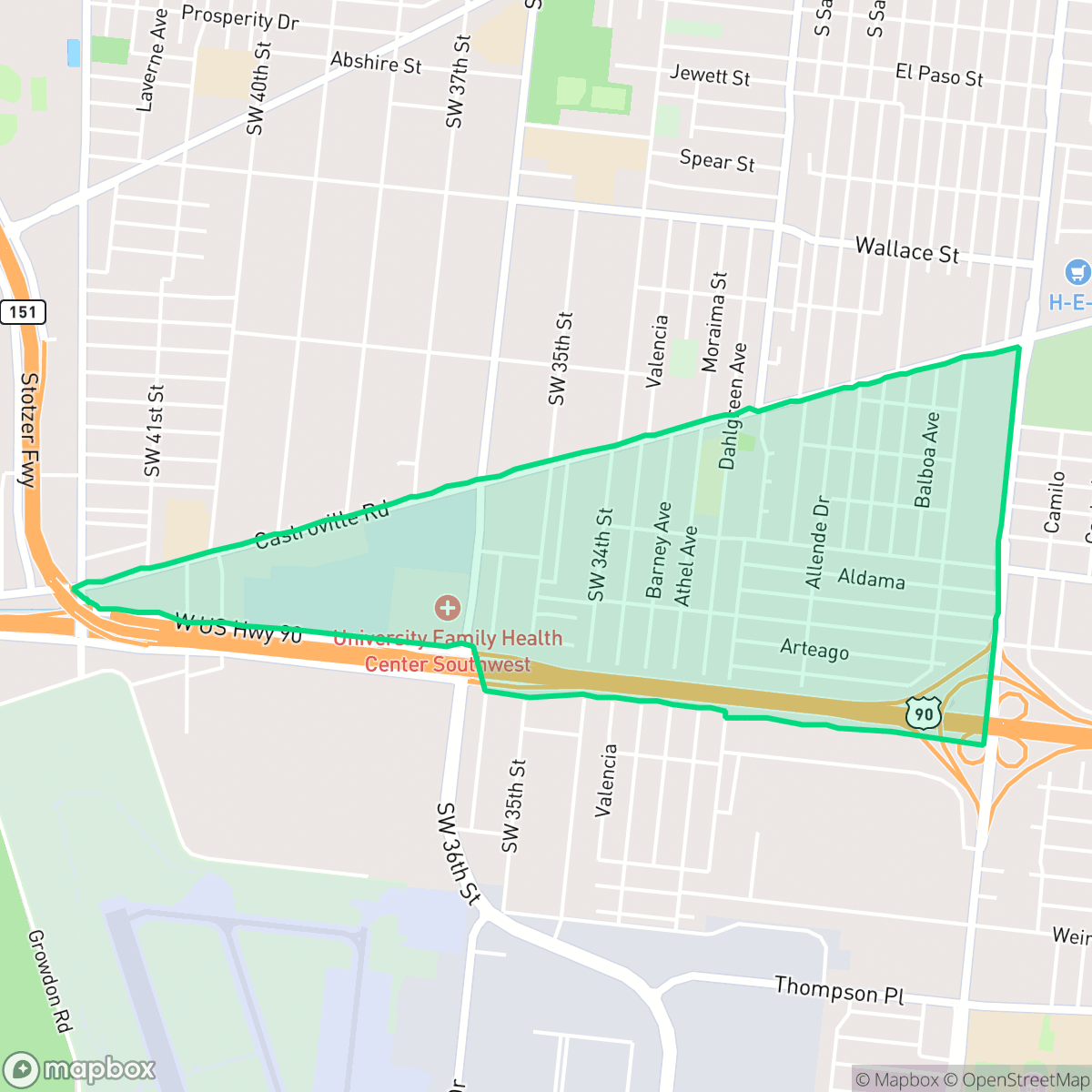
Greater Gardendale is a historic, culturally rich neighborhood on San Antonio’s West Side, defined by its collection of early 20th-century Craftsman cottages and bungalows. The area offers a quiet, suburban atmosphere, though residents should be aware of significant noise levels from nearby highway traffic and proximity to large-scale logistics warehouses.
Key Highlights
About Greater Gardendale
Located on San Antonio’s historic West Side, Greater Gardendale is a culturally rich neighborhood that developed in the early 20th century. Unlike affluent, deed-restricted areas of the city, Gardendale was established without racial covenants, allowing it to grow into a vibrant, working-class Mexican-American community with modest, closely knit lots. Its architectural landscape is defined by rows of colorful Craftsman cottages and bungalows constructed primarily between the 1920s and 1940s. A prominent local landmark is the historic Basila Frocks building at North Zarzamora and Martin streets. Originally a dressmaking factory in the early 1900s, it has been preserved and revitalized as a community hub for local businesses and nonprofits. Additionally, the neighborhood sits near the iconic Little Flower Basilica, which has drawn visitors to the area for nearly a century.
The neighborhood serves as a dense residential hub characterized by its single-story architectural style and proximity to key local landmarks like the Little Flower Basilica. While the area maintains a strong sense of community, the landscape is shaped by a mix of residential streets and heavy transit corridors, with industrial logistics hubs contributing to the local economic footprint. Residents benefit from the presence of neighborhood-focused institutions, including local churches and dedicated early learning centers, which provide essential services within walking distance.
Living in this part of San Antonio involves specific trade-offs, particularly regarding environmental factors. The area experiences elevated noise levels primarily due to road traffic, and air quality metrics suggest a more industrial-adjacent environment. While the Edgewood Independent School District is currently navigating a period of operational transition, the neighborhood remains a stable, flood-resistant choice for those seeking a central location with deep cultural roots. It is best suited for individuals who prioritize affordability and a central location over quiet, low-traffic surroundings.
Neighborhood Scores Across 15 Qualities
Residential spacing provides a balanced level of separation between neighbors, sitting slightly above the San Antonio average. While some areas feature significant distance or vacant land, many standard lots have limited private buffer zones.
Low traffic on residential streets allows for safe walking, but the lack of consistent sidewalks makes the area less walkable than the San Antonio average. Pedestrians often rely on dirt shoulders on certain through-roads, and proximity to major highway interchanges can impact safety.
Standard tract housing dominates the area with simple rooflines and small yards. According to iHuus data, the visual landscape is less varied and lacks the lush greenery or luxury amenities found throughout much of San Antonio.
Public parks and wide green verges are scarce in this area, as greenery is largely confined to private, fenced yards. According to iHuus data, the lack of accessible public greenery and narrow road shoulders makes this neighborhood less dog friendly than the San Antonio average.
Residential areas transition from dense suburban grids to low-density pockets featuring large unbuilt lots and open land. This balance of suburban development and semi-rural elements is consistent with the San Antonio average according to iHuus data.
Suburban rhythms and low-density spaces define this area, which offers a calmer atmosphere than the San Antonio average. Residents can find various local eateries and churches, though the landscape is largely car-oriented with a focus on industrial and residential utility.
Frequent noise from nearby freeways and rail lines characterizes this area. According to iHuus data, acoustic comfort levels are lower than the San Antonio average.
Frequent unhealthy air quality levels present a significant risk to sensitive groups. According to iHuus data, air conditions in this area are worse than the San Antonio average.
Residential and institutional uses dominate the area with very little exposure to heavy industrial hazards. While some logistics hubs and small commercial yards exist along central corridors, the level of industrial proximity is slightly lower than the San Antonio average according to iHuus data.
Health insurance access is notably lower here than in the rest of San Antonio, according to iHuus data. Residents may face greater challenges accessing employer-sponsored or private medical coverage within this area.
Voting patterns and census indicators show a significantly more liberal leaning than the San Antonio average. According to iHuus data, the area is characterized by predominantly liberal political preferences.
Residents live alongside a balanced mix of young adults, families, and older populations. This age distribution is very similar to the broader San Antonio area, according to iHuus data.
Significant flood risk exists within this area because parts of the neighborhood fall inside the 100-year floodplain. According to iHuus data, this risk level is notably higher than the San Antonio average and may necessitate flood insurance.
Address-Level Insights for Greater Gardendale


iHuus Neighborhood Intelligence Insights
Get address-level neighborhood insights for Greater Gardendale
- Street-level scores — see how individual blocks compare, not just neighborhood averages
- Micro-zone boundaries — identify quiet pockets, flood boundaries, and walkable clusters before you visit
- 15 dimensions in full — walkability, noise, air quality, school quality, insurance coverage, population age profile, urban/rural index, and more
- Boundary risk alerts — know if your address sits near a block boundary where scores drop, the kind of detail no listing will ever mention
- School insights — individual school ratings and insights, not just district-level data
- Compare before you commit — side-by-side data across neighborhoods, down to block precision
No credit card required
Compare with Any Neighborhood
| Dimension | Greater Gardendale | 145 Association |
|---|---|---|
| 🚶 Walkabilityavg 6.44 | ||
| 🔊 Acoustic Comfortavg 4.07 | ||
| 🤫 Privacy Indexavg 5.75 | ||
| 🎨 Visual Appealavg 6.11 | ||
| 🐕 Dog Friendlinessavg 5.91 | ||
| 🗺️ Urban-Rural Indexavg 6.87 | ||
| ✨ Neighborhood Vibeavg 4.35 | ||
| 🏥 Health Insurance Coverageavg 5.94 | ||
| 🌿 Air Qualityavg 2.27 | ||
| 🏭 Industrial Proximityavg 8.31 | ||
| 🌊 Flood Safetyavg 4.2 | ||
| 🗳️ Ideological Leanavg 7.37 | ||
| 👥 Population Age Profileavg 4.68 | ||
| 🔥 Fire Safety | ||
| 🏫 School Quality |
Greater Gardendale Rankings
School Districts Serving Greater Gardendale
School Insights for Greater Gardendale
Below average outcomes; significant attendance and academic challenges.
School Insights
See what's really behind every school rating near Greater Gardendale
- Individual school ratings — each school's own score with outcome context, not just a district average
- Enrollment & class size data — student-to-teacher ratio and how it compares to the state average
- Full demographics breakdown — ethnicity and gender composition for every school in the enrollment zone
- Every school in the district — all schools within the enrollment boundary ranked by rating, not just the closest one
- Grade levels & benchmarks — elementary through high school, with below/above state-average flags
No credit card required