Great Northwest, San Antonio
Updated · 13,557 residents
Great Northwest is a sprawling, established suburban community defined by its mature tree canopy and extensive network of greenbelts. Residents enjoy a notably walkable environment for the region, featuring consistent sidewalks and a quiet atmosphere free from industrial noise.
Key Highlights
About Great Northwest
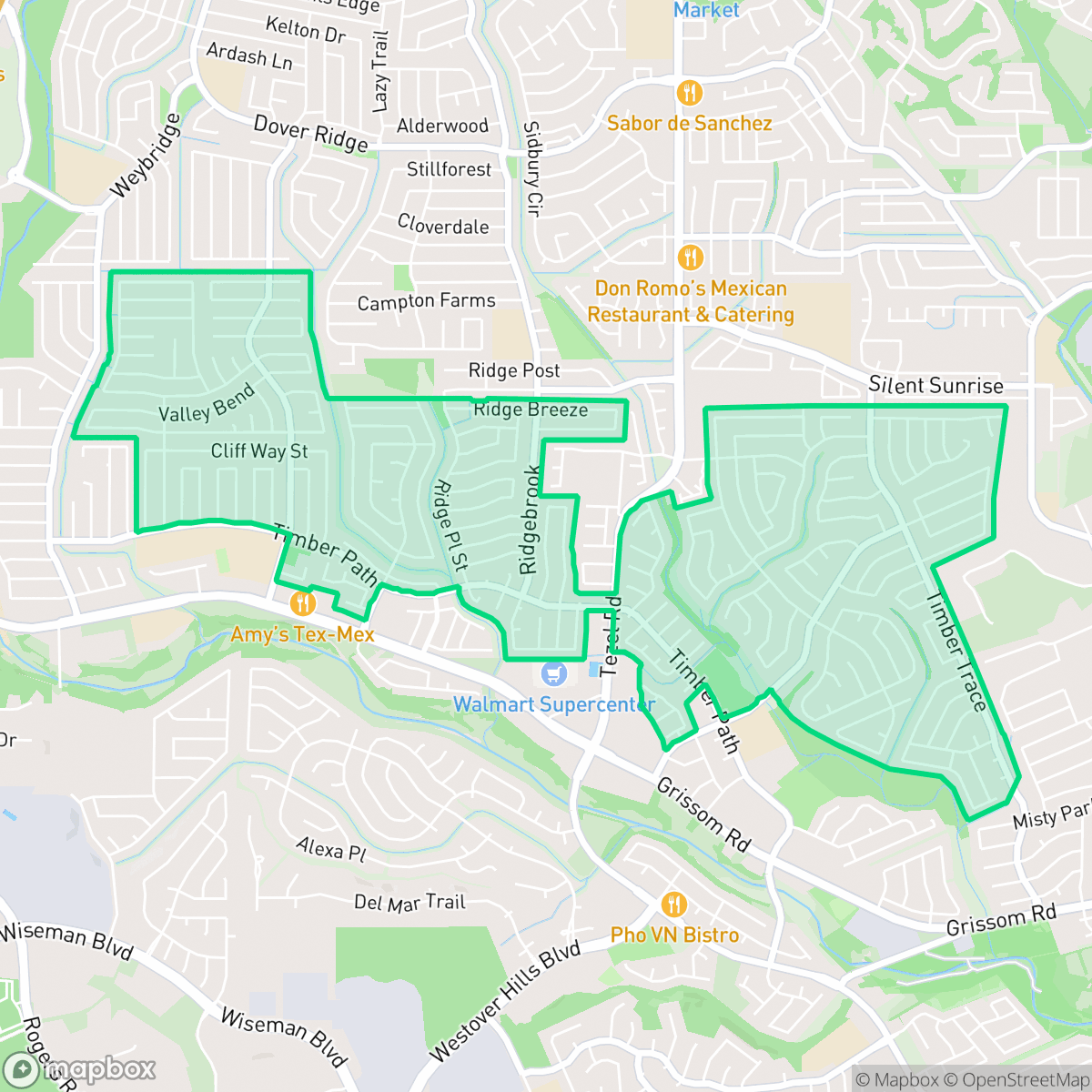
Established in 1976 on San Antonio’s northwest side, the Great Northwest is one of the largest self-managed, single-family homeowners associations in Texas. The master-planned community comprises seven distinct subdivisions—including Silver Creek, Emerald Valley, and Ridge Creek—and is home to nearly 15,000 residents across approximately 5,000 homes. Most of the neighborhood's housing stock consists of single-family homes built between 1970 and 1999, characterized by mature, tree-lined streets and a network of scenic drainage greenbelts. The neighborhood’s active community identity is anchored by local landmarks like the Silver Creek Clubhouse, Kuwamura Park, and nearby Cathedral Rock Nature Park, alongside long-standing local traditions such as the annual Polar Bear Swim and Fourth of July parade.
The area offers a classic suburban experience characterized by its dense, single-family residential layout and a complete absence of heavy industrial presence. According to iHuus data, the neighborhood benefits from a higher than average walkability score for the region, supported by a grid of pedestrian-friendly streets and accessible green spaces that serve as natural buffers between homes. While the visual landscape consists primarily of traditional tract housing, the presence of mature trees and well-maintained drainage corridors provides a consistent aesthetic and recreational value for residents.
Prospective residents should anticipate a quiet, residential-focused lifestyle with limited nightlife or commercial entertainment options within immediate walking distance. Families are served by the Northside Independent School District, which provides a strong academic foundation despite current budgetary challenges. The neighborhood is well-suited for those prioritizing a stable, family-oriented environment and proximity to nature trails over high-density urban amenities.
Neighborhood Scores Across 15 Qualities
Residential spacing is consistent with the city average, featuring a mix of closely situated homes and properties buffered by mature trees or greenbelts. Depending on the specific block, some areas offer significant visual buffers while others present higher density housing.
Low traffic volumes and an established trail network make walking throughout the area highly convenient. Sidewalk connectivity is notably higher than the San Antonio average, though heavy tree canopy occasionally obscures paths in certain residential loops.
Spacious yards, custom homes, and frequent private pools contribute to a visual appeal that is higher than the San Antonio average. According to iHuus data, the area features a mix of large, well-manicured estates and standard suburban developments.
Abundant wooded trails, greenbelts, and wide drainage corridors offer excellent walking paths for dogs. According to iHuus data, the availability of connected green spaces and natural buffers in this area is above the San Antonio average.
Spacious residential layouts with significant tree canopy and preserved green belts characterize this area. This level of openness and natural integration is slightly higher than the San Antonio average, according to iHuus data.
Residential life here is characterized by a serene, low-density atmosphere with limited walking access to daily essentials. According to iHuus data, the area is slightly less lively than the San Antonio average, as most social hubs and services require a drive.
Steady sounds from nearby busy streets create a consistent level of ambient noise. This acoustic environment is slightly more active than the typical San Antonio neighborhood, according to iHuus data.
Frequent unhealthy air quality levels pose a significant risk to sensitive groups. According to iHuus data, conditions in this area are slightly worse than the San Antonio average.
Residential and light commercial uses dominate the area, with an absence of heavy industrial facilities or warehouses. This neighborhood maintains a cleaner profile than the San Antonio average, though some areas sit near a Superfund site with potential environmental considerations.
Health insurance coverage among residents is notably higher than the San Antonio average, according to iHuus data. This indicates a greater proportion of the local population has access to medical benefits.
Political leanings in this area align closely with the San Antonio average, featuring a liberal majority with a modest opposing presence according to iHuus data.
Residents will find a diverse mix of young adults, families, and older populations. This age distribution aligns closely with the broader San Antonio average.
Flood risk in this area is slightly higher than the San Antonio average, though official FEMA studies for this specific location remain incomplete. Residents should remain cautious as the precise level of flood susceptibility is currently undetermined.
Address-Level Insights for Great Northwest


iHuus Neighborhood Intelligence Insights
Get address-level neighborhood insights for Great Northwest
- Street-level scores — see how individual blocks compare, not just neighborhood averages
- Micro-zone boundaries — identify quiet pockets, flood boundaries, and walkable clusters before you visit
- 15 dimensions in full — walkability, noise, air quality, school quality, insurance coverage, population age profile, urban/rural index, and more
- Boundary risk alerts — know if your address sits near a block boundary where scores drop, the kind of detail no listing will ever mention
- School insights — individual school ratings and insights, not just district-level data
- Compare before you commit — side-by-side data across neighborhoods, down to block precision
No credit card required
Compare with Any Neighborhood
| Dimension | Great Northwest | 145 Association |
|---|---|---|
| 🚶 Walkabilityavg 6.44 | ||
| 🔊 Acoustic Comfortavg 4.07 | ||
| 🤫 Privacy Indexavg 5.75 | ||
| 🎨 Visual Appealavg 6.11 | ||
| 🐕 Dog Friendlinessavg 5.91 | ||
| 🗺️ Urban-Rural Indexavg 6.87 | ||
| ✨ Neighborhood Vibeavg 4.35 | ||
| 🏥 Health Insurance Coverageavg 5.94 | ||
| 🌿 Air Qualityavg 2.27 | ||
| 🏭 Industrial Proximityavg 8.31 | ||
| 🌊 Flood Safetyavg 4.2 | ||
| 🗳️ Ideological Leanavg 7.37 | ||
| 👥 Population Age Profileavg 4.68 | ||
| 🔥 Fire Safety | ||
| 🏫 School Quality |
Great Northwest Rankings
School Districts Serving Great Northwest
School Insights for Great Northwest
Below average outcomes; significant attendance and academic challenges.
School Insights
See what's really behind every school rating near Great Northwest
- Individual school ratings — each school's own score with outcome context, not just a district average
- Enrollment & class size data — student-to-teacher ratio and how it compares to the state average
- Full demographics breakdown — ethnicity and gender composition for every school in the enrollment zone
- Every school in the district — all schools within the enrollment boundary ranked by rating, not just the closest one
- Grade levels & benchmarks — elementary through high school, with below/above state-average flags
No credit card required