Five Points, San Antonio
Updated · 1,576 residents
Five Points is a highly walkable urban neighborhood characterized by a diverse age demographic and a vibrant social scene centered around local dining. While residents benefit from easy pedestrian access and a strong community identity, the area faces challenges including elevated flood risks, poor air quality, and significant noise from nearby transportation corridors.
Key Highlights
About Five Points
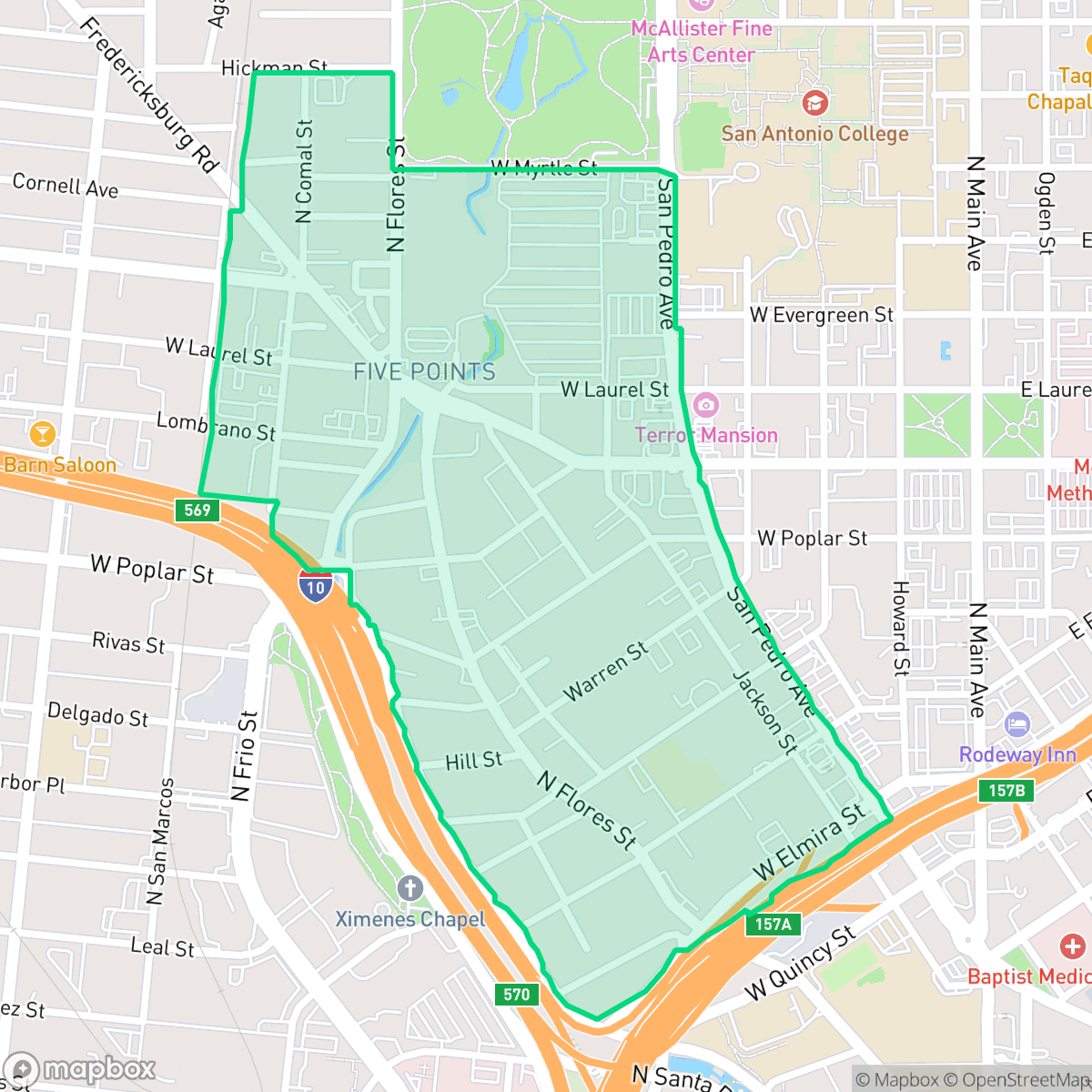
Five Points is one of San Antonio’s oldest neighborhoods, situated just north of downtown and historically defined by its proximity to San Pedro Creek and the Spanish acequias that supported early agricultural development. The area features a unique residential character with an abundance of historic structures, including Queen Anne, Neo-classical, and bungalow-style homes, many dating back to the late 19th and early 20th centuries. Historically a working-class enclave, the neighborhood has maintained a distinct cultural identity, serving as an early stomping ground for figures like Congressman Henry B. Gonzalez. While it faced periods of decline and high vacancy in the late 20th century, the area has seen ongoing revitalization efforts aimed at preserving its historic housing stock and fostering a walkable, community-oriented environment near the city’s urban core.
The area functions as a lively social hub with a dense mix of residential and commercial spaces that foster a strong sense of community. Residents enjoy high levels of walkability due to a consistent street grid and accessible sidewalks, which support an active lifestyle. According to iHuus data, the demographic makeup is notably varied, bringing together young adults, families, and seniors in a way that creates a distinct, strongly liberal local culture. The neighborhood offers a convenient urban lifestyle that remains largely free from heavy industrial presence, allowing for a more focused residential environment.
Prospective residents should consider several practical trade-offs when evaluating the neighborhood. The proximity to major highways and rail lines results in frequent traffic noise, and the local air quality is generally lower than the city average. Furthermore, the area is situated within a designated floodplain, necessitating awareness of potential water-related issues. While the neighborhood offers a convenient location, those with school-aged children will be served by the San Antonio Independent School District, which is currently navigating significant structural and academic transitions as part of a district-wide rightsizing effort.
Neighborhood Scores Across 15 Qualities
Residential spacing varies between dense clusters of multi-family apartments and standard urban lots with small yards. According to iHuus data, this neighborhood offers slightly less separation between neighbors than the San Antonio average.
Pedestrian navigation is generally easy due to a consistent street grid and visible sidewalks on most residential roads. According to iHuus data, this area offers much better sidewalk connectivity and safer crossings than the San Antonio average.
Modest single-family homes and small lots define the area's visual character. The neighborhood appears slightly less visually diverse than the San Antonio average, consisting primarily of standard rooflines and mid-sized commercial structures.
Access to green space for pets is inconsistent across the area. While a large public park with walking paths is available in the southern quadrant, narrow sidewalks and major highways create significant barriers to safe walking in other parts of the neighborhood, matching the city average for accessibility.
Developed streetscapes with a dense mix of residential, commercial, and industrial buildings characterize this area. This level of urbanization is slightly less prominent than the typical San Antonio landscape, according to iHuus data.
Social activity is notably higher than the San Antonio average, driven by a variety of local dining establishments and community spaces. According to iHuus data, the area features several concentrated pockets of energy ranging from mid-rise urban blocks to active suburban corridors.
Frequent sounds from nearby railroad tracks and major freeways contribute to a louder environment than most other parts of San Antonio. According to iHuus data, residents may experience more persistent acoustic disturbances than the city average.
Frequent unhealthy air quality levels pose a significant risk to sensitive groups. According to iHuus data, the air quality in Five Points is lower than the San Antonio average.
Residential life here remains largely uninterrupted by heavy industry. While some light commercial activity and logistics centers are visible near the highway and railway, the area has less industrial density than the San Antonio average.
Health insurance coverage among residents is slightly below the San Antonio average, according to iHuus data.
Voting patterns and census indicators reflect a significantly more liberal leaning than the San Antonio average, according to iHuus data.
A balanced distribution of young adults, families, and seniors characterizes the area. This demographic variety is more pronounced here than is typical for the San Antonio average, according to iHuus data.
Frequent flood risk exists due to the area's location within a designated floodplain; according to iHuus data, this level of risk is higher than the San Antonio average.
Address-Level Insights for Five Points


iHuus Neighborhood Intelligence Insights
Get address-level neighborhood insights for Five Points
- Street-level scores — see how individual blocks compare, not just neighborhood averages
- Micro-zone boundaries — identify quiet pockets, flood boundaries, and walkable clusters before you visit
- 15 dimensions in full — walkability, noise, air quality, school quality, insurance coverage, population age profile, urban/rural index, and more
- Boundary risk alerts — know if your address sits near a block boundary where scores drop, the kind of detail no listing will ever mention
- School insights — individual school ratings and insights, not just district-level data
- Compare before you commit — side-by-side data across neighborhoods, down to block precision
No credit card required
Compare with Any Neighborhood
| Dimension | Five Points | 145 Association |
|---|---|---|
| 🚶 Walkabilityavg 6.44 | ||
| 🔊 Acoustic Comfortavg 4.07 | ||
| 🤫 Privacy Indexavg 5.75 | ||
| 🎨 Visual Appealavg 6.11 | ||
| 🐕 Dog Friendlinessavg 5.91 | ||
| 🗺️ Urban-Rural Indexavg 6.87 | ||
| ✨ Neighborhood Vibeavg 4.35 | ||
| 🏥 Health Insurance Coverageavg 5.94 | ||
| 🌿 Air Qualityavg 2.27 | ||
| 🏭 Industrial Proximityavg 8.31 | ||
| 🌊 Flood Safetyavg 4.2 | ||
| 🗳️ Ideological Leanavg 7.37 | ||
| 👥 Population Age Profileavg 4.68 | ||
| 🔥 Fire Safety | ||
| 🏫 School Quality |
Five Points Rankings
School Districts Serving Five Points
School Insights for Five Points
Below average outcomes; significant attendance and academic challenges.
School Insights
See what's really behind every school rating near Five Points
- Individual school ratings — each school's own score with outcome context, not just a district average
- Enrollment & class size data — student-to-teacher ratio and how it compares to the state average
- Full demographics breakdown — ethnicity and gender composition for every school in the enrollment zone
- Every school in the district — all schools within the enrollment boundary ranked by rating, not just the closest one
- Grade levels & benchmarks — elementary through high school, with below/above state-average flags
No credit card required