Encino Park, San Antonio
Updated · 2,333 residents
Encino Park is a quiet, low-density residential community known for its mature oak trees and traditional suburban architecture. While the area offers a serene environment with significant green space, residents should anticipate higher noise levels from nearby road traffic and a reliance on personal vehicles for daily errands.
Key Highlights
About Encino Park
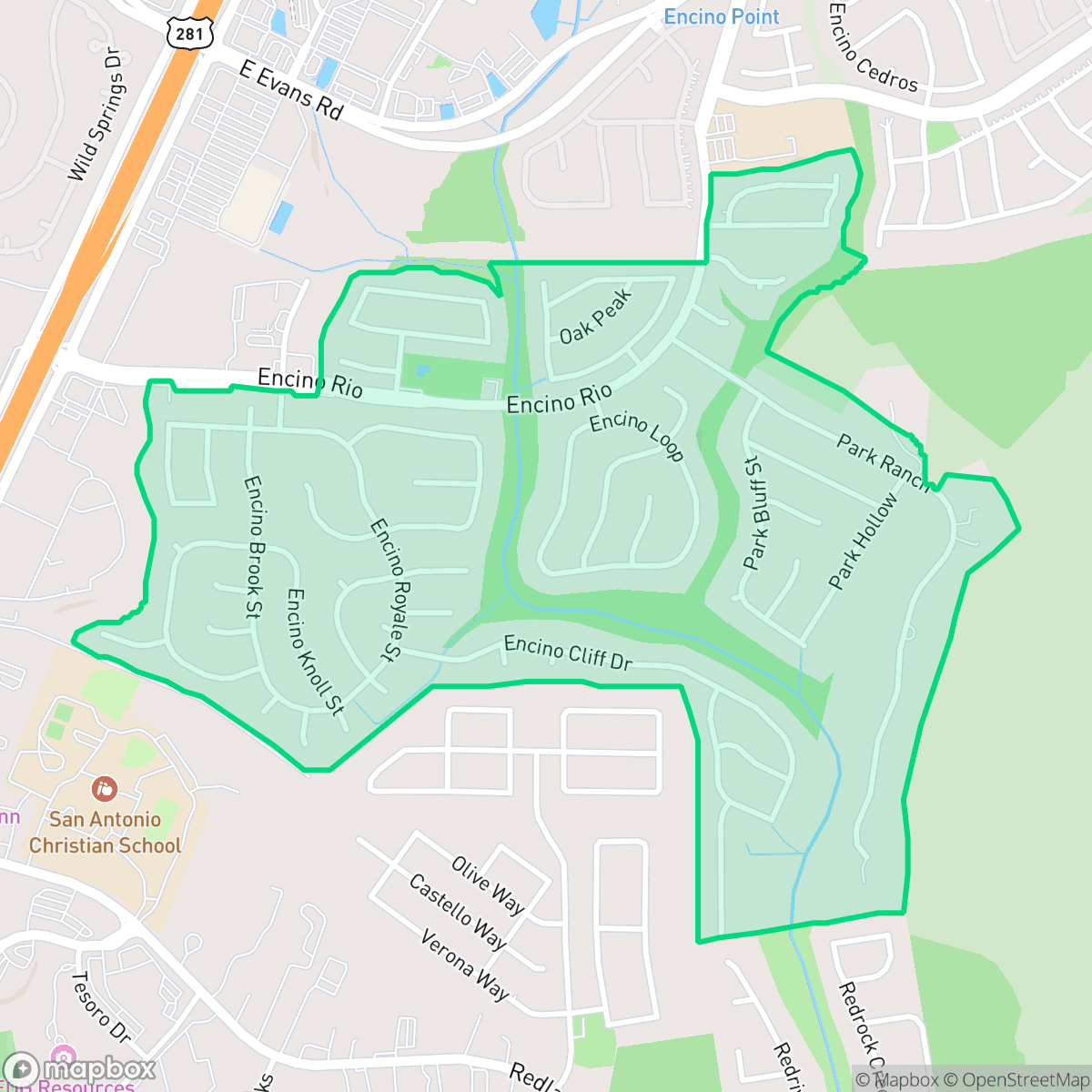
Encino Park is an established neighborhood in North Central San Antonio, located north of Loop 1604 along the U.S. Route 281 corridor. Developed starting in 1981 by homebuilders like Sitterly, the community pioneered residential expansion north of the loop. True to its name—"encino" meaning "oak" in Spanish—the neighborhood is defined by its mature oak canopies, larger lots, and brick-and-stone homes. In 1989, Encino Park Elementary School opened as the first North East Independent School District campus north of Loop 1604, solidifying the area's growth. Historically characterized by its rural, open-field surroundings in the 1980s, the neighborhood has evolved into a highly sought-after suburban enclave. Today, local landmarks like the Encino Branch Library and the Northside Islamic Center of San Antonio reflect the community's modern growth and cultural diversity.
Encino Park serves as a quiet, low-density residential enclave that prioritizes space and natural surroundings. According to iHuus data, the area maintains a high urban-rural index, characterized by expansive green spaces and a lack of dense commercial development. Families are often drawn to the neighborhood for its inclusion in the North East Independent School District, which remains a primary draw for those seeking access to stable educational resources. The visual appeal is bolstered by mature landscaping and well-maintained properties, offering a distinct sense of place that contrasts with the more congested central corridors of the city. Prospective residents should note that the neighborhood functions primarily as a car-dependent environment, as local services are scattered and require travel. While the area offers a peaceful atmosphere, acoustic comfort is lower than the city average due to consistent road traffic noise. The community is best suited for those who value a suburban lifestyle with high health insurance coverage and a stable, quiet environment, provided they are comfortable with the trade-offs associated with suburban commuting and limited walkability.
Neighborhood Scores Across 15 Qualities
Residential spacing offers a balanced degree of separation between neighbors, slightly higher than the San Antonio average. Properties feature a mix of density and buffer zones that provide a moderate level of seclusion.
Pedestrian accessibility is higher than the San Antonio average, featuring sidewalks on one side of the street and safe crossings for residents. Most local movements can be completed on foot with a reasonable level of comfort.
Large residential properties and frequent upscale amenities create a landscape that is significantly more polished than the San Antonio average. According to iHuus data, the area features spacious driveways and well-maintained streetscapes.
Connected green spaces and wide, traffic-safe paths make this area significantly more dog-friendly than the San Antonio average, according to iHuus data.
Open land and scattered residential pockets create a more semi-rural atmosphere than the typical San Antonio landscape. According to iHuus data, this area features a distinct transition between suburban office parks and more expansive, undeveloped spaces.
Suburban and industrial zones create a calm, low-density environment that lacks a concentrated commercial core. While some essential services and dining options are available, the area is largely car-oriented and similar to the city average in terms of activity levels.
Persistent sound from nearby major roadways and transit routes characterizes this area. According to iHuus data, acoustic comfort levels are slightly below the San Antonio average.
Frequent unhealthy air quality levels pose a significant risk to sensitive groups. This area is slightly worse than the San Antonio average, according to iHuus data.
Industrial presence is minimal and significantly lower than the San Antonio average, though a large quarry on the western edge may introduce occasional dust and noise. Aside from this localized feature, the area consists of quiet residential streets and open green spaces.
Health insurance accessibility is notably higher than the San Antonio average, according to iHuus data. Most residents in this area have access to comprehensive medical coverage.
Political leanings in this area are notably more conservative than the San Antonio average; residents will find a clear conservative majority with a smaller presence of opposing viewpoints.
A balanced mix of young adults, families, and older residents defines the local demographic. This age distribution is largely consistent with the broader San Antonio area, according to iHuus data.
Flood risk in this area is notably lower than the San Antonio average, although some residual risk remains due to its location within the 500-year floodplain. According to iHuus data, the area sits primarily in a zone with minimal expected flood frequency.
Address-Level Insights for Encino Park


iHuus Neighborhood Intelligence Insights
Get address-level neighborhood insights for Encino Park
- Street-level scores — see how individual blocks compare, not just neighborhood averages
- Micro-zone boundaries — identify quiet pockets, flood boundaries, and walkable clusters before you visit
- 15 dimensions in full — walkability, noise, air quality, school quality, insurance coverage, population age profile, urban/rural index, and more
- Boundary risk alerts — know if your address sits near a block boundary where scores drop, the kind of detail no listing will ever mention
- School insights — individual school ratings and insights, not just district-level data
- Compare before you commit — side-by-side data across neighborhoods, down to block precision
No credit card required
Compare with Any Neighborhood
| Dimension | Encino Park | 145 Association |
|---|---|---|
| 🚶 Walkabilityavg 6.44 | ||
| 🔊 Acoustic Comfortavg 4.07 | ||
| 🤫 Privacy Indexavg 5.75 | ||
| 🎨 Visual Appealavg 6.11 | ||
| 🐕 Dog Friendlinessavg 5.91 | ||
| 🗺️ Urban-Rural Indexavg 6.87 | ||
| ✨ Neighborhood Vibeavg 4.35 | ||
| 🏥 Health Insurance Coverageavg 5.94 | ||
| 🌿 Air Qualityavg 2.27 | ||
| 🏭 Industrial Proximityavg 8.31 | ||
| 🌊 Flood Safetyavg 4.2 | ||
| 🗳️ Ideological Leanavg 7.37 | ||
| 👥 Population Age Profileavg 4.68 | ||
| 🔥 Fire Safety | ||
| 🏫 School Quality |
Encino Park Rankings
School Districts Serving Encino Park
School Insights for Encino Park
Below average outcomes; significant attendance and academic challenges.
School Insights
See what's really behind every school rating near Encino Park
- Individual school ratings — each school's own score with outcome context, not just a district average
- Enrollment & class size data — student-to-teacher ratio and how it compares to the state average
- Full demographics breakdown — ethnicity and gender composition for every school in the enrollment zone
- Every school in the district — all schools within the enrollment boundary ranked by rating, not just the closest one
- Grade levels & benchmarks — elementary through high school, with below/above state-average flags
No credit card required