East Terrell Hills, San Antonio
Updated · 2,529 residents
East Terrell Hills is a quiet, mid-century residential area in northeast San Antonio defined by its grid layout and direct access to local greenways. While residents enjoy diverse dining options and established community amenities, the neighborhood experiences moderate traffic noise and sits near significant industrial logistics centers.
Key Highlights
About East Terrell Hills
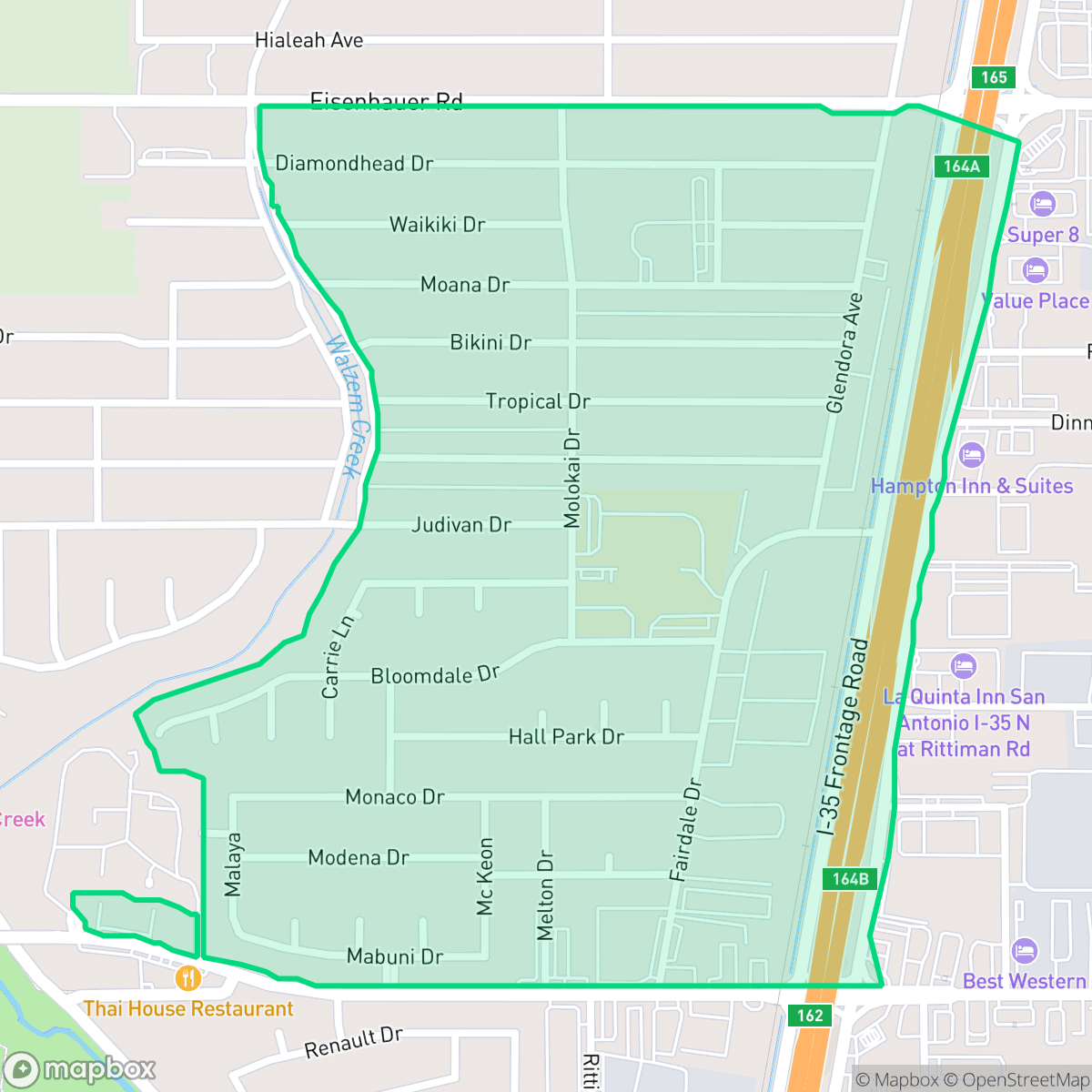
East Terrell Hills is a well-established, mid-century residential neighborhood in northeast San Antonio, Texas, primarily developed between the 1940s and 1960s. The neighborhood’s housing stock is characterized by classic, single-story ranch-style homes featuring original wood flooring and generous lot sizes. Due to its immediate proximity to Fort Sam Houston, East Terrell Hills has historically maintained a strong military connection, with active-duty personnel and veterans significantly shaping its cultural identity. A notable local landmark is East Terrell Hills Elementary School, which opened in 1964 and was designed by the prominent San Antonio architecture firm Marmon & Mok. For recreation, residents enjoy direct access to John James Park and the Howard W. Peak Greenway Trail System, which borders the neighborhood.
The neighborhood maintains a calm, suburban atmosphere characterized by a mix of single-family homes and proximity to large-scale commercial blocks. Residents benefit from a walkable grid system featuring sidewalks on both main arterials and residential streets, making it a functional environment for daily errands and outdoor activity. The area is home to a varied culinary scene, with local favorites such as El Chilango Tacos, Kim's Galbi, and Thai House Restaurant providing diverse options within a short distance. According to iHuus data, the location serves as a balanced district where quiet residential life meets the practical needs of a dense suburban environment.
Livability in the area involves navigating trade-offs between its central location and environmental factors. The eastern portion of the neighborhood is influenced by nearby industrial logistics warehouses, which contributes to higher levels of road traffic noise and impacts air quality. Prospective residents should consider that while the area is served by the highly regarded North East Independent School District, the district is currently managing budget transitions that affect local campuses. It is best suited for those seeking a well-connected suburban setting who prioritize proximity to major thoroughfares and outdoor recreation over absolute acoustic seclusion.
Neighborhood Scores Across 15 Qualities
Residential spacing provides a moderate level of separation between homes, which is slightly higher than the San Antonio average. While houses are positioned relatively close to one another, standard side-yard setbacks offer some buffer between neighbors.
Low-traffic residential streets and sidewalks on main arterials allow for safe walking, though overall walkability is slightly below the San Antonio average. According to iHuus data, the neighborhood lacks consistent sidewalk coverage throughout all residential pockets.
Uniform tract housing with small yards and consistent rooflines characterizes this area. This visual landscape is roughly comparable to the broader San Antonio average according to iHuus data.
Continuous sidewalks with grassy verges and a nearby public park with a ball field offer decent walking options for pet owners. According to iHuus data, the level of dog friendliness in this area is slightly below the San Antonio average.
Frequent open land and scattered homes amid woodland characterize this area. This landscape provides a more open environment than the typical San Antonio urban density.
Suburban streets and green spaces provide a calm atmosphere punctuated by pockets of activity near diverse dining options. This area offers more variety in local amenities than the San Antonio average, though many sections remain car-dependent due to nearby industrial corridors.
Persistent noise from nearby railroad tracks and major freeway traffic is a significant factor in this area. According to iHuus data, acoustic comfort is notably lower than the San Antonio average.
Air quality in this area fluctuates between acceptable and unhealthy levels, though conditions remain notably better than the San Antonio average according to iHuus data. Sensitive individuals may experience occasional concerns during certain periods.
Residential streets and open green spaces remain largely undisturbed by heavy industry. While some light commercial activity exists, the area lacks the massive logistics hubs and heavy truck traffic found more frequently in other parts of San Antonio.
Health insurance coverage among residents is notably higher than the San Antonio average, according to iHuus data.
Political leanings in this area favor liberal perspectives more than the typical San Antonio neighborhood, according to iHuus data.
Residents live alongside a balanced mix of young adults, families, and older individuals. This demographic distribution is slightly more varied than the San Antonio average, according to iHuus data.
Flood risk in this area is difficult to assess because FEMA has not yet completed a detailed study for the neighborhood. According to iHuus data, the level of risk is slightly higher than the San Antonio average.
Address-Level Insights for East Terrell Hills


iHuus Neighborhood Intelligence Insights
Get address-level neighborhood insights for East Terrell Hills
- Street-level scores — see how individual blocks compare, not just neighborhood averages
- Micro-zone boundaries — identify quiet pockets, flood boundaries, and walkable clusters before you visit
- 15 dimensions in full — walkability, noise, air quality, school quality, insurance coverage, population age profile, urban/rural index, and more
- Boundary risk alerts — know if your address sits near a block boundary where scores drop, the kind of detail no listing will ever mention
- School insights — individual school ratings and insights, not just district-level data
- Compare before you commit — side-by-side data across neighborhoods, down to block precision
No credit card required
Compare with Any Neighborhood
| Dimension | East Terrell Hills | 145 Association |
|---|---|---|
| 🚶 Walkabilityavg 6.44 | ||
| 🔊 Acoustic Comfortavg 4.07 | ||
| 🤫 Privacy Indexavg 5.75 | ||
| 🎨 Visual Appealavg 6.11 | ||
| 🐕 Dog Friendlinessavg 5.91 | ||
| 🗺️ Urban-Rural Indexavg 6.87 | ||
| ✨ Neighborhood Vibeavg 4.35 | ||
| 🏥 Health Insurance Coverageavg 5.94 | ||
| 🌿 Air Qualityavg 2.27 | ||
| 🏭 Industrial Proximityavg 8.31 | ||
| 🌊 Flood Safetyavg 4.2 | ||
| 🗳️ Ideological Leanavg 7.37 | ||
| 👥 Population Age Profileavg 4.68 | ||
| 🔥 Fire Safety | ||
| 🏫 School Quality |
East Terrell Hills Rankings
School Districts Serving East Terrell Hills
School Insights for East Terrell Hills
Below average outcomes; significant attendance and academic challenges.
School Insights
See what's really behind every school rating near East Terrell Hills
- Individual school ratings — each school's own score with outcome context, not just a district average
- Enrollment & class size data — student-to-teacher ratio and how it compares to the state average
- Full demographics breakdown — ethnicity and gender composition for every school in the enrollment zone
- Every school in the district — all schools within the enrollment boundary ranked by rating, not just the closest one
- Grade levels & benchmarks — elementary through high school, with below/above state-average flags
No credit card required