East Pyron - Symphony Lane-Mission San Jose, San Antonio
Updated · 819 residents
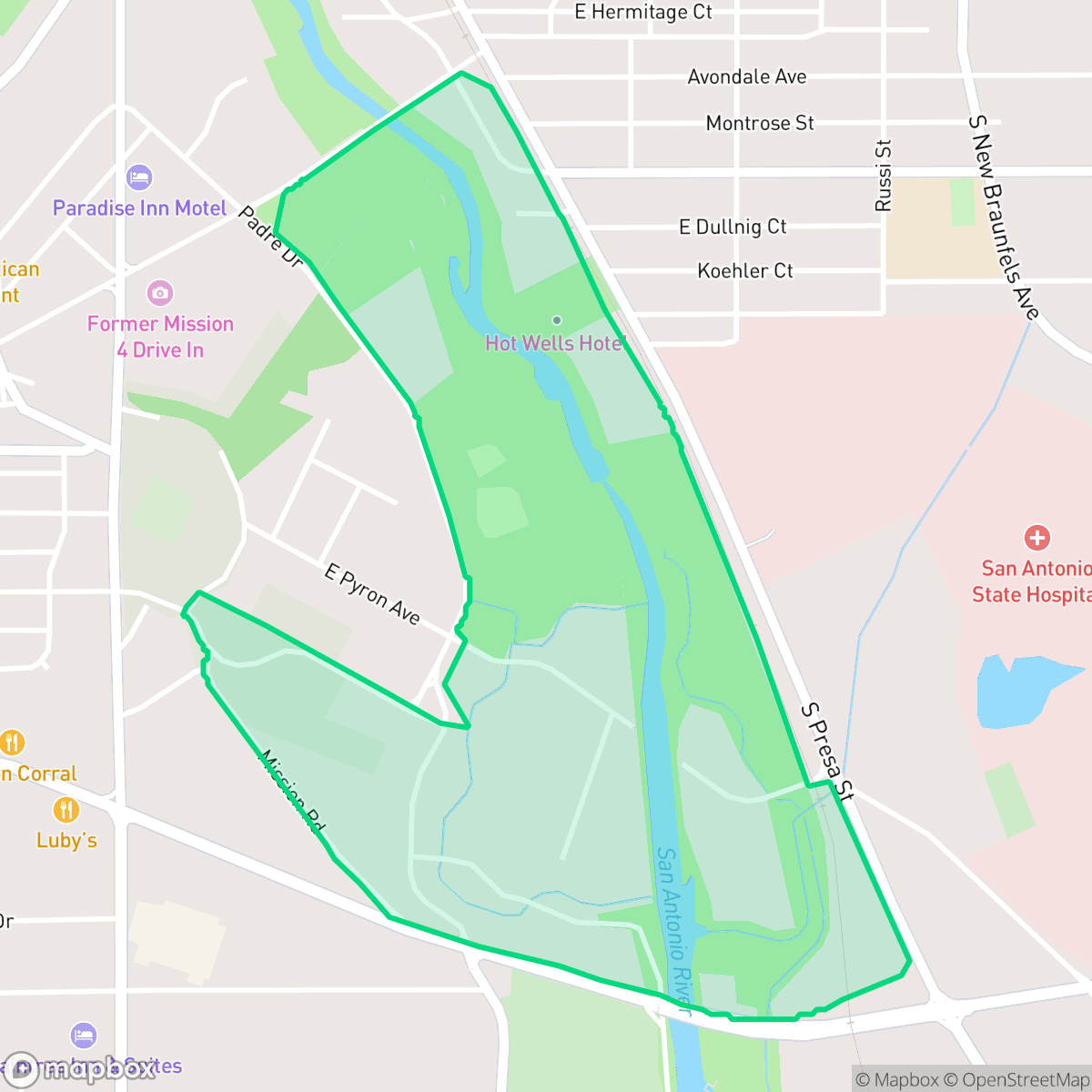
East Pyron - Symphony Lane-Mission San Jose is a quiet residential enclave situated near the historic Mission San Jose. The area is notably dog-friendly and features above-average walkability, making it an accessible choice for those seeking a slower pace of life near significant cultural landmarks.
Key Highlights
About East Pyron - Symphony Lane-Mission San Jose
Nestled on San Antonio’s South Side, the East Pyron - Symphony Lane-Mission San Jose neighborhood is deeply intertwined with the adjacent Mission San José, the 1720 "Queen of the Missions" and UNESCO World Heritage Site. The neighborhood's primary thoroughfare, East Pyron Avenue, is named for Confederate officer Charles Lynn Pyron, who once owned a ranch in the area. This street crosses a historic two-lane bridge over an original channel of the San Antonio River, leading to "the island"—a unique local enclave of about 20 homes surrounded entirely by water. Highlighting the area's deep indigenous roots, local residents formed the Old River Heritage Group to secure a Texas Historical Commission marker near Padre Park, commemorating Pajalate, the Coahuiltecan language spoken by the area’s original Native American inhabitants. The neighborhood's housing stock consists largely of established mid-20th-century homes.
This neighborhood serves as a peaceful residential community on the South Side, characterized by its established mid-20th-century housing and proximity to the San Antonio River. Residents benefit from a calm environment with a strong sense of local identity, supported by active community groups that preserve the area's indigenous heritage. The landscape is a mix of traditional suburban streets and open green spaces, providing a distinct contrast to the more densely developed parts of the city.
While the area offers high walkability and excellent opportunities for pet owners, prospective residents should consider specific environmental and infrastructure factors. The neighborhood maintains high proximity to industrial zones and faces challenges regarding air quality and flood risk. Additionally, the local school districts are currently undergoing significant transitions, which may be a primary consideration for families. The area is best suited for those who prioritize a quiet, pet-friendly environment and historical character over modern, high-density amenities.
Neighborhood Scores Across 15 Qualities
Residential spacing varies between closely set neighbors and more open riparian corridors. This level of privacy is slightly higher than the San Antonio average, according to iHuus data.
Residential streets offer a peaceful environment for walking, though the presence of large industrial zones means pedestrian infrastructure is not consistent throughout the area. This level of walkability is slightly below the San Antonio average according to iHuus data.
Residential views consist of typical tract housing and older mobile homes situated near industrial zones. This visual landscape is roughly in line with the city average according to iHuus data.
Expansive river-adjacent parks and wide, connected green buffers provide ample space for walking pets away from traffic. According to iHuus data, these accessible trails and natural buffers make the area significantly more dog friendly than the San Antonio average.
Frequent open land and scattered homes among woodlands provide a sense of openness, though the area is very similar to the San Antonio average. According to iHuus data, the landscape features a mix of low-density residential pockets and larger industrial blocks.
Primarily a low-density and industrial landscape, this area offers a calm setting with limited walkable amenities. Most dining and essential services require a vehicle to access, making the local energy less vibrant than the San Antonio average.
Steady traffic sounds from nearby busy streets are present, though the area remains quieter than much of San Antonio. According to iHuus data, the acoustic environment is more active than the city average.
Frequent unhealthy air quality levels pose a significant risk to sensitive groups. This area experiences air quality that is slightly worse than the San Antonio average, according to iHuus data.
Commercial activity and light industrial units are integrated with residential streets, resulting in lower levels of industrial density than the San Antonio average. According to iHuus data, residents may encounter a blend of quiet residential pockets and areas with increased daytime commercial traffic.
Health insurance accessibility is lower than the San Antonio average, with fewer residents holding coverage compared to the rest of the city. According to iHuus data, this indicates a higher proportion of uninsured individuals within the community.
Voting patterns and census indicators show a strong liberal leaning that is more pronounced than the San Antonio average, according to iHuus data.
Residents live alongside a balanced mix of young adults, families, and seniors. According to iHuus data, the age distribution is slightly more concentrated toward certain age groups than the San Antonio average.
Flood risk in this area remains uncertain because official FEMA studies for the neighborhood are not yet complete. According to iHuus data, the potential for flooding is consistent with the average levels seen across San Antonio.
Address-Level Insights for East Pyron - Symphony Lane-Mission San Jose


iHuus Neighborhood Intelligence Insights
Get address-level neighborhood insights for East Pyron - Symphony Lane-Mission San Jose
- Street-level scores — see how individual blocks compare, not just neighborhood averages
- Micro-zone boundaries — identify quiet pockets, flood boundaries, and walkable clusters before you visit
- 15 dimensions in full — walkability, noise, air quality, school quality, insurance coverage, population age profile, urban/rural index, and more
- Boundary risk alerts — know if your address sits near a block boundary where scores drop, the kind of detail no listing will ever mention
- School insights — individual school ratings and insights, not just district-level data
- Compare before you commit — side-by-side data across neighborhoods, down to block precision
No credit card required
Compare with Any Neighborhood
| Dimension | East Pyron - Symphony Lane-Mission San Jose | 145 Association |
|---|---|---|
| 🚶 Walkabilityavg 6.44 | ||
| 🔊 Acoustic Comfortavg 4.07 | ||
| 🤫 Privacy Indexavg 5.75 | ||
| 🎨 Visual Appealavg 6.11 | ||
| 🐕 Dog Friendlinessavg 5.91 | ||
| 🗺️ Urban-Rural Indexavg 6.87 | ||
| ✨ Neighborhood Vibeavg 4.35 | ||
| 🏥 Health Insurance Coverageavg 5.94 | ||
| 🌿 Air Qualityavg 2.27 | ||
| 🏭 Industrial Proximityavg 8.31 | ||
| 🌊 Flood Safetyavg 4.2 | ||
| 🗳️ Ideological Leanavg 7.37 | ||
| 👥 Population Age Profileavg 4.68 | ||
| 🔥 Fire Safety | ||
| 🏫 School Quality |
East Pyron - Symphony Lane-Mission San Jose Rankings
School Districts Serving East Pyron - Symphony Lane-Mission San Jose
School Insights for East Pyron - Symphony Lane-Mission San Jose
Below average outcomes; significant attendance and academic challenges.
School Insights
See what's really behind every school rating near East Pyron - Symphony Lane-Mission San Jose
- Individual school ratings — each school's own score with outcome context, not just a district average
- Enrollment & class size data — student-to-teacher ratio and how it compares to the state average
- Full demographics breakdown — ethnicity and gender composition for every school in the enrollment zone
- Every school in the district — all schools within the enrollment boundary ranked by rating, not just the closest one
- Grade levels & benchmarks — elementary through high school, with below/above state-average flags
No credit card required