Downtown, San Antonio
Updated · 4,058 residents
Downtown San Antonio is a vibrant urban core defined by high-density living and a constant, energetic atmosphere. While it offers moderate walkability and proximity to iconic cultural landmarks, residents experience limited green space and a persistent hum of city traffic.
Key Highlights
About Downtown
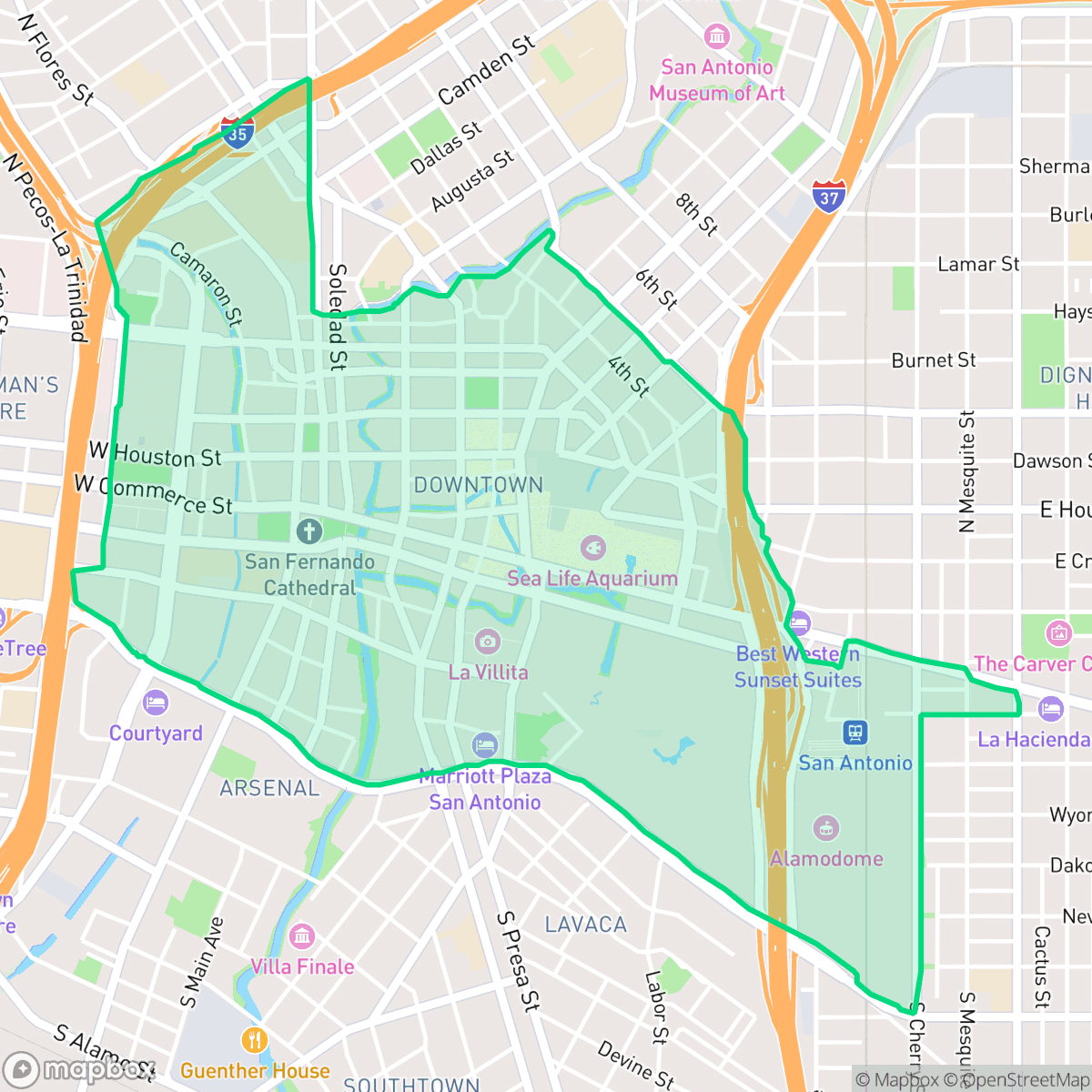
Downtown San Antonio, the historic heart of the city, traces its origins to the 1718 founding of Mission San Antonio de Valero (The Alamo) and the 1731 establishment of the San Fernando de Béxar settlement by Canary Islanders. This district serves as a living repository of Texas history, featuring the 18th-century Spanish Governor's Palace and the San Fernando Cathedral, one of the oldest continuously active religious communities in the United States. The area's architectural character is defined by a blend of Spanish Colonial adobe, Gothic Revival, and Richardsonian Romanesque styles, notably seen in the Bexar County Courthouse and the Tower Life Building. Central to its identity is the San Antonio River Walk, an iconic network of pedestrian paths originally engineered in the 1930s to mitigate flooding, which now anchors the neighborhood's vibrant cultural and commercial life.
The neighborhood functions as a dense urban core characterized by a mix of young professionals, families, and seniors. It is a high-energy environment where high-rise architecture and a lack of expansive parks define the visual landscape. Residents benefit from a central location that keeps them close to major social and dining hubs, though the area is notably more compact than other parts of the city. According to data from iHuus, the district maintains a strongly liberal leaning and a diverse demographic profile that contributes to its active, social atmosphere.
Living in this area requires navigating specific urban challenges, including elevated flood risks and a lack of pet-friendly outdoor spaces. The environment experiences frequent traffic noise and air quality concerns, which are common in such a concentrated urban setting. Prospective residents should also be aware that the local school district is currently undergoing significant administrative changes and infrastructure adjustments. This area is best suited for those who prioritize immediate access to city life over suburban quiet or private, expansive yards.
Neighborhood Scores Across 15 Qualities
Buildings and residential structures are tightly packed with minimal separation between properties. This level of density is notably higher than the San Antonio average, according to iHuus data.
Pedestrian navigation is manageable in high-density commercial blocks due to consistent sidewalks and crosswalks, though fragmented networks and heavy highway interchanges near arterial roads can make walking more difficult than in many other parts of the city.
High building density and a lack of expansive green space result in a visual landscape that is less lush than the San Antonio average. According to iHuus data, the area is characterized by standard urban structures, parking facilities, and modest residential lots without significant luxury landscaping.
Public green space and wide, grassy verges are scarce in this area. According to iHuus data, the lack of accessible parks and the prevalence of paved surfaces make it less dog friendly than the San Antonio average.
High-rise structures, major highways, and significant grey cover create a highly built-up environment. This level of density is notably higher than the city average, offering much less green space per acre than typical San Antonio neighborhoods.
A high concentration of social hubs, dining establishments, and high-rise density creates a much more active atmosphere than the San Antonio average. According to iHuus data, the area features a dense, high-energy landscape with notable pockets of activity ranging from riverside dining to busy urban blocks.
Continuous traffic sounds from nearby busy streets characterize the area, resulting in acoustic levels slightly below the city average according to iHuus data.
Frequent unhealthy air quality levels pose a significant risk to sensitive groups. According to iHuus data, the air quality in this area is slightly worse than the San Antonio average.
Industrial activity is very low, with only occasional light commercial operations and logistics centers near major transit corridors. Residents experience an environment similar to the city average, characterized by a mix of residential, institutional, and urban commercial spaces.
Health insurance access for residents in this area is lower than the San Antonio average, according to iHuus data.
Voting patterns and census indicators reflect a significantly more liberal political leaning than the San Antonio average, according to iHuus data.
A balanced demographic of young professionals, families, and seniors characterizes this area. According to iHuus data, the population age distribution is slightly more varied than the San Antonio average.
Property within this area is situated in a high-risk floodplain, which often necessitates flood insurance. According to iHuus data, the risk of flooding in Downtown is higher than the San Antonio average.
Address-Level Insights for Downtown


iHuus Neighborhood Intelligence Insights
Get address-level neighborhood insights for Downtown
- Street-level scores — see how individual blocks compare, not just neighborhood averages
- Micro-zone boundaries — identify quiet pockets, flood boundaries, and walkable clusters before you visit
- 15 dimensions in full — walkability, noise, air quality, school quality, insurance coverage, population age profile, urban/rural index, and more
- Boundary risk alerts — know if your address sits near a block boundary where scores drop, the kind of detail no listing will ever mention
- School insights — individual school ratings and insights, not just district-level data
- Compare before you commit — side-by-side data across neighborhoods, down to block precision
No credit card required
Compare with Any Neighborhood
| Dimension | Downtown | 145 Association |
|---|---|---|
| 🚶 Walkabilityavg 6.44 | ||
| 🔊 Acoustic Comfortavg 4.07 | ||
| 🤫 Privacy Indexavg 5.75 | ||
| 🎨 Visual Appealavg 6.11 | ||
| 🐕 Dog Friendlinessavg 5.91 | ||
| 🗺️ Urban-Rural Indexavg 6.87 | ||
| ✨ Neighborhood Vibeavg 4.35 | ||
| 🏥 Health Insurance Coverageavg 5.94 | ||
| 🌿 Air Qualityavg 2.27 | ||
| 🏭 Industrial Proximityavg 8.31 | ||
| 🌊 Flood Safetyavg 4.2 | ||
| 🗳️ Ideological Leanavg 7.37 | ||
| 👥 Population Age Profileavg 4.68 | ||
| 🔥 Fire Safety | ||
| 🏫 School Quality |
Downtown Rankings
School Districts Serving Downtown
School Insights for Downtown
Below average outcomes; significant attendance and academic challenges.
School Insights
See what's really behind every school rating near Downtown
- Individual school ratings — each school's own score with outcome context, not just a district average
- Enrollment & class size data — student-to-teacher ratio and how it compares to the state average
- Full demographics breakdown — ethnicity and gender composition for every school in the enrollment zone
- Every school in the district — all schools within the enrollment boundary ranked by rating, not just the closest one
- Grade levels & benchmarks — elementary through high school, with below/above state-average flags
No credit card required