Donaldson Terrace, San Antonio
Updated · 6,258 residents
Donaldson Terrace is a quiet, established residential community in San Antonio's Near Northwest area known for its mid-century architecture and grid-based street layout. Residents benefit from a relatively peaceful acoustic environment, though the area remains largely car-dependent for daily errands and services.
Key Highlights
About Donaldson Terrace
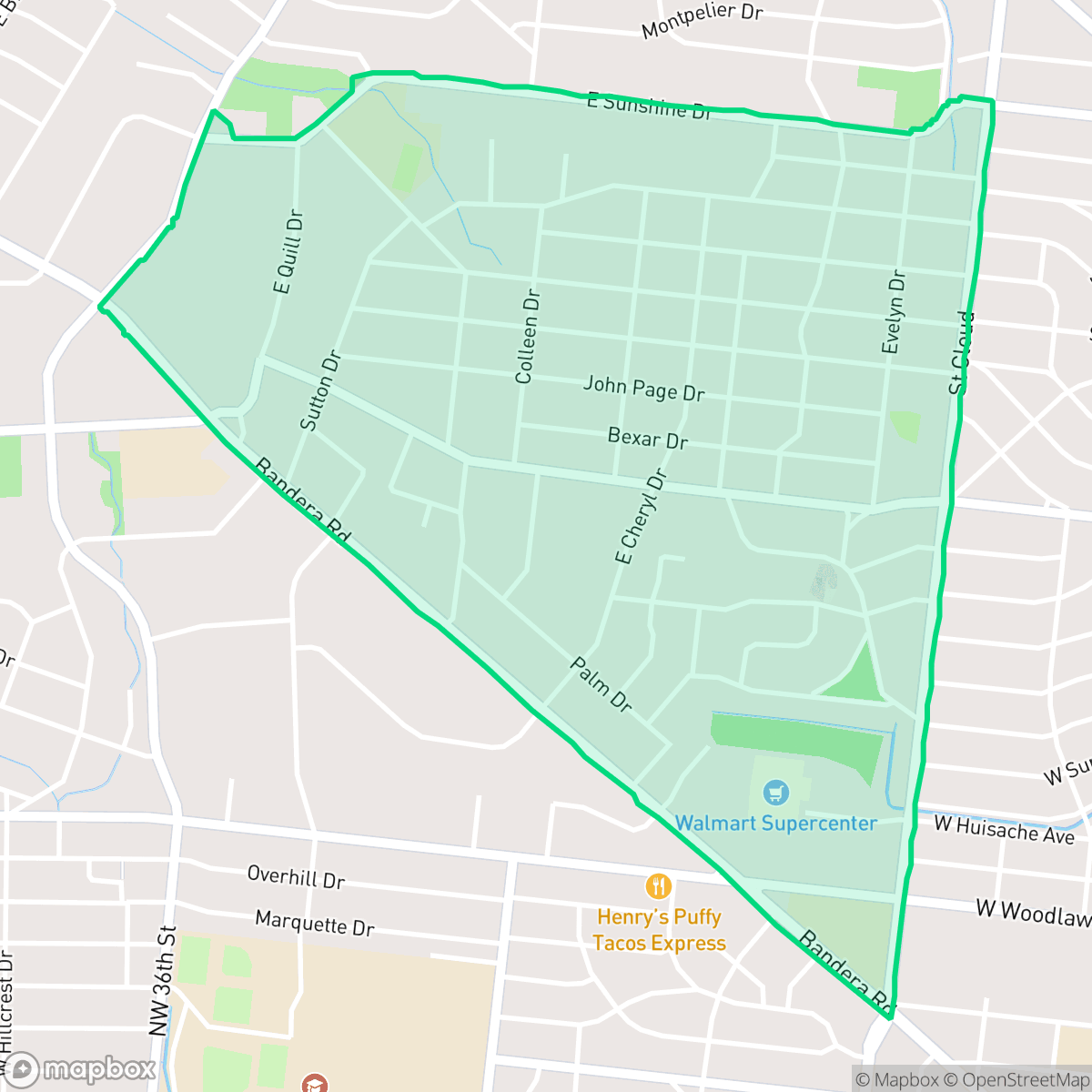
Located inside Loop 410 in San Antonio's Near Northwest area, Donaldson Terrace is an established neighborhood that began development in the late 1930s under developer Lowery. Completed shortly after World War II, the community is characterized by mature, tree-lined streets and a diverse mix of mid-century ranch-style homes, Tudor Revival cottages, and modest single-family residences. The neighborhood's local character is defined by its close proximity to Woodlawn Lake Park, St. Mary’s University, and the historic Thomas Jefferson High School. Additionally, long-standing local businesses along its borders, such as Tellez Tamales, Randy's, and the Culebra Meat Market, contribute to the neighborhood's rich cultural identity and enduring community appeal.
The area maintains a consistent suburban feel, characterized by single-family homes on modest lots that foster a sense of privacy. The grid layout provides functional navigation, and the absence of heavy industrial activity contributes to a stable, residential atmosphere. While the neighborhood is primarily quiet, it offers easy access to local amenities and educational institutions, supported by a balanced mix of green space and residential density. Prospective residents should note that the neighborhood relies on a car-centric infrastructure, as most daily necessities require a short drive. The local school district is currently undergoing significant institutional changes, which is a factor for families to consider. With a stable acoustic environment and a lack of industrial noise, the area is well-suited for those seeking a predictable, low-density living experience within the city.
Neighborhood Scores Across 15 Qualities
Residential spacing is slightly above the San Antonio average, offering a balance of moderate density with clear boundaries between properties. Backyard fencing and varied lot sizes provide a modest buffer between neighbors according to iHuus data.
Residential streets offer quiet, low-traffic routes for walking, but a lack of continuous sidewalks on many roads makes pedestrian travel less seamless than the San Antonio average. According to iHuus data, some major corridors lack dedicated paths, though the neighborhood grid remains navigable.
Modest single-family homes and mid-range apartments define the landscape, featuring uniform rooflines and small yards. This visual character is slightly below the San Antonio average according to iHuus data.
Limited public greenery and narrow street verges make outdoor exercise difficult. Most available green space consists of private fenced backyards, placing this area below the San Antonio average for dog-friendly infrastructure.
Frequent open land and scattered homes among fields or woodland characterize this area. This landscape feels slightly less dense than the San Antonio average, according to iHuus data.
Suburban streets and green spaces provide a peaceful setting, but most dining and service options require a vehicle as local business density is below the San Antonio average. According to iHuus data, the area functions primarily around daily convenience and light industrial units.
Steady traffic sounds from a nearby busy street are present; however, acoustic comfort remains higher than the San Antonio average according to iHuus data.
Unhealthy air quality levels occur frequently in this area. According to iHuus data, the air quality is slightly worse than the San Antonio average, posing a significant risk to sensitive groups.
Industrial activity is virtually nonexistent in this area, offering a landscape of residential and light commercial use that is significantly cleaner than the San Antonio average. According to iHuus data, there are no heavy warehouses or hazardous industrial sites detected within the neighborhood boundaries.
Health insurance access among residents is lower than the San Antonio average, according to iHuus data. This indicates a higher proportion of uninsured individuals living in the area compared to most of the city.
Voting patterns and census indicators show a notably more liberal leaning than the San Antonio average, according to iHuus data.
Residents live alongside a balanced mix of young adults, families, and older individuals. This demographic spread is slightly more varied than the typical profile found across San Antonio.
Flood risk in this area remains uncertain because FEMA has not yet completed a detailed study for the neighborhood. According to iHuus data, the potential for flooding is roughly comparable to the San Antonio average.
Address-Level Insights for Donaldson Terrace


iHuus Neighborhood Intelligence Insights
Get address-level neighborhood insights for Donaldson Terrace
- Street-level scores — see how individual blocks compare, not just neighborhood averages
- Micro-zone boundaries — identify quiet pockets, flood boundaries, and walkable clusters before you visit
- 15 dimensions in full — walkability, noise, air quality, school quality, insurance coverage, population age profile, urban/rural index, and more
- Boundary risk alerts — know if your address sits near a block boundary where scores drop, the kind of detail no listing will ever mention
- School insights — individual school ratings and insights, not just district-level data
- Compare before you commit — side-by-side data across neighborhoods, down to block precision
No credit card required
Compare with Any Neighborhood
| Dimension | Donaldson Terrace | 145 Association |
|---|---|---|
| 🚶 Walkabilityavg 6.44 | ||
| 🔊 Acoustic Comfortavg 4.07 | ||
| 🤫 Privacy Indexavg 5.75 | ||
| 🎨 Visual Appealavg 6.11 | ||
| 🐕 Dog Friendlinessavg 5.91 | ||
| 🗺️ Urban-Rural Indexavg 6.87 | ||
| ✨ Neighborhood Vibeavg 4.35 | ||
| 🏥 Health Insurance Coverageavg 5.94 | ||
| 🌿 Air Qualityavg 2.27 | ||
| 🏭 Industrial Proximityavg 8.31 | ||
| 🌊 Flood Safetyavg 4.2 | ||
| 🗳️ Ideological Leanavg 7.37 | ||
| 👥 Population Age Profileavg 4.68 | ||
| 🔥 Fire Safety | ||
| 🏫 School Quality |
Donaldson Terrace Rankings
School Districts Serving Donaldson Terrace
School Insights for Donaldson Terrace
Below average outcomes; significant attendance and academic challenges.
School Insights
See what's really behind every school rating near Donaldson Terrace
- Individual school ratings — each school's own score with outcome context, not just a district average
- Enrollment & class size data — student-to-teacher ratio and how it compares to the state average
- Full demographics breakdown — ethnicity and gender composition for every school in the enrollment zone
- Every school in the district — all schools within the enrollment boundary ranked by rating, not just the closest one
- Grade levels & benchmarks — elementary through high school, with below/above state-average flags
No credit card required