Dignowity Hill, San Antonio
Updated · 4,095 residents
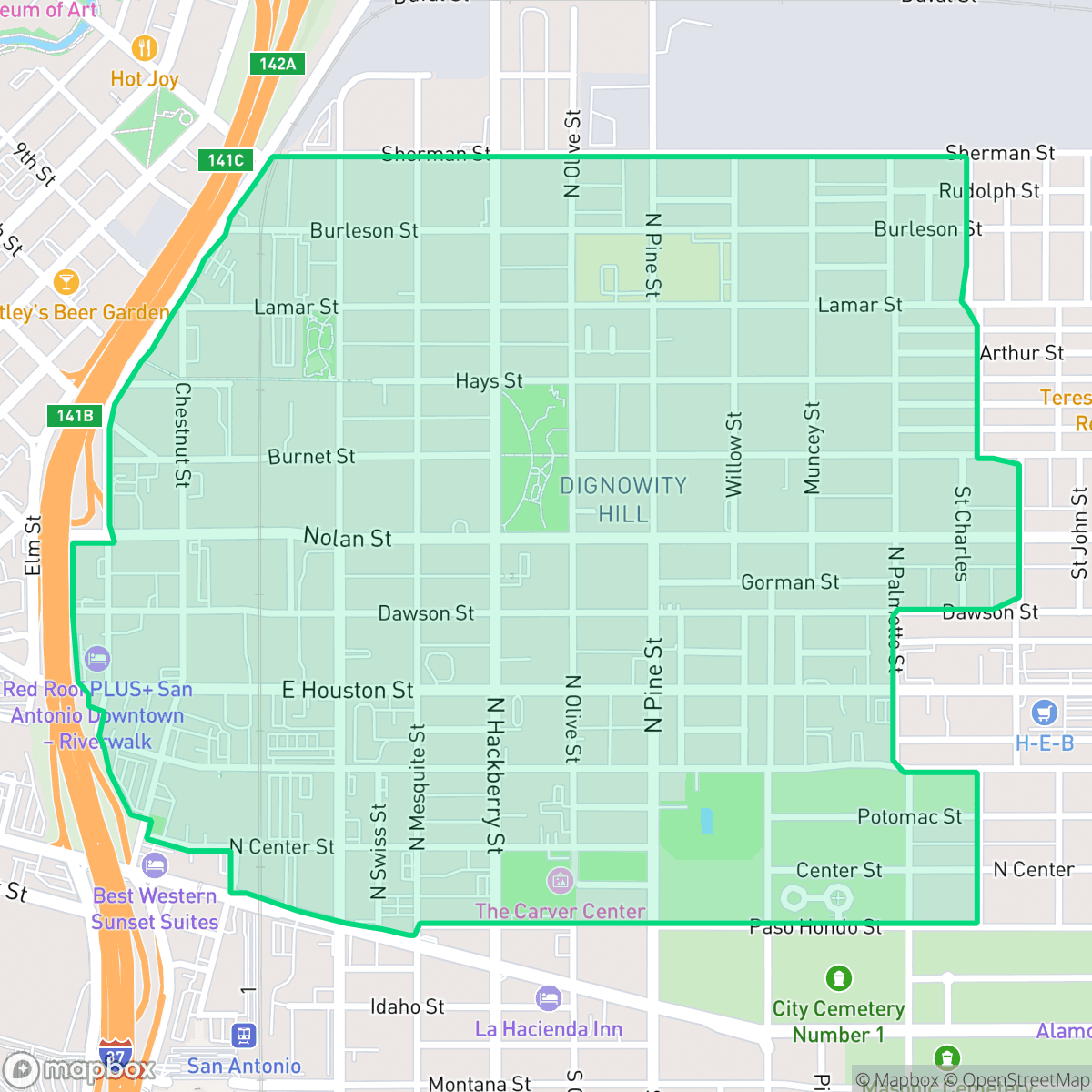
Dignowity Hill is a historic San Antonio district defined by its collection of Folk Victorian and Craftsman architecture and elevated skyline views from its namesake park. The area features a dense, grid-based layout with closely spaced homes, offering a quiet atmosphere despite its proximity to major industrial rail yards and highway infrastructure.
Key Highlights
About Dignowity Hill
Founded in the 1850s by Czech immigrant and physician Dr. Anthony Michael Dignowity, Dignowity Hill was established as San Antonio’s first exclusive residential suburb. Dr. Dignowity’s estate, Harmony House, anchored the neighborhood until its 1925 demolition; the site is now Dignowity Park, offering prominent skyline views. Originally home to the city's elite, the neighborhood boasts a rich architectural stock of Folk Victorian, Queen Anne, and Craftsman homes. The arrival of the railroad in 1877 and subsequent industrialization shifted the area into a diverse, working-class community. In the mid-20th century, the construction of Interstate 35 and Interstate 37 physically isolated the neighborhood from downtown, leading to decades of decline before modern revitalization efforts. Today, Dignowity Hill is recognized as a local historic district on the National Register of Historic Places.
The neighborhood functions as a distinct residential enclave near the urban core, characterized by its grid-based street layout and a blend of modest single-family homes. While it maintains a quiet residential feel, the area is influenced by its proximity to active industrial zones and major transportation arteries, including the nearby rail yard and highway corridors. Residents have access to local dining options and green spaces like the park that overlooks the downtown skyline, providing a unique vantage point within the city.
Prospective residents should note that the area presents a mix of urban trade-offs, including inconsistent pedestrian infrastructure and limited privacy due to narrow lot sizes. According to iHuus data, the neighborhood maintains moderate noise levels from traffic and rail activity, which may be a consideration for those sensitive to ambient sound. While the local school district is undergoing significant structural changes, the area remains a viable option for those seeking a historic, centrally located community that balances proximity to downtown with a modest, established residential environment.
Neighborhood Scores Across 15 Qualities
Houses are often situated on narrow lots with limited spacing between structures, resulting in a privacy level slightly below the San Antonio average.
Pedestrian navigation is manageable due to a grid layout and safe crossings, though sidewalk continuity is inconsistent across residential streets. This level of walkability is roughly comparable to the city average.
Modest homes with simple rooflines and small yards characterize this area. According to iHuus data, the visual landscape is less varied than the San Antonio average.
Limited green space and narrow street verges make walking dogs more challenging here than in most parts of San Antonio. While a small park exists on the western edge, there is a lack of widespread public park access throughout the neighborhood.
Residential streets and green spaces are balanced with commercial infrastructure, representing a less dense environment than the San Antonio average. According to iHuus data, the area features a mix of single-family homes and light industrial elements.
A mix of industrial zones and residential blocks provides a consistent level of activity that is slightly more vibrant than the San Antonio average. While some dense pockets offer diverse dining options, much of the area relies on driving due to the proximity of highways and warehouses.
Ongoing noise from nearby busy streets creates a moderate acoustic environment. This level of activity is slightly higher than the typical sound profile found across San Antonio, according to iHuus data.
Frequent unhealthy air quality levels pose a significant risk to sensitive groups. According to iHuus data, conditions here are slightly worse than the San Antonio average.
Nearby rail yards and logistics depots on the northern edge introduce intermittent noise and dust. While much of the area remains quiet and residential, the neighborhood has a higher industrial presence than the San Antonio average according to iHuus data.
Health insurance coverage among residents is notably lower than the San Antonio average. According to iHuus data, a small portion of the population maintains medical coverage.
Voting patterns and census indicators show a significantly more liberal leaning than the San Antonio average, according to iHuus data.
Residents experience a balanced demographic spread of young adults, families, and older individuals. This distribution of ages is consistent with the typical age profile found throughout San Antonio.
Flood risk levels for this area are currently difficult to assess because a detailed study has not yet been completed by FEMA. According to iHuus data, the uncertainty regarding potential flooding in Dignowity Hill is consistent with the broader San Antonio area.
Address-Level Insights for Dignowity Hill


iHuus Neighborhood Intelligence Insights
Get address-level neighborhood insights for Dignowity Hill
- Street-level scores — see how individual blocks compare, not just neighborhood averages
- Micro-zone boundaries — identify quiet pockets, flood boundaries, and walkable clusters before you visit
- 15 dimensions in full — walkability, noise, air quality, school quality, insurance coverage, population age profile, urban/rural index, and more
- Boundary risk alerts — know if your address sits near a block boundary where scores drop, the kind of detail no listing will ever mention
- School insights — individual school ratings and insights, not just district-level data
- Compare before you commit — side-by-side data across neighborhoods, down to block precision
No credit card required
Compare with Any Neighborhood
| Dimension | Dignowity Hill | 145 Association |
|---|---|---|
| 🚶 Walkabilityavg 6.44 | ||
| 🔊 Acoustic Comfortavg 4.07 | ||
| 🤫 Privacy Indexavg 5.75 | ||
| 🎨 Visual Appealavg 6.11 | ||
| 🐕 Dog Friendlinessavg 5.91 | ||
| 🗺️ Urban-Rural Indexavg 6.87 | ||
| ✨ Neighborhood Vibeavg 4.35 | ||
| 🏥 Health Insurance Coverageavg 5.94 | ||
| 🌿 Air Qualityavg 2.27 | ||
| 🏭 Industrial Proximityavg 8.31 | ||
| 🌊 Flood Safetyavg 4.2 | ||
| 🗳️ Ideological Leanavg 7.37 | ||
| 👥 Population Age Profileavg 4.68 | ||
| 🔥 Fire Safety | ||
| 🏫 School Quality |
Dignowity Hill Rankings
School Districts Serving Dignowity Hill
School Insights for Dignowity Hill
Below average outcomes; significant attendance and academic challenges.
School Insights
See what's really behind every school rating near Dignowity Hill
- Individual school ratings — each school's own score with outcome context, not just a district average
- Enrollment & class size data — student-to-teacher ratio and how it compares to the state average
- Full demographics breakdown — ethnicity and gender composition for every school in the enrollment zone
- Every school in the district — all schools within the enrollment boundary ranked by rating, not just the closest one
- Grade levels & benchmarks — elementary through high school, with below/above state-average flags
No credit card required