Denver Heights, San Antonio
Updated · 3,177 residents
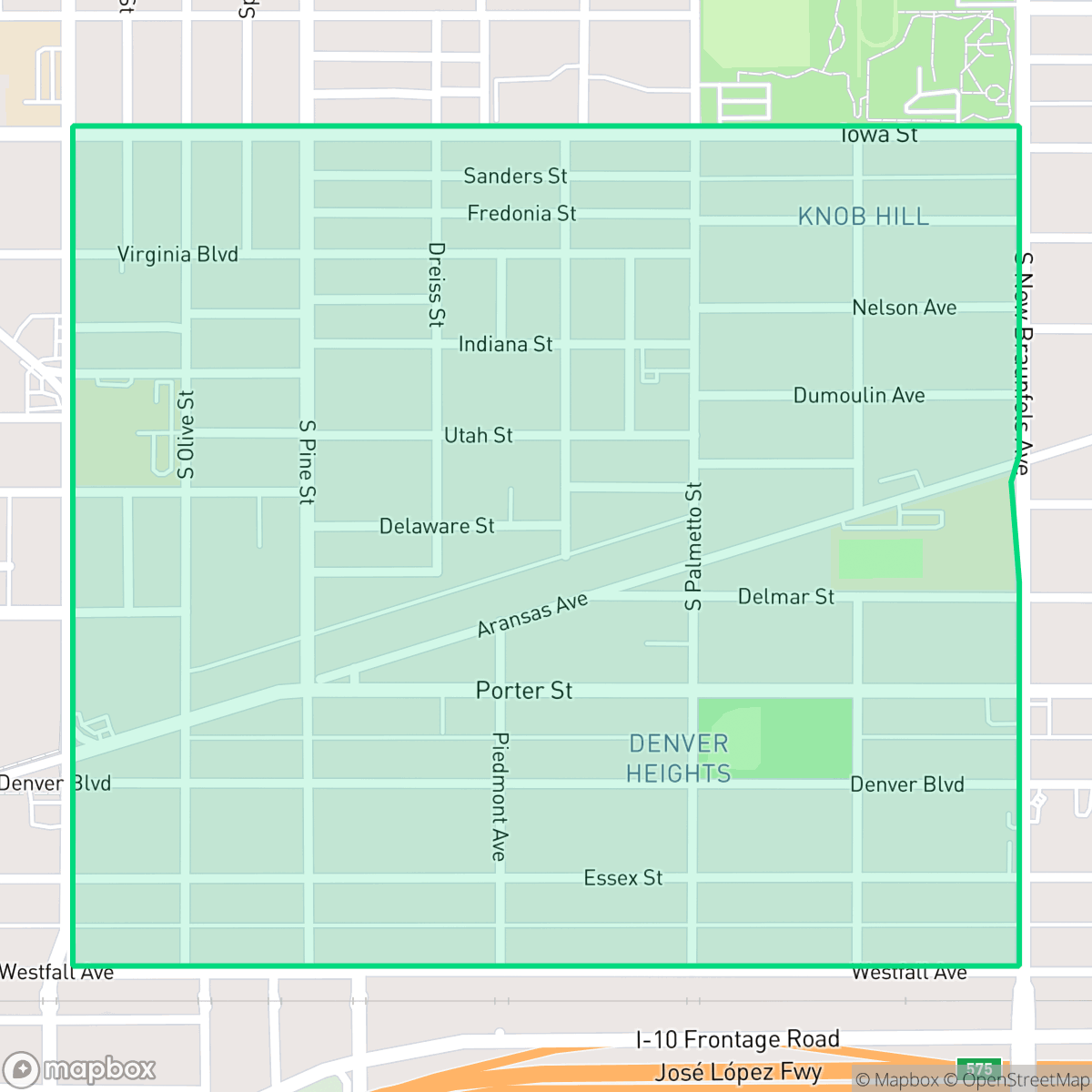
Denver Heights is a historic San Antonio community defined by its grid of 1920s Craftsman bungalows and proximity to significant local landmarks. While the area offers a quiet, suburban atmosphere, residents experience notable noise from nearby highway traffic and limited access to expansive green spaces.
Key Highlights
About Denver Heights
Developed by J.A. Bartholomew, who named it after his Colorado hometown, Denver Heights is one of San Antonio’s oldest historically Black neighborhoods. By the 1920s, deed restrictions elsewhere pushed African Americans to the East Side, transforming Denver Heights into a thriving hub for Black professionals, Pullman porters, and entrepreneurs. The neighborhood’s architectural character is defined by 1920s and 1930s Craftsman bungalows and historic cottages. Local landmarks include Pittman-Sullivan Park—the endpoint of San Antonio’s massive annual Martin Luther King Jr. March—and the Holy Redeemer Catholic Church, the city's only remaining historically Black Catholic parish. Influential figures like political boss Charles Bellinger shaped its early civic life, while historic businesses like the 1930s Pine Street Pharmacy and modern staples like Mark’s Outing cemented its cultural footprint.
The neighborhood functions as a dense residential grid, characterized by uniform housing styles on small lots. It maintains a distinct identity through its historic architecture and local landmarks, providing a stable, community-focused environment. Despite its central location, the area remains largely residential with light commercial pockets, avoiding heavy industrial encroachment.
Potential residents should note that the neighborhood experiences higher noise levels due to its proximity to major road arteries, and air quality metrics are lower than the city average. The local school district is currently undergoing significant restructuring, which impacts educational options for families. The area is best suited for those seeking a historically significant community with high health insurance coverage and a strong sense of civic engagement, provided they are comfortable with the noise levels and current school performance metrics.
Neighborhood Scores Across 15 Qualities
Residential structures are closely spaced on a tight grid, providing a level of privacy that is slightly below the San Antonio average. While some homes feature small lot sizes with minimal separation, many properties maintain moderate buffers through standard backyard fencing.
Pedestrian connectivity is slightly above the city average due to a navigable grid layout, though sidewalk continuity can be interrupted by heavy tree cover or high traffic near southern arterial roads.
Standard tract housing with uniform rooflines and small yards characterizes this area. The visual landscape lacks luxury amenities and greenery, appearing less lush than the San Antonio average according to iHuus data.
Access to public green space is somewhat limited, though a central park with baseball fields and open grass offers reliable walking areas. Some street sections feature narrow sidewalk verges, which makes the area slightly less dog friendly than the San Antonio average.
Residential streets feature a consistent grid pattern with significant tree canopy and a balanced mix of greenery and built structures. This low-density environment feels slightly more developed than the more semi-rural areas found across the wider city.
Residential life here is primarily quiet and suburban, though the area is less lively than the San Antonio average. While diverse dining and green spaces like Pittman-Sullivan Park are available, the neighborhood is largely car-oriented with limited walkability to many local businesses.
Steady traffic noise from nearby busy streets is a common feature of this area. According to iHuus data, acoustic levels are slightly higher than the San Antonio average.
Frequent unhealthy air quality levels pose a significant risk to sensitive groups. According to iHuus data, air quality in Denver Heights is slightly worse than the San Antonio average.
Residential areas predominate with only occasional light commercial structures nearby. While the neighborhood is slightly more industrial than the San Antonio average, residents should note that proximity to a major highway may introduce some noise and air pollution.
Health insurance accessibility is slightly below the San Antonio average. Residents may find fewer options for employer-sponsored or subsidized plans within this area according to iHuus data.
Voting patterns and census indicators show a distinctly liberal leaning, which is significantly more pronounced than the San Antonio average.
Residents live alongside a balanced mix of young adults, families, and older generations. This demographic distribution is consistent with the overall average for San Antonio.
Flood risk levels in this area are currently undetermined because FEMA has not finalized a detailed study for the neighborhood. According to iHuus data, this uncertainty aligns with the average risk found across San Antonio.
Address-Level Insights for Denver Heights


iHuus Neighborhood Intelligence Insights
Get address-level neighborhood insights for Denver Heights
- Street-level scores — see how individual blocks compare, not just neighborhood averages
- Micro-zone boundaries — identify quiet pockets, flood boundaries, and walkable clusters before you visit
- 15 dimensions in full — walkability, noise, air quality, school quality, insurance coverage, population age profile, urban/rural index, and more
- Boundary risk alerts — know if your address sits near a block boundary where scores drop, the kind of detail no listing will ever mention
- School insights — individual school ratings and insights, not just district-level data
- Compare before you commit — side-by-side data across neighborhoods, down to block precision
No credit card required
Compare with Any Neighborhood
| Dimension | Denver Heights | 145 Association |
|---|---|---|
| 🚶 Walkabilityavg 6.44 | ||
| 🔊 Acoustic Comfortavg 4.07 | ||
| 🤫 Privacy Indexavg 5.75 | ||
| 🎨 Visual Appealavg 6.11 | ||
| 🐕 Dog Friendlinessavg 5.91 | ||
| 🗺️ Urban-Rural Indexavg 6.87 | ||
| ✨ Neighborhood Vibeavg 4.35 | ||
| 🏥 Health Insurance Coverageavg 5.94 | ||
| 🌿 Air Qualityavg 2.27 | ||
| 🏭 Industrial Proximityavg 8.31 | ||
| 🌊 Flood Safetyavg 4.2 | ||
| 🗳️ Ideological Leanavg 7.37 | ||
| 👥 Population Age Profileavg 4.68 | ||
| 🔥 Fire Safety | ||
| 🏫 School Quality |
Denver Heights Rankings
School Districts Serving Denver Heights
School Insights for Denver Heights
Below average outcomes; significant attendance and academic challenges.
School Insights
See what's really behind every school rating near Denver Heights
- Individual school ratings — each school's own score with outcome context, not just a district average
- Enrollment & class size data — student-to-teacher ratio and how it compares to the state average
- Full demographics breakdown — ethnicity and gender composition for every school in the enrollment zone
- Every school in the district — all schools within the enrollment boundary ranked by rating, not just the closest one
- Grade levels & benchmarks — elementary through high school, with below/above state-average flags
No credit card required