Dellcrest Area, San Antonio
Updated · 3,382 residents
The Dellcrest Area is an East Side San Antonio neighborhood defined by its mid-century residential layout and active commercial corridors. Residents experience a car-dependent environment with moderate road noise, yet benefit from a lively local atmosphere and access to established community institutions.
Key Highlights
About Dellcrest Area
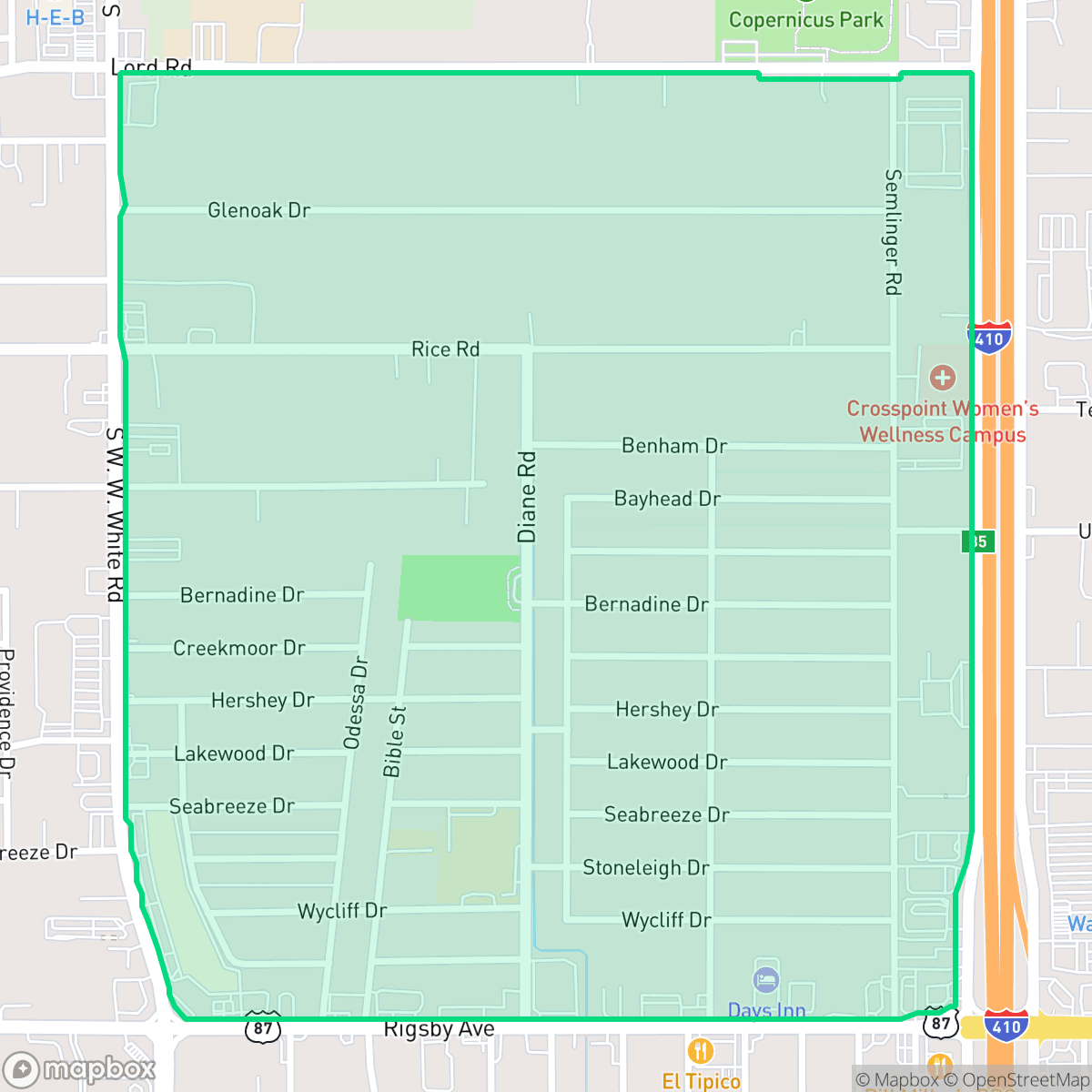
Located on the East Side of San Antonio, the Dellcrest Area transitioned from historic farmland into a mid-century residential neighborhood during the 1960s. This agricultural past is still reflected in its unique layout, which blends sprawling, country-style lots with traditional city blocks. The neighborhood’s cultural and commercial identity is anchored by long-standing local institutions, such as Fanick’s Garden Center, a family-owned nursery operating on Holmgreen Road since 1939. Additionally, South W.W. White Road serves as a key community corridor, hosting beloved local eateries and the annual Juneteenth Parade. The neighborhood is supported by the Dellcrest Area Neighborhood Association (DANA), which merged with the adjacent Dellcrest Forrest community in 2011 to preserve the area's strong sense of community, diverse heritage, and local green spaces like Dellcrest Park.
The neighborhood maintains a distinct suburban character, blending residential streets with light industrial zones that contribute to its active daytime energy. Local dining options and community hubs provide a steady rhythm to the area, supported by a strong sense of local identity. While the layout requires a vehicle for most errands, the presence of green space and long-standing landmarks offers a sense of stability within this East Side community.
Prospective residents should note that the area faces challenges regarding air quality and limited health insurance coverage, which are important factors for long-term planning. The local school district, San Antonio ISD, is currently undergoing significant restructuring, and families should research specific campus performance as the district navigates these systemic changes. Overall, the neighborhood is best suited for those seeking an established, community-focused environment who are comfortable with a car-reliant lifestyle and proximity to light industrial activity.
Neighborhood Scores Across 15 Qualities
Residential spacing provides a moderate level of separation between neighbors, which is slightly higher than the San Antonio average. According to iHuus data, the area features mixed density with some natural buffers between properties.
Low street traffic makes for a peaceful walking environment, though the absence of sidewalks makes it less walkable than most parts of San Antonio.
Residential streets feature consistent, boxy rooflines and tidy, compact yards. This level of visual variety is slightly below the San Antonio average according to iHuus data.
Limited access to public parks and minimal green verges make this area less ideal for dog owners. According to iHuus data, the availability of pet-friendly spaces is below the San Antonio average.
Residential pockets here feature a blend of low density housing and larger industrial or commercial blocks. This area serves as a transition zone that is slightly less developed than the San Antonio average, according to iHuus data.
Diverse dining options and local social hubs provide more activity than the typical San Antonio neighborhood. While various amenities are available, the area's layout remains car-dependent due to the presence of industrial units and highway corridors.
Frequent acoustic disturbances from nearby major freeways and railroad tracks characterize this area. According to iHuus data, noise levels in the Dellcrest Area are notably higher than the San Antonio average.
Frequent unhealthy air quality levels pose a significant risk to sensitive groups. According to iHuus data, the air quality in this area is worse than the San Antonio average.
Residential streets and open green spaces dominate the area, though some light commercial activity is present. According to iHuus data, this area has less exposure to heavy industrial presence than the San Antonio average.
Health insurance coverage among residents is significantly lower than the San Antonio average, according to iHuus data. This lack of coverage may present challenges for accessing regular medical services and managing healthcare costs.
Voting patterns and census indicators show a markedly liberal political leaning that is significantly higher than the San Antonio average, according to iHuus data.
Residents live alongside a balanced variety of young adults, families, and seniors. This demographic spread is slightly more even than the average found across San Antonio.
Flood risk levels in this area are slightly higher than the San Antonio average. According to iHuus data, the lack of a detailed FEMA study means residents should remain cautious regarding potential drainage issues during heavy rainfall.
Address-Level Insights for Dellcrest Area


iHuus Neighborhood Intelligence Insights
Get address-level neighborhood insights for Dellcrest Area
- Street-level scores — see how individual blocks compare, not just neighborhood averages
- Micro-zone boundaries — identify quiet pockets, flood boundaries, and walkable clusters before you visit
- 15 dimensions in full — walkability, noise, air quality, school quality, insurance coverage, population age profile, urban/rural index, and more
- Boundary risk alerts — know if your address sits near a block boundary where scores drop, the kind of detail no listing will ever mention
- School insights — individual school ratings and insights, not just district-level data
- Compare before you commit — side-by-side data across neighborhoods, down to block precision
No credit card required
Compare with Any Neighborhood
| Dimension | Dellcrest Area | 145 Association |
|---|---|---|
| 🚶 Walkabilityavg 6.44 | ||
| 🔊 Acoustic Comfortavg 4.07 | ||
| 🤫 Privacy Indexavg 5.75 | ||
| 🎨 Visual Appealavg 6.11 | ||
| 🐕 Dog Friendlinessavg 5.91 | ||
| 🗺️ Urban-Rural Indexavg 6.87 | ||
| ✨ Neighborhood Vibeavg 4.35 | ||
| 🏥 Health Insurance Coverageavg 5.94 | ||
| 🌿 Air Qualityavg 2.27 | ||
| 🏭 Industrial Proximityavg 8.31 | ||
| 🌊 Flood Safetyavg 4.2 | ||
| 🗳️ Ideological Leanavg 7.37 | ||
| 👥 Population Age Profileavg 4.68 | ||
| 🔥 Fire Safety | ||
| 🏫 School Quality |
Dellcrest Area Rankings
School Districts Serving Dellcrest Area
School Insights for Dellcrest Area
Below average outcomes; significant attendance and academic challenges.
School Insights
See what's really behind every school rating near Dellcrest Area
- Individual school ratings — each school's own score with outcome context, not just a district average
- Enrollment & class size data — student-to-teacher ratio and how it compares to the state average
- Full demographics breakdown — ethnicity and gender composition for every school in the enrollment zone
- Every school in the district — all schools within the enrollment boundary ranked by rating, not just the closest one
- Grade levels & benchmarks — elementary through high school, with below/above state-average flags
No credit card required