Deerfield, San Antonio
Updated · 2,025 residents
Deerfield is a quiet, master-planned community on San Antonio's North Side known for its high visual appeal and tranquil, low-density environment. Residents benefit from a strong sense of security through dedicated patrols and access to high-performing schools within the North East Independent School District.
Key Highlights
About Deerfield
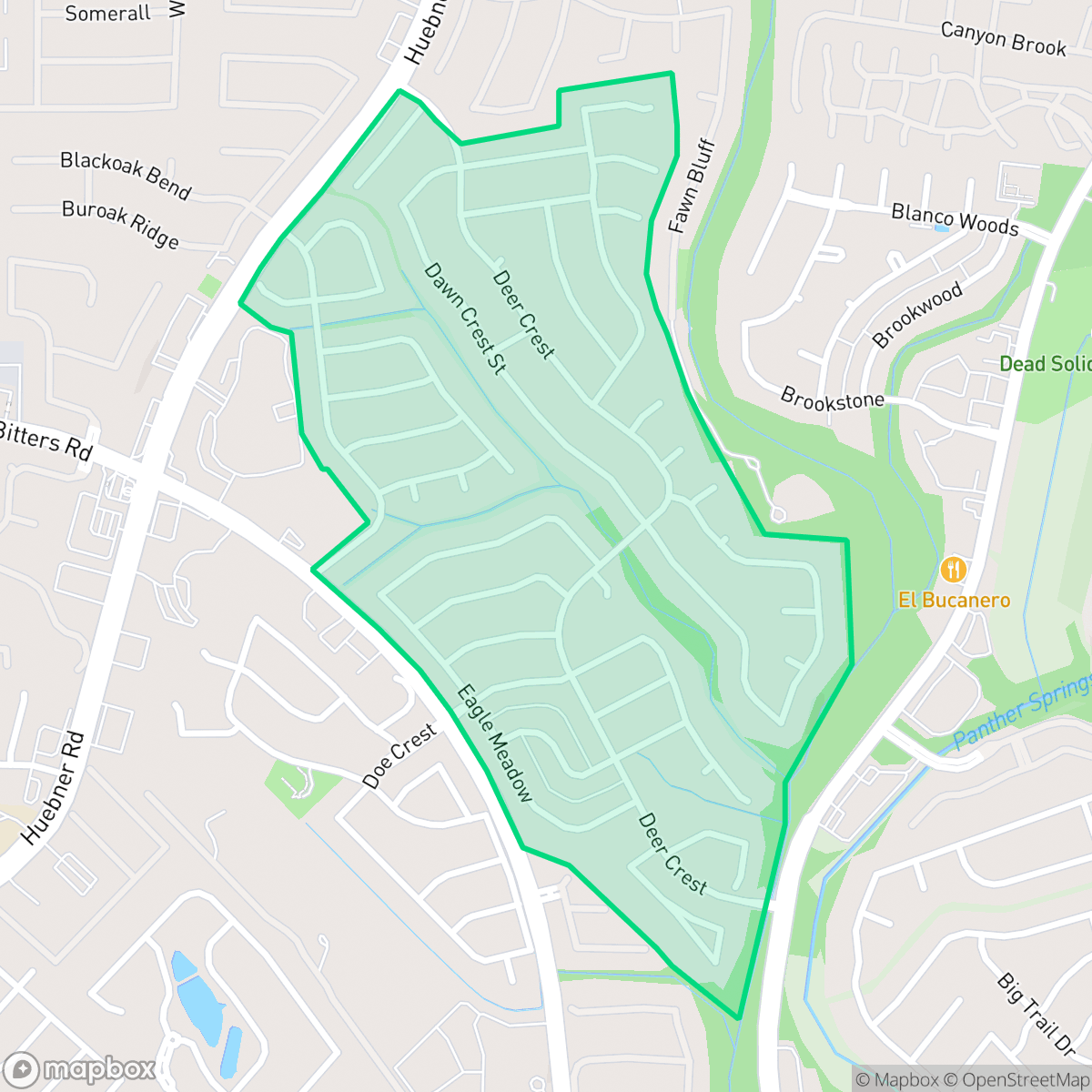
Established in the mid-1980s, Deerfield is a premier, master-planned residential community located on the North Side of San Antonio, Texas, nestled inside Loop 1604 off Huebner and Bitters roads. The Deerfield Owners Association was incorporated in 1985 to manage the neighborhood's growth, which primarily features custom-built, traditional-style single-family homes constructed between 1985 and 1999. The community expanded in the 1990s and 2000s with surrounding subdivisions, including The Park, The Reserve, The Waters, and The Woods of Deerfield. Characterized by its mature oak trees, quiet streets, and the central Thrush Ridge Park, the neighborhood is locally distinguished by its dedicated 24-hour off-duty police patrol and its active community swim team, the Deerfield Dragons.
The area maintains a high level of visual appeal, characterized by its mature trees and well-maintained single-family residences. With an acoustic comfort level that keeps ambient noise to a minimum, it offers a peaceful retreat from the surrounding urban environment. The community is strictly residential with very limited commercial activity, which contributes to its low-key atmosphere and a high degree of privacy relative to the rest of the city. Residents also benefit from exceptional health insurance coverage rates and a stable, family-oriented environment.
While the neighborhood excels in safety and aesthetic quality, it is less suited for those seeking a vibrant, walkable urban lifestyle. Daily errands typically require a vehicle, as the area remains primarily residential with few businesses within walking distance. However, it remains an attractive destination for families and professionals who prioritize stability, flood safety, and proximity to reputable public schools within the North East Independent School District.
Neighborhood Scores Across 15 Qualities
Residential spacing is somewhat variable; many detached homes feature significant tree buffers, though some properties sit closer to neighbors than the San Antonio average. According to iHuus data, this creates a mix of open and more secluded living environments.
Sidewalks are available along main roads and residential streets are low traffic, making the area slightly more walkable than the San Antonio average. Mature tree canopy provides shade for pedestrians, though sidewalk coverage is not universal across all side streets.
Large homes with complex rooflines, private pools, and spacious driveways create a highly aesthetic environment that is noticeably more polished than the San Antonio average. According to iHuus data, the area features frequent upscale amenities and well-maintained properties.
Continuous tree canopies and wide residential verges provide a safe environment for pets. According to iHuus data, the availability of communal green spaces and connected paths is notably higher than the San Antonio average.
Open land and woodland areas are frequently interspersed with residential pockets, making this area slightly more rural than the San Antonio average. Mature suburban layouts and commercial clusters along main arteries complement this landscape, according to iHuus data.
Suburban streets and green spaces offer a serene environment, though most dining and retail options require a vehicle to access. According to iHuus data, the local liveliness is slightly below the San Antonio average due to the low density of walkable businesses.
Constant sound from nearby major freeways and rail lines characterizes the area. According to iHuus data, acoustic comfort levels here are lower than the San Antonio average.
Frequent unhealthy air quality levels present a significant health risk to sensitive groups. According to iHuus data, the air quality in this area is slightly worse than the San Antonio average.
Industrial activity and heavy warehouses are absent from this area, providing a more tranquil environment than the San Antonio average. According to iHuus data, the landscape is comprised solely of residential and commercial zones without any detectable industrial hazards.
Health insurance accessibility is significantly higher than the San Antonio average, providing residents with greater access to medical care. According to iHuus data, a substantial majority of the population in this area maintains active coverage.
Conservative values represent the majority of the population here, creating a political landscape that is notably more conservative than the San Antonio average according to iHuus data.
Residents live alongside a balanced mix of young adults, families, and older individuals. This age distribution is slightly more varied than the average found across San Antonio, according to iHuus data.
Flood risk in this area is significantly lower than the San Antonio average, though some residual risk remains due to its location within the 500-year floodplain. According to iHuus data, properties here are situated outside the most high-risk zones.
Address-Level Insights for Deerfield


iHuus Neighborhood Intelligence Insights
Get address-level neighborhood insights for Deerfield
- Street-level scores — see how individual blocks compare, not just neighborhood averages
- Micro-zone boundaries — identify quiet pockets, flood boundaries, and walkable clusters before you visit
- 15 dimensions in full — walkability, noise, air quality, school quality, insurance coverage, population age profile, urban/rural index, and more
- Boundary risk alerts — know if your address sits near a block boundary where scores drop, the kind of detail no listing will ever mention
- School insights — individual school ratings and insights, not just district-level data
- Compare before you commit — side-by-side data across neighborhoods, down to block precision
No credit card required
Compare with Any Neighborhood
| Dimension | Deerfield | 145 Association |
|---|---|---|
| 🚶 Walkabilityavg 6.44 | ||
| 🔊 Acoustic Comfortavg 4.07 | ||
| 🤫 Privacy Indexavg 5.75 | ||
| 🎨 Visual Appealavg 6.11 | ||
| 🐕 Dog Friendlinessavg 5.91 | ||
| 🗺️ Urban-Rural Indexavg 6.87 | ||
| ✨ Neighborhood Vibeavg 4.35 | ||
| 🏥 Health Insurance Coverageavg 5.94 | ||
| 🌿 Air Qualityavg 2.27 | ||
| 🏭 Industrial Proximityavg 8.31 | ||
| 🌊 Flood Safetyavg 4.2 | ||
| 🗳️ Ideological Leanavg 7.37 | ||
| 👥 Population Age Profileavg 4.68 | ||
| 🔥 Fire Safety | ||
| 🏫 School Quality |
Deerfield Rankings
School Districts Serving Deerfield
School Insights for Deerfield
Below average outcomes; significant attendance and academic challenges.
School Insights
See what's really behind every school rating near Deerfield
- Individual school ratings — each school's own score with outcome context, not just a district average
- Enrollment & class size data — student-to-teacher ratio and how it compares to the state average
- Full demographics breakdown — ethnicity and gender composition for every school in the enrollment zone
- Every school in the district — all schools within the enrollment boundary ranked by rating, not just the closest one
- Grade levels & benchmarks — elementary through high school, with below/above state-average flags
No credit card required