Community Workers Council-Los Jardines, San Antonio
Updated · 3,747 residents
Community Workers Council-Los Jardines is a residential area on San Antonio's Westside characterized by a mix of modest single-family homes and light industrial activity. While the neighborhood offers a relatively quiet acoustic environment, it remains a car-dependent community with limited walkability and few services within immediate reach.
Key Highlights
About Community Workers Council-Los Jardines
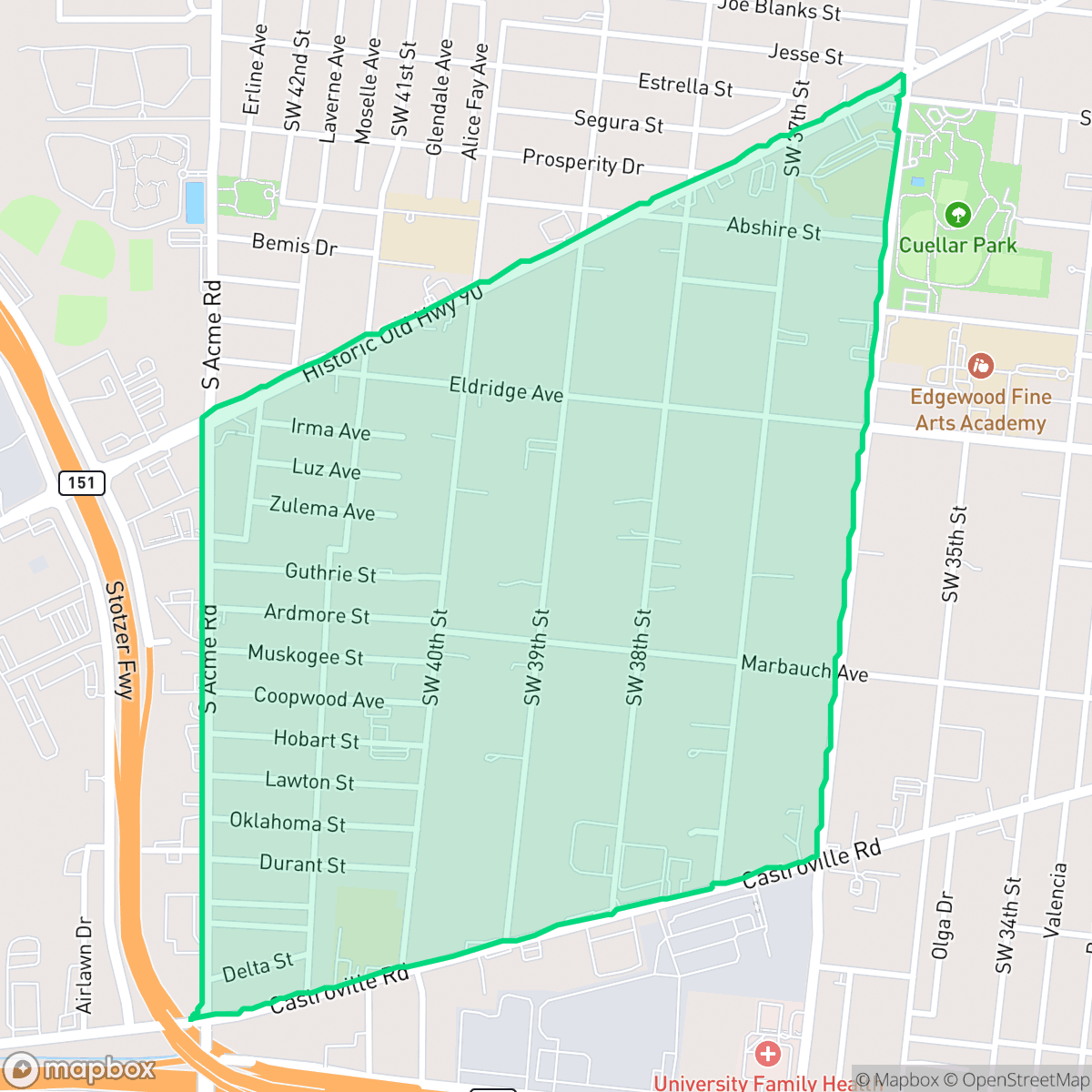
Located on San Antonio’s Westside, the Community Workers Council-Los Jardines area traces its origins to July 1908, when J. C. Clapton platted a 32-block farming community. In 1914, the Lady of the Lake Gardens Company replatted the land into a standard grid subdivision. The name "Los Jardines" (Spanish for "the gardens") reflects this development and the local farms that persisted into the 1950s. Bordered by Castroville Road to the south and Acme Road to the west, the neighborhood is bisected by Old Highway 90, which separates the Los Jardines sector from the active Community Workers Council neighborhood association to the north. Historically defined by its agricultural roots, the neighborhood transitioned in the mid-to-late 20th century into a residential community of modest single-family homes, heavily shaped by its proximity to Kelly Air Force Base and a strong Mexican-American cultural identity.
The area maintains a distinct identity rooted in its mid-century development, where residential blocks blend with commercial daytime traffic. Local dining options like El Puesto and La Isla Pescaderia serve as community hubs, reflecting the neighborhood's long-standing cultural character. Residents benefit from a relatively low noise profile, with average levels around 52 decibels, providing a sense of calm that contrasts with the busier corridors of the city.
Prospective residents should be aware of several livability trade-offs, including the necessity of a vehicle for daily errands due to the car-oriented layout. The area faces significant challenges regarding flood safety and air quality, which are important considerations for long-term planning. While the local Edgewood Independent School District is undergoing a complex transition, it offers a range of specialized programs that cater to diverse student needs. The community is best suited for those seeking a quiet, established residential setting who are comfortable with the inherent limitations of a suburban, car-dependent environment.
Neighborhood Scores Across 15 Qualities
Residential spacing is varied, with many structures separated by significant distances or vacant brush land. This layout provides slightly more buffer between neighbors than the San Antonio average, according to iHuus data.
Pedestrians must often use dirt shoulders due to a lack of sidewalks on many roads. While the streets are quiet, walkability is lower than the San Antonio average according to iHuus data.
Standard tract housing with small yards and irregular structures defines the area. Visible debris and unpaved driveways contribute to a landscape that is less aesthetically polished than the San Antonio average.
Public park access is minimal and most greenery is contained within private lots. This area offers fewer opportunities for outdoor pet activities than the San Antonio average, according to iHuus data.
Open land and scattered homes characterize this area, which maintains a semi-rural atmosphere similar to the San Antonio average. According to iHuus data, the landscape features a mix of large unbuilt lots and low-density residential areas transitioning into industrial corridors.
A steady rhythm of residential life meets scattered light industrial and warehouse zones. This area offers a calm setting with significant green space, though the layout remains largely car-dependent and similar to the city average for liveliness.
Steady noise from nearby busy streets is present, though levels remain more favorable than the San Antonio average. According to iHuus data, residents can expect a consistent hum of local traffic throughout the day.
Frequent unhealthy air quality levels pose a significant risk to sensitive groups. According to iHuus data, these conditions are worse than the typical levels found across San Antonio.
Residential life is largely undisturbed by heavy industry, though some nearby logistics hubs and warehouses contribute to localized commercial traffic. According to iHuus data, the concentration of industrial activity in this area is lower than the San Antonio average.
Health insurance coverage levels in this area are lower than the San Antonio average. According to iHuus data, fewer than half of the residents currently hold health insurance coverage.
Voting patterns and census indicators show a significantly more liberal political leaning than the San Antonio average. According to iHuus data, this community is characterized by a much higher concentration of liberal-leaning residents.
Residents live alongside a balanced mix of young adults, families, and seniors. This age distribution is consistent with the broader San Antonio area according to iHuus data.
Significant flood hazards are present in this area, placing it well above the San Antonio average for risk. Residents should anticipate high insurance premiums and potential property vulnerabilities according to iHuus data.
Address-Level Insights for Community Workers Council-Los Jardines


iHuus Neighborhood Intelligence Insights
Get address-level neighborhood insights for Community Workers Council-Los Jardines
- Street-level scores — see how individual blocks compare, not just neighborhood averages
- Micro-zone boundaries — identify quiet pockets, flood boundaries, and walkable clusters before you visit
- 15 dimensions in full — walkability, noise, air quality, school quality, insurance coverage, population age profile, urban/rural index, and more
- Boundary risk alerts — know if your address sits near a block boundary where scores drop, the kind of detail no listing will ever mention
- School insights — individual school ratings and insights, not just district-level data
- Compare before you commit — side-by-side data across neighborhoods, down to block precision
No credit card required
Compare with Any Neighborhood
| Dimension | Community Workers Council-Los Jardines | 145 Association |
|---|---|---|
| 🚶 Walkabilityavg 6.44 | ||
| 🔊 Acoustic Comfortavg 4.07 | ||
| 🤫 Privacy Indexavg 5.75 | ||
| 🎨 Visual Appealavg 6.11 | ||
| 🐕 Dog Friendlinessavg 5.91 | ||
| 🗺️ Urban-Rural Indexavg 6.87 | ||
| ✨ Neighborhood Vibeavg 4.35 | ||
| 🏥 Health Insurance Coverageavg 5.94 | ||
| 🌿 Air Qualityavg 2.27 | ||
| 🏭 Industrial Proximityavg 8.31 | ||
| 🌊 Flood Safetyavg 4.2 | ||
| 🗳️ Ideological Leanavg 7.37 | ||
| 👥 Population Age Profileavg 4.68 | ||
| 🔥 Fire Safety | ||
| 🏫 School Quality |
Community Workers Council-Los Jardines Rankings
School Districts Serving Community Workers Council-Los Jardines
School Insights for Community Workers Council-Los Jardines
Below average outcomes; significant attendance and academic challenges.
School Insights
See what's really behind every school rating near Community Workers Council-Los Jardines
- Individual school ratings — each school's own score with outcome context, not just a district average
- Enrollment & class size data — student-to-teacher ratio and how it compares to the state average
- Full demographics breakdown — ethnicity and gender composition for every school in the enrollment zone
- Every school in the district — all schools within the enrollment boundary ranked by rating, not just the closest one
- Grade levels & benchmarks — elementary through high school, with below/above state-average flags
No credit card required