Churchill Estates, San Antonio
Updated · 2,053 residents
Churchill Estates is a quiet, residential North Side enclave defined by its mature canopy and expansive, tree-lined streets. While the area offers high levels of privacy and a strong suburban atmosphere, residents should anticipate significant road noise from nearby thoroughfares and a reliance on personal vehicles for daily errands.
Key Highlights
About Churchill Estates
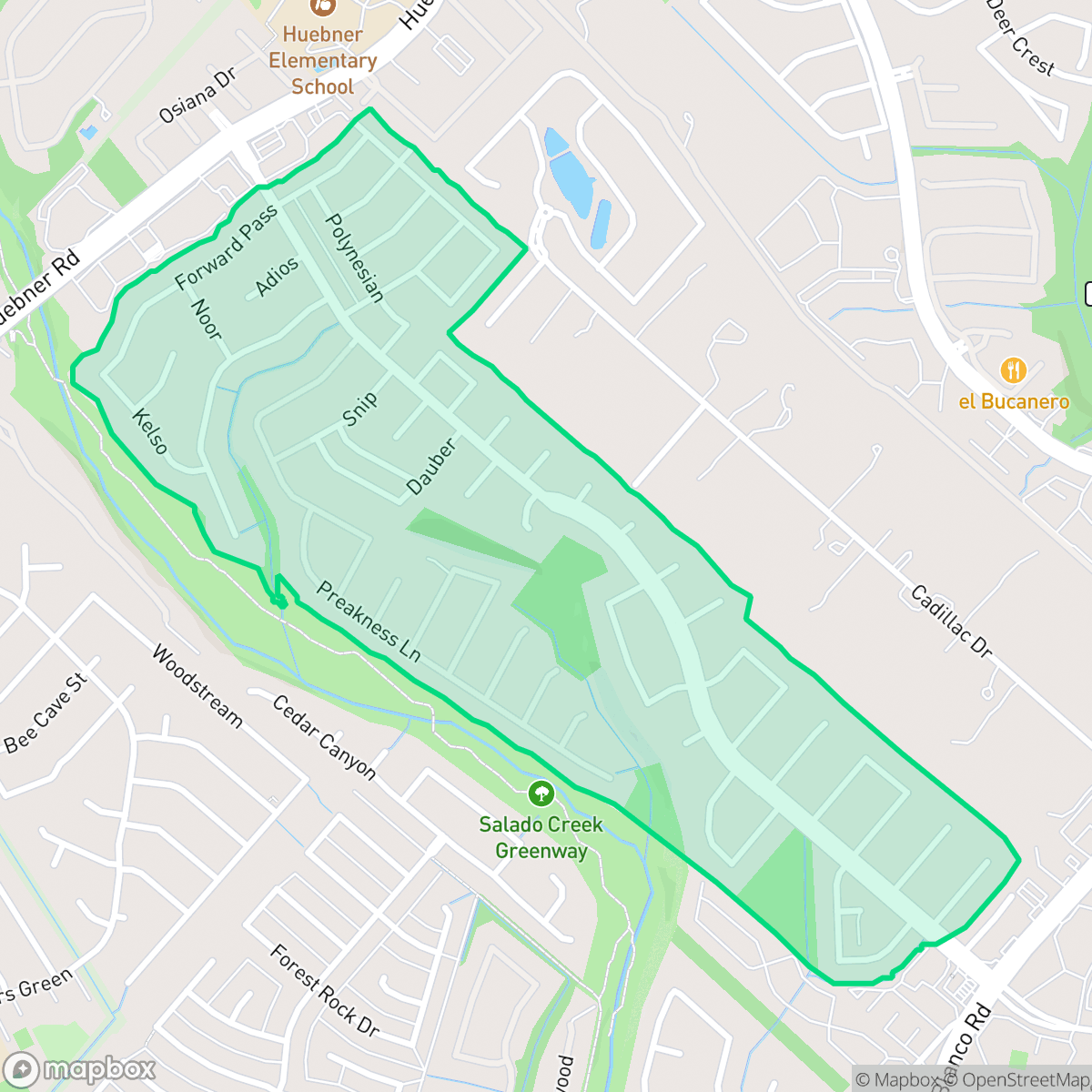
Established in 1975, Churchill Estates is an upper-middle-class residential subdivision located on the North Side of San Antonio, bounded by Huebner Road and Blanco Road. Development of the neighborhood began in the mid-1970s, resulting in a community of approximately 875 contemporary estate and garden homes. The neighborhood is characterized by its spacious lots and lush, tree-lined streets featuring mature live oaks, ashe junipers, and cedar elms. Its central spine is the 1.5-mile Churchill Estates Boulevard, a signature thoroughfare equipped with a dedicated lane for cyclists, runners, and walkers. Governed by the Churchill Estates Homes Association, the community maintains a peaceful, suburban character with local amenities like a recreational center and proximity to the Walker Ranch Historic Landmark Park.
The neighborhood functions as a secluded retreat, characterized by its low-density layout and significant green space. Residents benefit from proximity to local landmarks like Walker Ranch Historic Landmark Park, which provides accessible outdoor recreation. The area maintains a distinct residential focus, with limited commercial activity requiring most residents to commute for shopping and dining needs. According to data, the community experiences higher levels of road traffic noise, which is a notable factor for prospective residents considering the area's otherwise tranquil aesthetic.
The neighborhood is served by the North East Independent School District, a high-performing system that remains a primary draw for families. While the district navigates ongoing fiscal adjustments, it continues to offer robust academic and extracurricular programs. The area is best suited for those who prioritize privacy, established greenery, and access to quality public education, provided they are comfortable with a car-dependent lifestyle and the ambient noise associated with its location near major transit routes.
Neighborhood Scores Across 15 Qualities
Substantial backyard tree buffers and large lot separations provide a sense of seclusion that is higher than the San Antonio average. According to iHuus data, houses are spaced widely enough to maintain significant distance from neighbors.
Low-traffic residential streets and cul-de-sacs offer a safe environment for walking, with sidewalks available on one side of the road. This level of walkability is slightly higher than the San Antonio average according to iHuus data.
Large homes with complex architectural features and private swimming pools contribute to a visual landscape that is significantly more manicured than the San Antonio average. According to iHuus data, the frequent presence of high-end amenities and spacious lots creates a highly polished aesthetic throughout the area.
Large forested buffer zones and wide residential verges provide ample green space for walking dogs. According to iHuus data, the level of connectivity to nature and safety from traffic is above the San Antonio average.
Frequent open land and scattered homes amid woodland provide a more semi-rural feel than the San Antonio average. This area features dense suburban development characterized by single-family homes and high tree canopy coverage according to iHuus data.
Low density and significant open space create a serene environment, though the area is less active than the San Antonio average. Most daily needs require a vehicle, as local business density is limited to a few scattered service spots.
Persistent noise from nearby major freeways and transit corridors is common here. According to iHuus data, acoustic levels are notably higher than the San Antonio average.
Frequent unhealthy air quality levels pose a significant risk to sensitive groups. This area experiences worse air quality than the San Antonio average, according to iHuus data.
Industrial activity and warehouses are entirely absent from this area. According to iHuus data, the neighborhood offers a significant reduction in industrial proximity compared to the San Antonio average.
Health insurance access is notably higher here than the San Antonio average, according to iHuus data. Most residents in this area maintain active health coverage.
Political leanings within the neighborhood are relatively balanced between conservative and liberal perspectives. This contrasts with the broader San Antonio area, which leans significantly more toward the conservative side according to iHuus data.
Residents live alongside a diverse mix of young adults, families, and seniors. According to iHuus data, this demographic distribution is more balanced than the San Antonio average.
Flood risk in this area is notably lower than the San Antonio average, though some residual risk remains due to proximity to the 500-year floodplain according to iHuus data.
Address-Level Insights for Churchill Estates


iHuus Neighborhood Intelligence Insights
Get address-level neighborhood insights for Churchill Estates
- Street-level scores — see how individual blocks compare, not just neighborhood averages
- Micro-zone boundaries — identify quiet pockets, flood boundaries, and walkable clusters before you visit
- 15 dimensions in full — walkability, noise, air quality, school quality, insurance coverage, population age profile, urban/rural index, and more
- Boundary risk alerts — know if your address sits near a block boundary where scores drop, the kind of detail no listing will ever mention
- School insights — individual school ratings and insights, not just district-level data
- Compare before you commit — side-by-side data across neighborhoods, down to block precision
No credit card required
Compare with Any Neighborhood
| Dimension | Churchill Estates | 145 Association |
|---|---|---|
| 🚶 Walkabilityavg 6.44 | ||
| 🔊 Acoustic Comfortavg 4.07 | ||
| 🤫 Privacy Indexavg 5.75 | ||
| 🎨 Visual Appealavg 6.11 | ||
| 🐕 Dog Friendlinessavg 5.91 | ||
| 🗺️ Urban-Rural Indexavg 6.87 | ||
| ✨ Neighborhood Vibeavg 4.35 | ||
| 🏥 Health Insurance Coverageavg 5.94 | ||
| 🌿 Air Qualityavg 2.27 | ||
| 🏭 Industrial Proximityavg 8.31 | ||
| 🌊 Flood Safetyavg 4.2 | ||
| 🗳️ Ideological Leanavg 7.37 | ||
| 👥 Population Age Profileavg 4.68 | ||
| 🔥 Fire Safety | ||
| 🏫 School Quality |
Churchill Estates Rankings
School Districts Serving Churchill Estates
School Insights for Churchill Estates
Below average outcomes; significant attendance and academic challenges.
School Insights
See what's really behind every school rating near Churchill Estates
- Individual school ratings — each school's own score with outcome context, not just a district average
- Enrollment & class size data — student-to-teacher ratio and how it compares to the state average
- Full demographics breakdown — ethnicity and gender composition for every school in the enrollment zone
- Every school in the district — all schools within the enrollment boundary ranked by rating, not just the closest one
- Grade levels & benchmarks — elementary through high school, with below/above state-average flags
No credit card required