Brooks, San Antonio
Updated · 2,353 residents
Brooks is a master-planned, mixed-use community on San Antonio’s South Side that blends modern residential life with industrial heritage. Residents enjoy access to extensive green spaces like The Greenline, though the area remains primarily car-dependent with a suburban feel that balances commercial convenience with quiet residential pockets.
Key Highlights
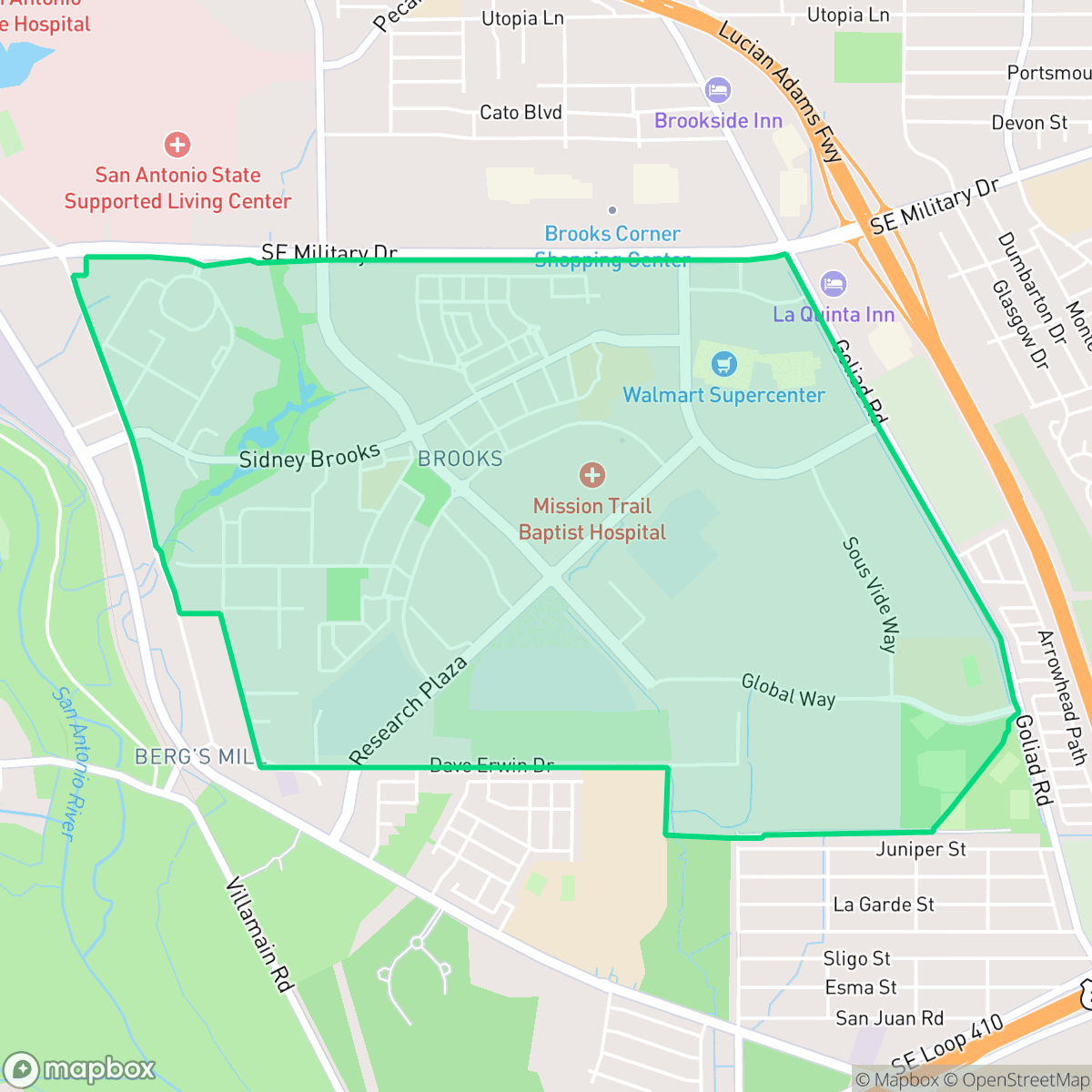
About Brooks
Located on San Antonio’s South Side, the Brooks neighborhood originated in 1917 as Brooks Field (initially Kelly Field #5), named after pioneering local aviator Sidney J. Brooks Jr. As a legendary military installation and home to the School of Aerospace Medicine, the site birthed crucial innovations, including the backpack parachute, the MRI, and LASIK surgery. It gained national prominence when President John F. Kennedy dedicated the school’s new facilities the day before his assassination in 1963. Following its decommissioning as an Air Force Base in 2011, the 1,308-acre site was master-planned by the Brooks Development Authority into a vibrant, mixed-use community. Today, historic military barracks have been converted into modern apartments, and the neighborhood features Hangar 9—the oldest wooden aircraft hangar still in its original location—and the 43-acre linear park, The Greenline.
The neighborhood functions as a dynamic hub where repurposed military infrastructure meets contemporary suburban development. Life here is defined by a mix of multi-story apartment living and proximity to essential medical and retail services. According to iHuus data, the area offers a unique urban-rural balance, providing residents with access to local dining and social hubs while maintaining a lower population density than many central San Antonio districts.
Prospective residents should note that the area is largely car-dependent, requiring personal vehicles for most daily errands. While the neighborhood offers a tranquil environment with significant green space, it is characterized by proximity to logistics corridors and major roadways, which contributes to moderate noise levels. The community is well-suited for those seeking a modern, master-planned environment that prioritizes regional accessibility and proximity to major employment centers over traditional walkable urban density.
Neighborhood Scores Across 15 Qualities
Residential spacing in Brooks features a mix of density with some buffer between neighbors. This level of privacy is roughly comparable to the San Antonio average according to iHuus data.
Low traffic volumes and quiet streets allow for easy movement on foot, though a lack of sidewalks makes walking less convenient than in many other parts of San Antonio.
Standard tract housing defines the area, featuring modest yards and simple rooflines. According to iHuus data, the visual landscape is less varied than the San Antonio average.
Access to public parks and green spaces in this area is consistent with the San Antonio average. According to iHuus data, pet owners will find typical urban amenities for walking dogs.
Land use features a blend of multi-family housing and large-scale commercial warehouses alongside significant highway infrastructure. This landscape aligns with the typical density found throughout San Antonio.
Low-density industrial and suburban layouts create a subdued atmosphere that lacks significant social energy. Most dining and retail options are scattered and require a vehicle, making the area less lively than the San Antonio average.
Frequent noise from nearby freeway and railroad activity characterizes this area. According to iHuus data, acoustic comfort is notably lower than the San Antonio average.
Frequent unhealthy air quality levels pose a significant risk to sensitive groups, with conditions appearing slightly worse than the San Antonio average according to iHuus data.
Residential streets and green spaces dominate the area, offering much less industrial activity than the San Antonio average. According to iHuus data, the neighborhood is largely free of heavy manufacturing or significant industrial hazards.
Health insurance coverage among residents is higher than the San Antonio average, according to iHuus data. Most people living in this area have access to medical coverage.
Political leanings in this area are more liberal than the San Antonio average. According to iHuus data, the neighborhood maintains a liberal majority with a modest opposing presence.
Residents live alongside a balanced mix of young adults, families, and older populations. According to iHuus data, this age distribution is slightly more concentrated toward certain age brackets than the San Antonio average.
Flood risk is elevated in this area because it sits within a designated floodplain. According to iHuus data, this level of risk is higher than the San Antonio average and typically necessitates flood insurance.
Address-Level Insights for Brooks


iHuus Neighborhood Intelligence Insights
Get address-level neighborhood insights for Brooks
- Street-level scores — see how individual blocks compare, not just neighborhood averages
- Micro-zone boundaries — identify quiet pockets, flood boundaries, and walkable clusters before you visit
- 15 dimensions in full — walkability, noise, air quality, school quality, insurance coverage, population age profile, urban/rural index, and more
- Boundary risk alerts — know if your address sits near a block boundary where scores drop, the kind of detail no listing will ever mention
- School insights — individual school ratings and insights, not just district-level data
- Compare before you commit — side-by-side data across neighborhoods, down to block precision
No credit card required
Compare with Any Neighborhood
| Dimension | Brooks | 145 Association |
|---|---|---|
| 🚶 Walkabilityavg 6.44 | ||
| 🔊 Acoustic Comfortavg 4.07 | ||
| 🤫 Privacy Indexavg 5.75 | ||
| 🎨 Visual Appealavg 6.11 | ||
| 🐕 Dog Friendlinessavg 5.91 | ||
| 🗺️ Urban-Rural Indexavg 6.87 | ||
| ✨ Neighborhood Vibeavg 4.35 | ||
| 🏥 Health Insurance Coverageavg 5.94 | ||
| 🌿 Air Qualityavg 2.27 | ||
| 🏭 Industrial Proximityavg 8.31 | ||
| 🌊 Flood Safetyavg 4.2 | ||
| 🗳️ Ideological Leanavg 7.37 | ||
| 👥 Population Age Profileavg 4.68 | ||
| 🔥 Fire Safety | ||
| 🏫 School Quality |
Brooks Rankings
School Districts Serving Brooks
School Insights for Brooks
Below average outcomes; significant attendance and academic challenges.
School Insights
See what's really behind every school rating near Brooks
- Individual school ratings — each school's own score with outcome context, not just a district average
- Enrollment & class size data — student-to-teacher ratio and how it compares to the state average
- Full demographics breakdown — ethnicity and gender composition for every school in the enrollment zone
- Every school in the district — all schools within the enrollment boundary ranked by rating, not just the closest one
- Grade levels & benchmarks — elementary through high school, with below/above state-average flags
No credit card required