Braun Station West, San Antonio
Updated · 3,534 residents
Braun Station West is a quiet, residential enclave on San Antonio’s Northwest Side characterized by mature oak trees and a tranquil, suburban atmosphere. While the area offers a peaceful retreat with high visual appeal, it features limited local retail and dining options, making it best suited for those prioritizing a serene environment over immediate urban convenience.
Key Highlights
About Braun Station West
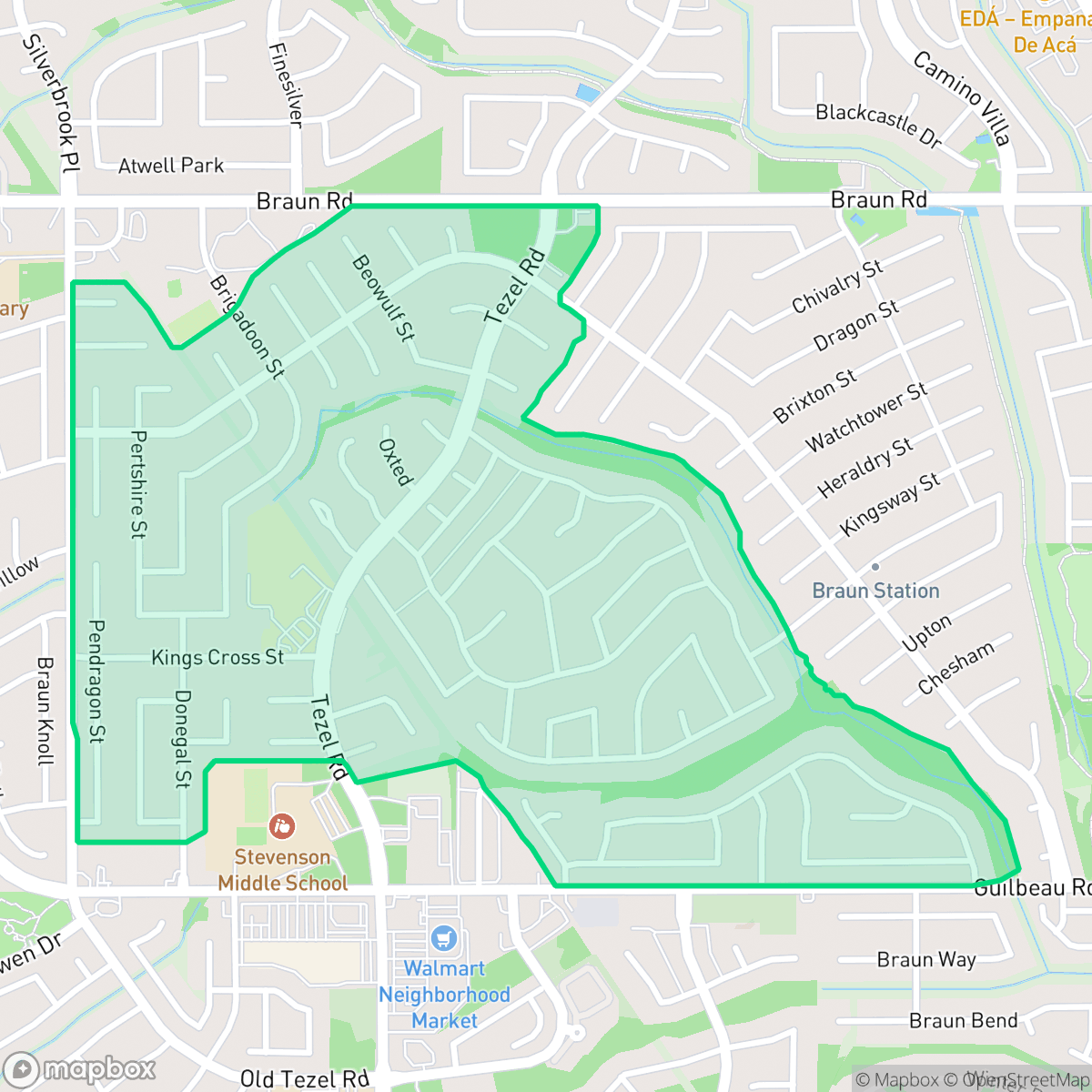
Located on San Antonio’s Northwest Side, the Braun Station West neighborhood traces its roots to the mid-1800s when German immigrant Friedrich Braun established a dairy farm on the land. In the 1970s, local developer John Thomas Saunders purchased the former farm and began constructing the Braun Station residential development, naming it to honor the Braun family's legacy. Braun Station West developed alongside its sister subdivision, Braun Station East, and the newer Braun Heights. Built primarily between the 1970s and 2000s, the neighborhood features a diverse mix of custom-built and pre-designed homes set among mature oak trees. Today, the community is anchored by the Braun Station West Community Improvement Association, which manages local gathering spaces like the neighborhood clubhouse and the Tezel and LaFrenier pools.
The neighborhood is defined by its low-density residential layout, which prioritizes green space and quiet streets over commercial development. Residents benefit from strong community management, with access to shared recreational facilities like the Tezel and LaFrenier pools. The area maintains a distinct suburban character, marked by a high visual appeal and a peaceful acoustic environment that sits quieter than the city average.
Families are drawn to the area by its proximity to the Northside Independent School District, specifically the well-regarded Braun Station Elementary. While the neighborhood is relatively walkable, the scarcity of nearby businesses means that most daily errands require a vehicle. Prospective residents should also note that the area has a low flood safety rating, making it important to review specific property elevations when considering a home purchase.
Neighborhood Scores Across 15 Qualities
Residential spacing provides a moderate level of separation between neighbors, sitting slightly above the San Antonio average. Detached homes typically feature private yards with enough distance to offer some buffer between adjacent structures.
Wide residential streets and a central park provide a safe environment for walking, with better sidewalk accessibility than most of San Antonio. Low traffic volumes and visible crossings make navigating the neighborhood on foot straightforward.
Large homes with private pools and well-maintained landscaping create a highly polished environment that is notably more aesthetically pleasing than the San Antonio average. According to iHuus data, the area is characterized by prominent architectural features and consistent greenery.
Continuous green corridors and a centrally located park with sports courts provide ample space for pets. According to iHuus data, these interconnected trails and tree-lined streets offer significantly better access to walking paths away from traffic than the San Antonio average.
Open land and scattered homes among trees create a semi-rural atmosphere that is slightly more sparse than the typical San Antonio urban layout. According to iHuus data, this area features more frequent woodland and field pockets compared to the city average.
Daily activity is subdued and primarily focused on essential services, making the area feel less vibrant than the San Antonio average. While some walkable paths and small retail spots exist, the neighborhood lacks a dense or bustling social atmosphere.
Steady hums from nearby busy streets are common here; however, acoustic comfort levels remain higher than the San Antonio average according to iHuus data.
Frequent unhealthy air quality levels pose a significant risk to sensitive groups. According to iHuus data, the atmosphere in this area is worse than the San Antonio average.
Industrial activity and warehouses are entirely absent from this area, offering a more residential environment than the San Antonio average. According to iHuus data, the neighborhood consists of quiet streets and open green spaces with no detected industrial facilities or hazard sites.
Health insurance access is significantly higher here than the San Antonio average, according to iHuus data. Most residents in this area have access to medical coverage.
Political leanings in this area are evenly split between conservative and liberal perspectives, representing a more balanced ideological landscape than the city average according to iHuus data.
Residents live among a balanced mix of young adults, families, and older individuals. This demographic spread is slightly more varied than the average found across San Antonio.
Flood risk levels are slightly above the San Antonio average, though a lack of detailed FEMA studies means the exact level of danger remains undetermined. Residents should remain cautious as official flood maps for this area have not been fully updated.
Address-Level Insights for Braun Station West


iHuus Neighborhood Intelligence Insights
Get address-level neighborhood insights for Braun Station West
- Street-level scores — see how individual blocks compare, not just neighborhood averages
- Micro-zone boundaries — identify quiet pockets, flood boundaries, and walkable clusters before you visit
- 15 dimensions in full — walkability, noise, air quality, school quality, insurance coverage, population age profile, urban/rural index, and more
- Boundary risk alerts — know if your address sits near a block boundary where scores drop, the kind of detail no listing will ever mention
- School insights — individual school ratings and insights, not just district-level data
- Compare before you commit — side-by-side data across neighborhoods, down to block precision
No credit card required
Compare with Any Neighborhood
| Dimension | Braun Station West | 145 Association |
|---|---|---|
| 🚶 Walkabilityavg 6.44 | ||
| 🔊 Acoustic Comfortavg 4.07 | ||
| 🤫 Privacy Indexavg 5.75 | ||
| 🎨 Visual Appealavg 6.11 | ||
| 🐕 Dog Friendlinessavg 5.91 | ||
| 🗺️ Urban-Rural Indexavg 6.87 | ||
| ✨ Neighborhood Vibeavg 4.35 | ||
| 🏥 Health Insurance Coverageavg 5.94 | ||
| 🌿 Air Qualityavg 2.27 | ||
| 🏭 Industrial Proximityavg 8.31 | ||
| 🌊 Flood Safetyavg 4.2 | ||
| 🗳️ Ideological Leanavg 7.37 | ||
| 👥 Population Age Profileavg 4.68 | ||
| 🔥 Fire Safety | ||
| 🏫 School Quality |
Braun Station West Rankings
School Districts Serving Braun Station West
School Insights for Braun Station West
Below average outcomes; significant attendance and academic challenges.
School Insights
See what's really behind every school rating near Braun Station West
- Individual school ratings — each school's own score with outcome context, not just a district average
- Enrollment & class size data — student-to-teacher ratio and how it compares to the state average
- Full demographics breakdown — ethnicity and gender composition for every school in the enrollment zone
- Every school in the district — all schools within the enrollment boundary ranked by rating, not just the closest one
- Grade levels & benchmarks — elementary through high school, with below/above state-average flags
No credit card required