Braun Station East, San Antonio
Updated · 1,501 residents
Braun Station East is a quiet, residential enclave in northwestern San Antonio known for its distinct architectural variety and tree-lined streets. According to iHuus data, the area offers high walkability and dog-friendly spaces, providing a peaceful suburban environment despite its proximity to major transit corridors.
Key Highlights
About Braun Station East
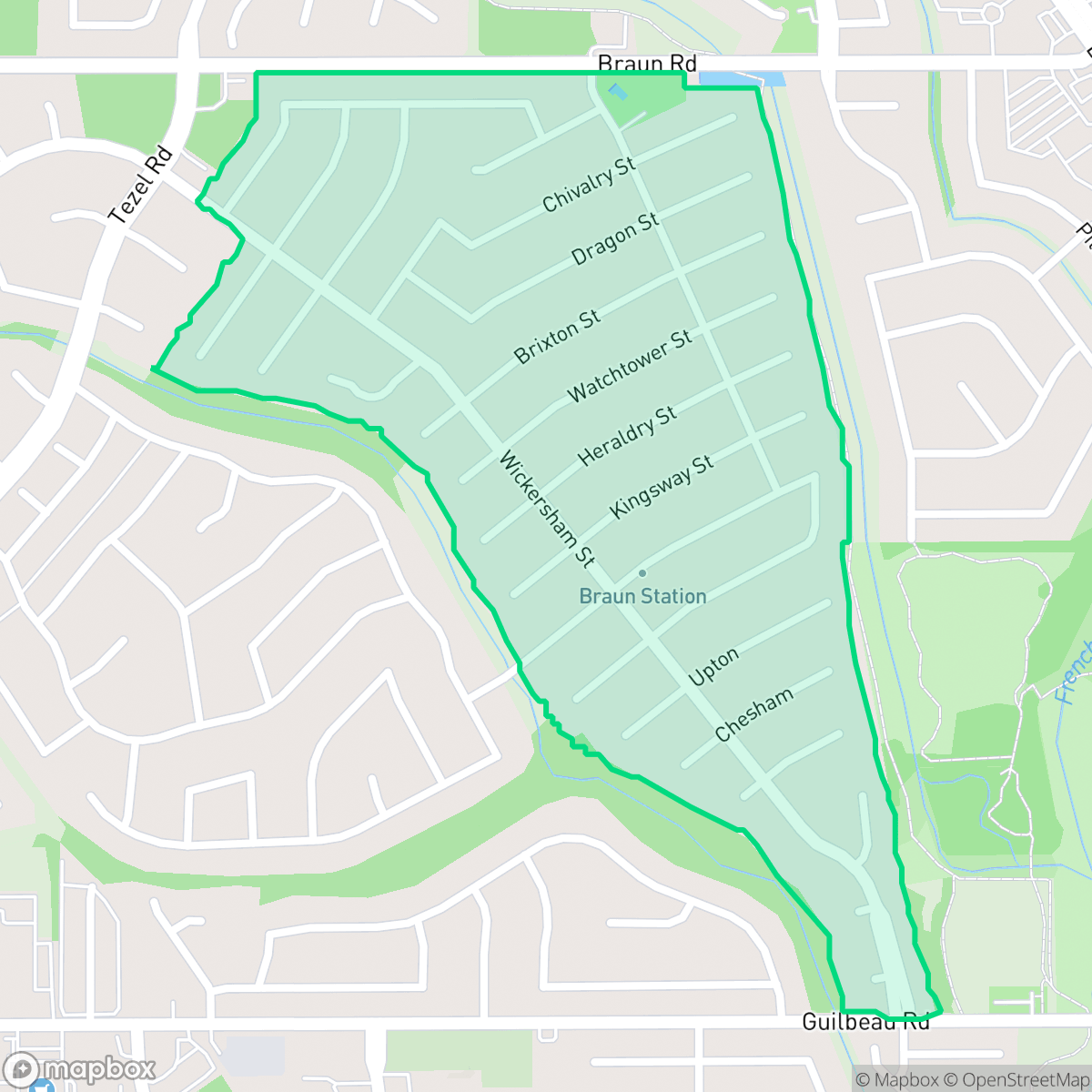
Braun Station East in northwestern San Antonio traces its roots to the mid-1800s, when the German immigrant Braun family established farms and ranches on the land. The property later operated as a dairy farm before developer John Thomas Saunders began transforming it into a residential community in the 1970s, naming it "Braun Station" to honor the family's legacy. Braun Station East was the development's first subdivision, welcoming its first residents in 1977. Today, the neighborhood is highly regarded for its architectural variety, featuring 626 custom-built homes designed so that no two share the same exterior. This established, tree-lined community maintains its historic charm and suburban identity while offering modern amenities managed by its active, long-standing community improvement association.
The area functions as a low-density residential pocket characterized by open green spaces and mature landscaping. It maintains a strong suburban identity with a focus on daily convenience and accessibility to local amenities. Residents benefit from a relatively quiet acoustic environment, which stands out as a primary advantage compared to many other parts of the city. The neighborhood is well-maintained and offers a visually appealing setting for those seeking a slower pace of life.
While the neighborhood provides a serene atmosphere, it experiences a relatively low level of social activity and commercial liveliness. Families often choose this area for its access to the Northside Independent School District, although prospective residents should be aware of the district's ongoing financial and capacity challenges. The area is well-suited for those prioritizing a walkable, pet-friendly, and visually appealing environment over a high-energy urban lifestyle.
Neighborhood Scores Across 15 Qualities
Residential spacing varies between suburban-style single houses and denser apartment clusters, providing slightly more separation between neighbors than the San Antonio average.
Sidewalk networks are comprehensive throughout the subdivisions and along major roads, providing better pedestrian accessibility than the San Antonio average. According to iHuus data, residential cul-de-sacs are safe and include designated crossings for pedestrians.
Residential views consist of standard tract housing and mid-range apartments, though the presence of communal pools and tennis courts provides a slightly more pleasant landscape than the San Antonio average. According to iHuus data, the area features a mix of suburban amenities and typical residential density.
Accessible greenways and residential verges provide ample space for pet exercise. According to iHuus data, these connected paths offer more safe walking opportunities than the San Antonio average.
Open land and scattered homes characterize this area, providing a more semi-rural landscape than the typical San Antonio environment. Residential pockets feature a mix of single-family homes and multi-story apartments situated near wooded or open spaces, according to iHuus data.
Low-density residential blocks and green spaces create a calm atmosphere, though retail and dining options are somewhat more limited than the San Antonio average. Residents can access a few local convenience businesses on foot, but the area lacks a dense urban center.
Local traffic from nearby busy streets creates a consistent level of background noise. This acoustic environment is slightly noisier than the San Antonio average, according to iHuus data.
Frequent unhealthy air quality levels pose a significant risk to sensitive groups. This area remains slightly below the San Antonio average according to iHuus data.
Residential streets and open green spaces are free from warehouses, industrial facilities, or hazardous sites. This area offers a notably lower presence of industrial activity compared to the San Antonio average, according to iHuus data.
Health insurance access is more prevalent in this area than in the rest of San Antonio, according to iHuus data.
Political leanings in this area are split relatively evenly between conservative and liberal viewpoints. This reflects a more moderate ideological landscape than the more strongly partisan leanings seen across the rest of San Antonio.
A balanced mix of young adults, families, and older residents defines the area. This demographic variety is slightly more diverse than the typical San Antonio distribution, according to iHuus data.
Flood risk levels in this area are higher than the San Antonio average, though current FEMA assessments remain undetermined for this specific zone. According to iHuus data, residents should exercise caution as detailed flood studies for the neighborhood have not yet been completed.
Address-Level Insights for Braun Station East


iHuus Neighborhood Intelligence Insights
Get address-level neighborhood insights for Braun Station East
- Street-level scores — see how individual blocks compare, not just neighborhood averages
- Micro-zone boundaries — identify quiet pockets, flood boundaries, and walkable clusters before you visit
- 15 dimensions in full — walkability, noise, air quality, school quality, insurance coverage, population age profile, urban/rural index, and more
- Boundary risk alerts — know if your address sits near a block boundary where scores drop, the kind of detail no listing will ever mention
- School insights — individual school ratings and insights, not just district-level data
- Compare before you commit — side-by-side data across neighborhoods, down to block precision
No credit card required
Compare with Any Neighborhood
| Dimension | Braun Station East | 145 Association |
|---|---|---|
| 🚶 Walkabilityavg 6.44 | ||
| 🔊 Acoustic Comfortavg 4.07 | ||
| 🤫 Privacy Indexavg 5.75 | ||
| 🎨 Visual Appealavg 6.11 | ||
| 🐕 Dog Friendlinessavg 5.91 | ||
| 🗺️ Urban-Rural Indexavg 6.87 | ||
| ✨ Neighborhood Vibeavg 4.35 | ||
| 🏥 Health Insurance Coverageavg 5.94 | ||
| 🌿 Air Qualityavg 2.27 | ||
| 🏭 Industrial Proximityavg 8.31 | ||
| 🌊 Flood Safetyavg 4.2 | ||
| 🗳️ Ideological Leanavg 7.37 | ||
| 👥 Population Age Profileavg 4.68 | ||
| 🔥 Fire Safety | ||
| 🏫 School Quality |
Braun Station East Rankings
School Districts Serving Braun Station East
School Insights for Braun Station East
Below average outcomes; significant attendance and academic challenges.
School Insights
See what's really behind every school rating near Braun Station East
- Individual school ratings — each school's own score with outcome context, not just a district average
- Enrollment & class size data — student-to-teacher ratio and how it compares to the state average
- Full demographics breakdown — ethnicity and gender composition for every school in the enrollment zone
- Every school in the district — all schools within the enrollment boundary ranked by rating, not just the closest one
- Grade levels & benchmarks — elementary through high school, with below/above state-average flags
No credit card required