Beacon Hill, San Antonio
Updated · 6,336 residents
Beacon Hill is a historic San Antonio neighborhood recognized for its diverse architectural styles and a vibrant local dining scene along the Blanco Road corridor. According to iHuus data, the area features a dense urban grid with modest, tightly packed homes and a lively community atmosphere.
Key Highlights
About Beacon Hill
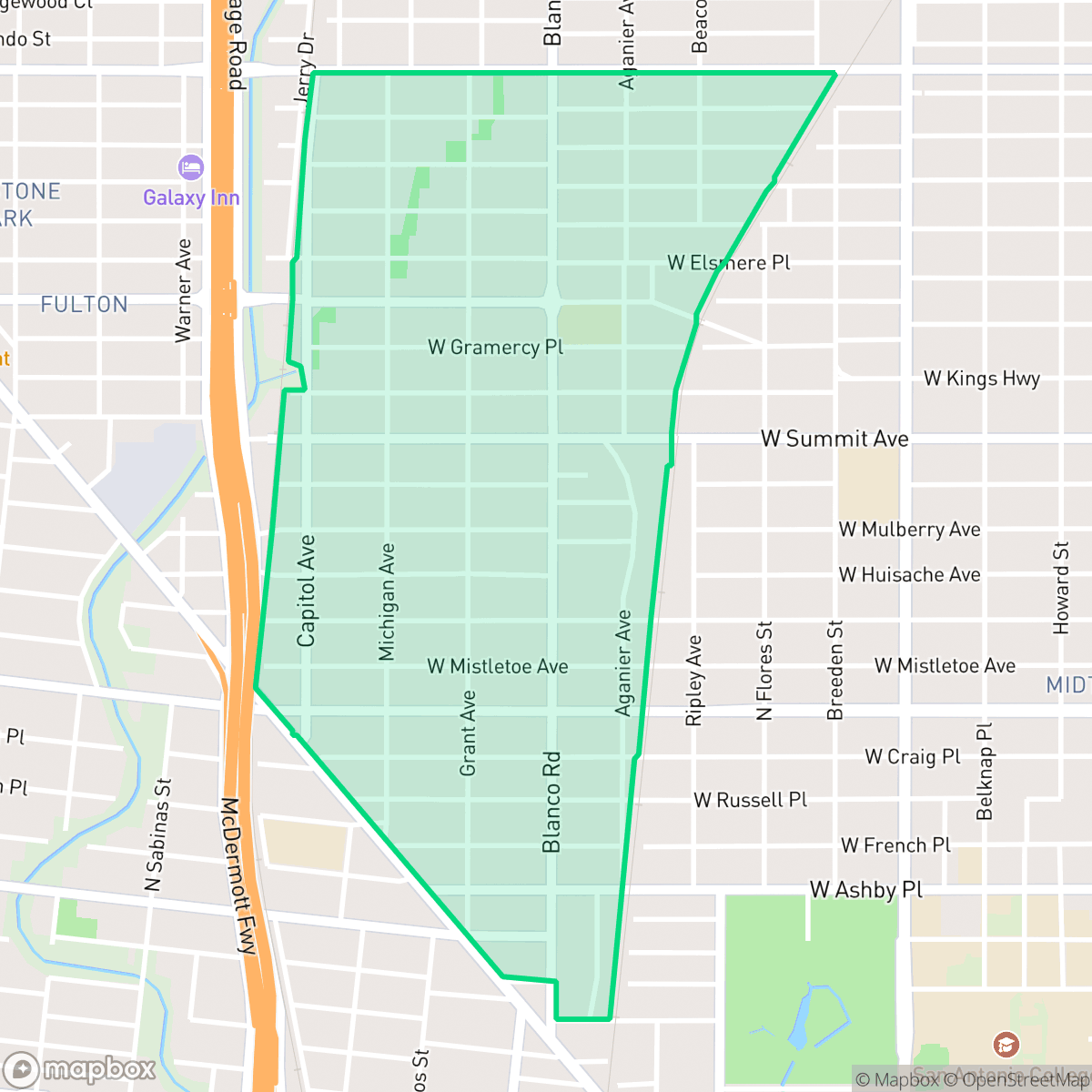
Developed during San Antonio’s northward expansion from the late 1890s through the 1920s, Beacon Hill was originally promoted in 1909 as "the Queen Suburb". This historic neighborhood—bounded by Interstate 10, San Pedro Avenue, Hildebrand Avenue, and Fredericksburg Road—evolved around early streetcar lines. Today, it is designated as a Neighborhood Conservation District celebrated for its diverse architectural styles, including Craftsman bungalows, Italianate, and Spanish Colonial Revival homes. Notable structures include the former Fire Station 17, designed in 1925 by prominent architect Harvey Partridge Smith. The neighborhood’s vibrant character is anchored by the Blanco Road commercial corridor, featuring local landmarks like the Blanco Café, the obelisk-shaped sculpture "The Beacon" at the Blanco and Fulton roundabout, and San Antonio’s first linear park.
The neighborhood maintains a distinct social energy, supported by local institutions like Bedoy's Bakery and various dining spots along the central corridor. While the area offers a lively atmosphere that exceeds city averages, the physical environment consists of a dense, low-density urban grid with modest single-family homes. Residents often find themselves in close proximity to neighbors, as the housing layout features tight lots and minimal spacing between structures.
Prospective residents should consider that the area presents specific trade-offs regarding infrastructure and amenities. While Agnes Cotton Academy provides a strong educational option, the broader San Antonio Independent School District faces ongoing challenges with aging facilities and academic consistency. Furthermore, the neighborhood experiences moderate noise levels from nearby road traffic, and the housing stock lacks many contemporary luxury features or private outdoor amenities like pools. It is best suited for those who prioritize a strong sense of community and historic character over modern, high-density residential privacy.
Neighborhood Scores Across 15 Qualities
Residential structures are often closely packed on narrow lots with minimal spacing between buildings. This level of density provides less separation between neighbors than the San Antonio average.
Residential streets are generally safe and easy to navigate on foot due to low traffic volumes. However, sidewalk availability is inconsistent and some major roads create barriers for pedestrians, making the area slightly less walkable than the San Antonio average.
Residential scenery consists of uniform, small-scale tract housing with limited greenery or luxury amenities. This landscape is notably less visually diverse than the San Antonio average, characterized by compact lots and simple rooflines.
Dog owners have access to a large greenway park on the west side and a public park in the southern quadrant; however, most greenery is confined to private yards, making this area slightly less dog friendly than the San Antonio average according to iHuus data.
Residential grids feature a combination of single-family homes and small commercial plots. This area is slightly less open than the San Antonio average, characterized by a dense low-rise layout of urban and industrial use.
Active social spots and diverse dining options provide a noticeable energy that is significantly higher than the San Antonio average. While many local eateries and cafes are accessible, the area remains largely car-dependent due to the suburban street layout.
Consistent noise from nearby busy streets is common in this area. This level of acoustic activity is typical for the San Antonio average.
Frequent unhealthy air quality levels pose significant risks to sensitive groups. According to iHuus data, the air quality in Beacon Hill is worse than the San Antonio average.
Heavy industrial presence is minimal throughout most of the neighborhood, although certain central corridors contain warehouses and logistics hubs that may increase local traffic. According to iHuus data, the overall level of industrial proximity is slightly higher than the San Antonio average.
Health insurance access among residents is notably lower than the San Antonio average, according to iHuus data. This indicates a higher proportion of uninsured individuals living in the area compared to most parts of the city.
Voting patterns and census indicators show a much more liberal leaning than the San Antonio average, according to iHuus data.
Residents live alongside a varied demographic of young professionals, families, and seniors. According to iHuus data, this age distribution is more balanced than the typical San Antonio profile.
Significant flood risk exists here due to the area being located within a 100-year floodplain. According to iHuus data, this risk level is notably higher than the San Antonio average and typically necessitates flood insurance.
Address-Level Insights for Beacon Hill


iHuus Neighborhood Intelligence Insights
Get address-level neighborhood insights for Beacon Hill
- Street-level scores — see how individual blocks compare, not just neighborhood averages
- Micro-zone boundaries — identify quiet pockets, flood boundaries, and walkable clusters before you visit
- 15 dimensions in full — walkability, noise, air quality, school quality, insurance coverage, population age profile, urban/rural index, and more
- Boundary risk alerts — know if your address sits near a block boundary where scores drop, the kind of detail no listing will ever mention
- School insights — individual school ratings and insights, not just district-level data
- Compare before you commit — side-by-side data across neighborhoods, down to block precision
No credit card required
Compare with Any Neighborhood
| Dimension | Beacon Hill | 145 Association |
|---|---|---|
| 🚶 Walkabilityavg 6.44 | ||
| 🔊 Acoustic Comfortavg 4.07 | ||
| 🤫 Privacy Indexavg 5.75 | ||
| 🎨 Visual Appealavg 6.11 | ||
| 🐕 Dog Friendlinessavg 5.91 | ||
| 🗺️ Urban-Rural Indexavg 6.87 | ||
| ✨ Neighborhood Vibeavg 4.35 | ||
| 🏥 Health Insurance Coverageavg 5.94 | ||
| 🌿 Air Qualityavg 2.27 | ||
| 🏭 Industrial Proximityavg 8.31 | ||
| 🌊 Flood Safetyavg 4.2 | ||
| 🗳️ Ideological Leanavg 7.37 | ||
| 👥 Population Age Profileavg 4.68 | ||
| 🔥 Fire Safety | ||
| 🏫 School Quality |
Beacon Hill Rankings
School Districts Serving Beacon Hill
School Insights for Beacon Hill
Below average outcomes; significant attendance and academic challenges.
School Insights
See what's really behind every school rating near Beacon Hill
- Individual school ratings — each school's own score with outcome context, not just a district average
- Enrollment & class size data — student-to-teacher ratio and how it compares to the state average
- Full demographics breakdown — ethnicity and gender composition for every school in the enrollment zone
- Every school in the district — all schools within the enrollment boundary ranked by rating, not just the closest one
- Grade levels & benchmarks — elementary through high school, with below/above state-average flags
No credit card required