Avenida Guadalupe, San Antonio
Updated · 9,306 residents
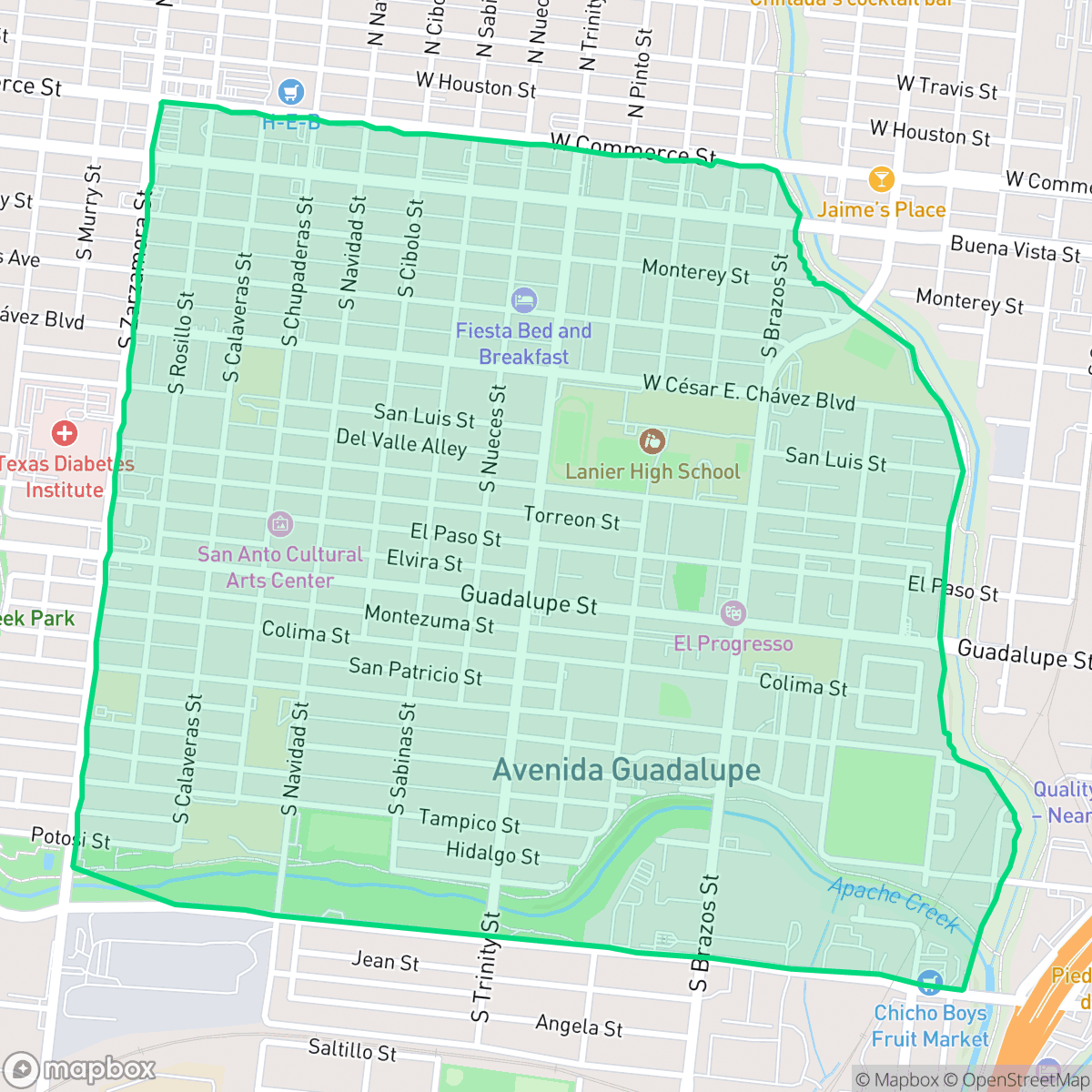
Avenida Guadalupe is a historic cultural hub on San Antonio's near Westside, defined by its dense residential grid and long-standing community landmarks. Residents experience a traditional urban environment with moderate walkability and a calm, suburban feel despite the close proximity of homes.
Key Highlights
About Avenida Guadalupe
Located in San Antonio’s near Westside, the Avenida Guadalupe neighborhood emerged in the early 1900s as the commercial and cultural heart of the city’s Mexican-American community. Following decades of municipal neglect, the neighborhood became a focal point for grassroots urban renewal. In 1979, the city designated it a revitalization target area, spurring the creation of the Avenida Guadalupe Association. This partnership led to the construction of Plaza Guadalupe in 1984, a rare Post-Modern public square that serves as a hub for local politics and culture. Key landmarks defining the neighborhood’s identity include the historic Guadalupe Theater—restored as a Mexican-American arts center—the Our Lady of Guadalupe Church-Shrine, Davila Pharmacy, and artist Jesse Treviño’s iconic "Veladora" mosaic mural depicting the Virgen de Guadalupe.
The area maintains a dense, low-rise urban character featuring a consistent street grid and modest housing footprints. It functions as a tight-knit residential community where daily life revolves around local institutions and accessible neighborhood dining options. According to iHuus data, the neighborhood balances its residential core with light commercial pockets, providing a steady, quiet atmosphere that contrasts with the city's busier corridors.
Prospective residents should consider the trade-offs inherent in this established district, including a high density that limits private outdoor space and significant challenges regarding flood safety. While the area benefits from a central location, the local school district faces ongoing structural changes and academic performance concerns. The neighborhood is best suited for those who value proximity to historic cultural sites and a community-focused lifestyle, though it requires careful consideration of environmental and infrastructure factors.
Neighborhood Scores Across 15 Qualities
Residential spacing is relatively tight with many homes situated on narrow lots. According to iHuus data, the level of separation between neighbors is slightly lower than the San Antonio average.
Pedestrian infrastructure is consistent with the city average, featuring a recognizable grid and accessible crossings. Sidewalk availability varies by block, as some residential streets lack continuous paths or have narrow walkways near the canal.
Housing consists primarily of older, tightly packed homes and apartment blocks with minimal yard space. This area lacks luxury amenities and features less greenery than the San Antonio average, according to iHuus data.
Walking routes for pets are primarily limited to central drainage corridors and scattered sports fields. According to iHuus data, the availability of dedicated green space and wide grass verges is slightly below the San Antonio average.
Residential streets and green spaces are balanced in equal measure, providing a more suburban feel than the typical San Antonio urban landscape. This mix of low-density housing and community facilities creates a landscape that is less densely built than the city average.
A mix of quiet suburban blocks and active social hubs creates a more energetic atmosphere than the typical San Antonio neighborhood. While certain pockets offer walkable dining options, much of the area requires a vehicle to access various amenities.
A steady hum from local traffic persists due to the proximity of a busy street. This level of acoustic activity is slightly higher than the San Antonio average according to iHuus data.
Frequent unhealthy air quality levels pose a significant risk to sensitive groups in this area. This level of pollution is slightly worse than the San Antonio average, according to iHuus data.
Residential and light commercial uses dominate the area, though some eastern sections feature warehouses and rail lines. This neighborhood contains less industrial activity than the San Antonio average, according to iHuus data.
Health insurance access among residents is below the San Antonio average, according to iHuus data. This indicates a higher proportion of uninsured individuals living in the area compared to the rest of the city.
Voting patterns and census indicators show a much more liberal leaning than the San Antonio average. According to iHuus data, this area is characterized by a distinctively progressive political landscape.
Residents live alongside a balanced distribution of young adults, families, and older populations. This demographic spread is largely comparable to the city average, according to iHuus data.
Flood risk in this area is significantly higher than the San Antonio average. Residents should prepare for much more expensive insurance premiums due to the neighborhood being located in a high-hazard zone.
Address-Level Insights for Avenida Guadalupe


iHuus Neighborhood Intelligence Insights
Get address-level neighborhood insights for Avenida Guadalupe
- Street-level scores — see how individual blocks compare, not just neighborhood averages
- Micro-zone boundaries — identify quiet pockets, flood boundaries, and walkable clusters before you visit
- 15 dimensions in full — walkability, noise, air quality, school quality, insurance coverage, population age profile, urban/rural index, and more
- Boundary risk alerts — know if your address sits near a block boundary where scores drop, the kind of detail no listing will ever mention
- School insights — individual school ratings and insights, not just district-level data
- Compare before you commit — side-by-side data across neighborhoods, down to block precision
No credit card required
Compare with Any Neighborhood
| Dimension | Avenida Guadalupe | 145 Association |
|---|---|---|
| 🚶 Walkabilityavg 6.44 | ||
| 🔊 Acoustic Comfortavg 4.07 | ||
| 🤫 Privacy Indexavg 5.75 | ||
| 🎨 Visual Appealavg 6.11 | ||
| 🐕 Dog Friendlinessavg 5.91 | ||
| 🗺️ Urban-Rural Indexavg 6.87 | ||
| ✨ Neighborhood Vibeavg 4.35 | ||
| 🏥 Health Insurance Coverageavg 5.94 | ||
| 🌿 Air Qualityavg 2.27 | ||
| 🏭 Industrial Proximityavg 8.31 | ||
| 🌊 Flood Safetyavg 4.2 | ||
| 🗳️ Ideological Leanavg 7.37 | ||
| 👥 Population Age Profileavg 4.68 | ||
| 🔥 Fire Safety | ||
| 🏫 School Quality |
Avenida Guadalupe Rankings
School Districts Serving Avenida Guadalupe
School Insights for Avenida Guadalupe
Below average outcomes; significant attendance and academic challenges.
School Insights
See what's really behind every school rating near Avenida Guadalupe
- Individual school ratings — each school's own score with outcome context, not just a district average
- Enrollment & class size data — student-to-teacher ratio and how it compares to the state average
- Full demographics breakdown — ethnicity and gender composition for every school in the enrollment zone
- Every school in the district — all schools within the enrollment boundary ranked by rating, not just the closest one
- Grade levels & benchmarks — elementary through high school, with below/above state-average flags
No credit card required